Is Claude Sonnet 5 Really Cheap? A Cost Breakdown by Task

Sonnet 5's real per-task cost can exceed Opus 4.8 once token explosion and tokenizer inflation are factored in.
Claude Sonnet 5 promises agentic capability at a competitive price, but the actual cost structure is far more nuanced. Max Effort mode consumes 40% more output tokens than Sonnet 4.6, a new tokenizer inflates English text by 42%, and at standard pricing Sonnet 5 averages $2.29 per task versus Opus 4.8's $1.99. Engineers should benchmark on real workloads and adopt task-tiered model selection.
Introduction: The Appearance and Reality of Value
When Anthropic launched Claude Sonnet 5, the official messaging centered on one word: Agentic. The model was billed as "the most agentic Sonnet yet." Agentic AI refers to model architectures capable of autonomous planning, tool calling, and multi-step reasoning. Unlike traditional single-turn Q&A, these models can decompose complex tasks into subtasks, invoke external tools (search, code execution, database queries, etc.), and dynamically adjust strategy based on intermediate results. This capability is typically built on the ReAct (Reasoning + Acting) framework, where the model alternates between "thinking" and "acting" at each step — and the price of that is significantly increased Token consumption.
But scroll through Hacker News and Reddit, and community reactions are far from unanimous: some say you're better off going straight to Opus 4.8, while others find it genuinely useful for everyday workflows.
This article takes an engineering perspective, combining Anthropic's official System Card, migration guide, and detailed benchmarks from Artificial Analysis to fully unpack Sonnet 5's cost structure. Bottom line up front: Sonnet 5 isn't a scam, but its cost structure is far more complex than the official messaging lets on. If you don't do the math carefully, it's easy to be misled by surface-level value.
Evaluating a model's true worth isn't about benchmark scores or version numbers — it's about what it actually costs you in real money to complete a real engineering task.
The Official Narrative: Smarter and Cheaper?
Sonnet 5's launch led with "agentic capabilities." Anthropic claims improvements across Reasoning, Tool Use, Coding, and Knowledge Work, with the model able to operate autonomously at levels previously requiring larger, more expensive models.
There's data backing this up. The Artificial Analysis Intelligence Index is a composite benchmark scoring system that aggregates multiple dimensions including reasoning, knowledge Q&A, code generation, and agentic tasks — providing an overall capability score through weighted averaging for cross-vendor model comparison. AA Briefcase and GDPval are sub-benchmarks specifically simulating real-world multi-step information retrieval and analysis scenarios for agentic knowledge work. Testing shows Sonnet 5's Intelligence Index is 6 points higher than Sonnet 4.6, and it even outperforms Opus 4.8 on agentic knowledge work tasks.
The pricing also looks attractive: Anthropic introduced an introductory rate of $2 per million input tokens and $10 per million output tokens through end of August, reverting to $3 and $15 on September 1. Sounds like a deal — but that's only half the story.
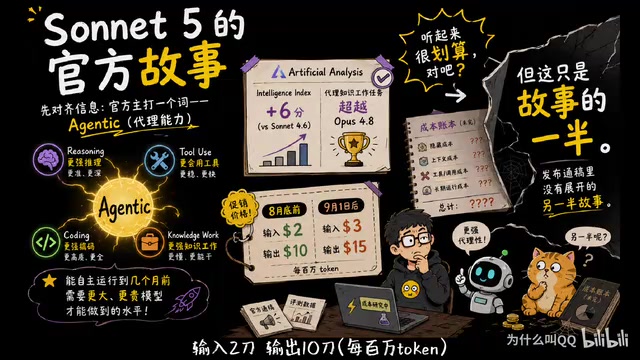
The Other Half Hidden in the Press Release: Token Consumption Explodes
Anthropic says Sonnet 5 is smarter and can autonomously handle complex problems. But what's the cost? The answer is dramatically higher Token consumption.
Sonnet 5's Effort parameter (Low/Medium/Max) is a user-controllable compute budget mechanism — similar to OpenAI's reasoning_effort parameter. In Low Effort mode, the model reduces internal reasoning steps and returns answers quickly; Max Effort allows for deeper multi-step thinking and tool calls. This design acknowledges an engineering reality: the model needs to pass the full context at each agentic step, and as the number of turns grows, costs scale near-linearly or even super-linearly.
According to Artificial Analysis data:
- In Max Effort mode, Sonnet 5 generates approximately 40% more output tokens per Intelligence Index task compared to Sonnet 4.6;
- On knowledge work evaluations like AA Briefcase and GDPval, Agentic Turns are roughly 3x higher;
- On GDPval, Max Effort costs approximately 6x more than Low Effort.
This means Sonnet 5 doesn't arrive at solutions in one shot — it iterates, retries, and calls tools repeatedly.
It's like ordering a dish at a restaurant where the chef doesn't just cook it — they taste it, add some salt, taste it again, add some oil — the dish eventually comes out fine, but the bill has tripled. In real business tasks, this translates directionally to more tool calls and more Token consumption.
The Hidden Trap: Token Inflation from the New Tokenizer
Even easier to miss is a detail buried in the official migration docs: a Tokenizer change.
A tokenizer is the key component that converts natural language text into a sequence of tokens the model can process. Different tokenizers use different subword segmentation strategies (BPE, WordPiece, SentencePiece, etc.), which directly determines how many tokens a given piece of text gets split into — affecting both billing and context utilization efficiency. Anthropic introduced a new tokenizer in Opus 4.7, likely optimized for multilingual support and code, but there's a trade-off between the optimization goals and token efficiency: English text is segmented more granularly, increasing token count; Chinese, being character-level by nature, is largely unaffected — which explains the distribution in the table below.
Sonnet 5 uses this same new tokenizer. The official documentation explicitly states that the same text will consume approximately 30% more tokens on Sonnet 5. But many developers read the launch post and never scrolled down to the migration guide.
Based on Simon Willison's empirical testing, the inflation varies considerably across languages and code types:
| Content Type | Token Increase |
|---|---|
| English text | +42% (1.42x) |
| Spanish | +33% (1.33x) |
| Python code | +27% (1.27x) |
| Chinese | Essentially unchanged (1.01x) |

In other words, English-language prompts now cost you about 42% more, and code with comments costs 27% more. The critical point: the introductory pricing expires August 31, but the tokenizer's cost impact is permanent. As long as Sonnet 5 continues using this tokenizer, the change in token volume will persistently affect your actual costs.
Cost Per Task: Is Sonnet 5 More Expensive Than Opus 4.8?
Here's where things get really counterintuitive. Using Artificial Analysis's standard pricing ($3/$15), Sonnet 5 averages $2.29 per task on the Intelligence Index, while Opus 4.8 comes in at just $1.99.
In other words, at standard pricing, Sonnet 5 is actually about 15% more expensive than Opus 4.8.
This finding is critical: if you find Sonnet 5's Low Effort mode insufficient, the right move isn't to dial up the Effort — it's to switch directly to Opus 4.8. On Hacker News, developers pulled a cost-performance curve chart that reached the same conclusion: if you need higher performance, going straight to Opus 4.8 at a lower effort setting is more cost-effective than running Sonnet 5 at higher effort.
Of course, these are averages. Actual costs will vary based on task type, language choice, and whether the introductory pricing is still active. Additionally, Anthropic's Prompt Caching technology can reduce cached input token costs by roughly 90%. In agentic scenarios, system prompts and tool definitions that remain constant across turns are ideal caching candidates — effective use of caching can compress actual costs to 30–50% of the nominal price, a significant cost lever that's often overlooked.
Why the Community Is "Deeply Divided"
Reddit's community summary describes the reaction as "deeply divided": disappointed users feel Sonnet 5 falls short of Opus 4.8, while others find it valuable for everyday workflows at Low/Medium Effort. The top Hacker News discussion converged on one consensus: if Medium Effort isn't enough, switch to Opus 4.8 — don't crank up the Effort.
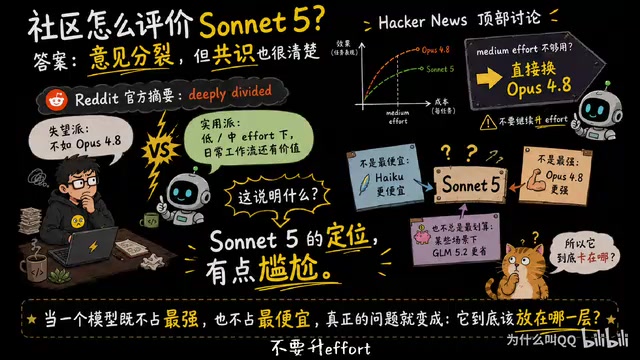
This reveals an awkward positioning: Sonnet 5 isn't the cheapest (Haiku is), isn't the most capable (Opus 4.8 is), and isn't the best value in all scenarios (GLM 5.2 is significantly cheaper in some cases).
Many believe Anthropic is playing a pricing game, using introductory rates and a new tokenizer for "stealth price increases." But the more fundamental truth is this: large language models have hit an invisible wall. Capability improvements are no longer linear and cheap — getting a model to do more complex reasoning, handle longer context, and perform multi-step agentic operations requires consuming more compute. Sonnet 5's improved agentic capability is achieved fundamentally by "letting the model think more steps" — and that thinking directly shows up as Token consumption. This isn't a conspiracy; it's the physical reality of AI engineering.
An Engineering Framework for Model Selection
Given Sonnet 5's complex cost structure, how should AI developers actually choose? The answer: build your own cost-performance evaluation framework — don't rely on official marketing data or let community sentiment steer you.
Four Practical Recommendations
- Benchmark against your own workload: Run your real tasks through Sonnet 5, Opus 4.8, and GLM 5.2, recording Token consumption and total cost. Note that all public benchmarks carry the risk of "benchmark overfitting" — a model may excel on test sets but underperform on your actual business scenarios. Only your own data is trustworthy.
- Account for long-term costs: The introductory pricing ends August 31, but the tokenizer's cost impact is permanent. Also evaluate Prompt Caching applicability — for agentic applications with lengthy system prompts, improving cache hit rates can significantly amortize costs.
- Tiered model selection by task type: Simple tasks → Haiku; moderate complexity → Sonnet 5 Low Effort; complex reasoning → Opus 4.8 directly. This is essentially a "task tiering" strategy — the existence of the Effort parameter itself hints that not all tasks require maximum-quality reasoning. Knowing when to step down is a basic engineering skill.
- Watch open-source alternatives: GLM 5.2 offers clear advantages on cost and open weights. While some benchmarks place it slightly below Sonnet 5, its price-to-performance ratio and the autonomy it provides are worth serious consideration.

This is fundamentally a "microservices architecture" mindset applied to the AI era — matching different models to different tasks rather than using one model for everything.
Future Trends: Token Optimization as a Dedicated Role
Looking ahead, four trends are worth watching:
First, model pricing will get increasingly complex. Looking only at the price per million tokens is meaningless. What matters is the "total cost to complete a single business task" — which requires accounting for the multiplicative effect of unit price, token volume, tokenizer efficiency, and cache hit rate.
Second, developers will become more vigilant about hidden costs. Tokenizer changes, parameter adjustments, and version number games will all become important factors in model selection.
Third, domestic open-source model competition will intensify. Models like GLM 5.2 and Qwen, with their cost and open-weight advantages, will attract a growing share of developers.
Fourth, Token optimization will become a dedicated engineering role. Just as we once needed DBAs to optimize SQL queries, the future will call for engineers specialized in optimizing prompts, reducing unnecessary reasoning turns, and leveraging Prompt Caching to cut costs. As agentic applications scale to production, a skilled "Token optimization engineer" can save an organization enough to offset the salary of several ordinary engineers.
Conclusion
One sentence summary: Don't look at the sticker price — recalculate the cost per task. Sonnet 5 isn't a scam, but it's far from a no-brainer choice. In multi-step agentic tasks, exploding Token consumption, tokenizer inflation, and iterative retry turns stack up to turn "looks cheap" into "actually expensive." Truly mature AI engineering practice means running benchmarks on your own workload, calculating total cost of ownership, and making full use of engineering levers like Prompt Caching, task tiering, and model routing to reduce spend — not getting dragged along by official press releases or community sentiment.
Key Takeaways
Related articles

Disaster and Glory of the Apollo Program: The History We Must Revisit Before Returning to the Moon
From the fatal Apollo 1 fire to Apollo 8's daring lunar orbit to Apollo 11's successful landing—revisiting the disasters, fears, and compromises of the Apollo program and their lessons for today's return to the Moon.
Netflix Trust Exercise Turns Into Firing Trap: Where Are the Boundaries of Corporate Trust?
A Netflix employee was fired after sharing private info in a trust exercise. We analyze the risks of corporate trust exercises and how employees can protect themselves.

AMD CDNA5 Architecture Deep Dive: Technical Evolution and the AI Computing Competition Landscape
Deep analysis of AMD's CDNA5 architecture covering Chiplet packaging upgrades, HBM memory evolution, and low-precision compute optimization, examining how AMD challenges NVIDIA's AI chip dominance.