Is CS229 Still Worth Taking? Evaluating an 8-Year-Old Course vs. Modern ML Learning Paths

CS229's math foundations remain timeless, but learners need supplementary deep learning courses for a complete ML education.
This article analyzes whether Stanford's CS229 machine learning course (recorded in 2018) is still worth taking. While its foundational theory on gradient descent, maximum likelihood estimation, and learning theory remains essential for understanding modern architectures like Transformers and RLHF, the course lacks deep learning coverage. The recommended path: start with CS229 for theory, then advance to CS231n/CS224n for deep learning, supplemented with hands-on projects.
Can a Classic Course Become Outdated? A Question Worth Pondering
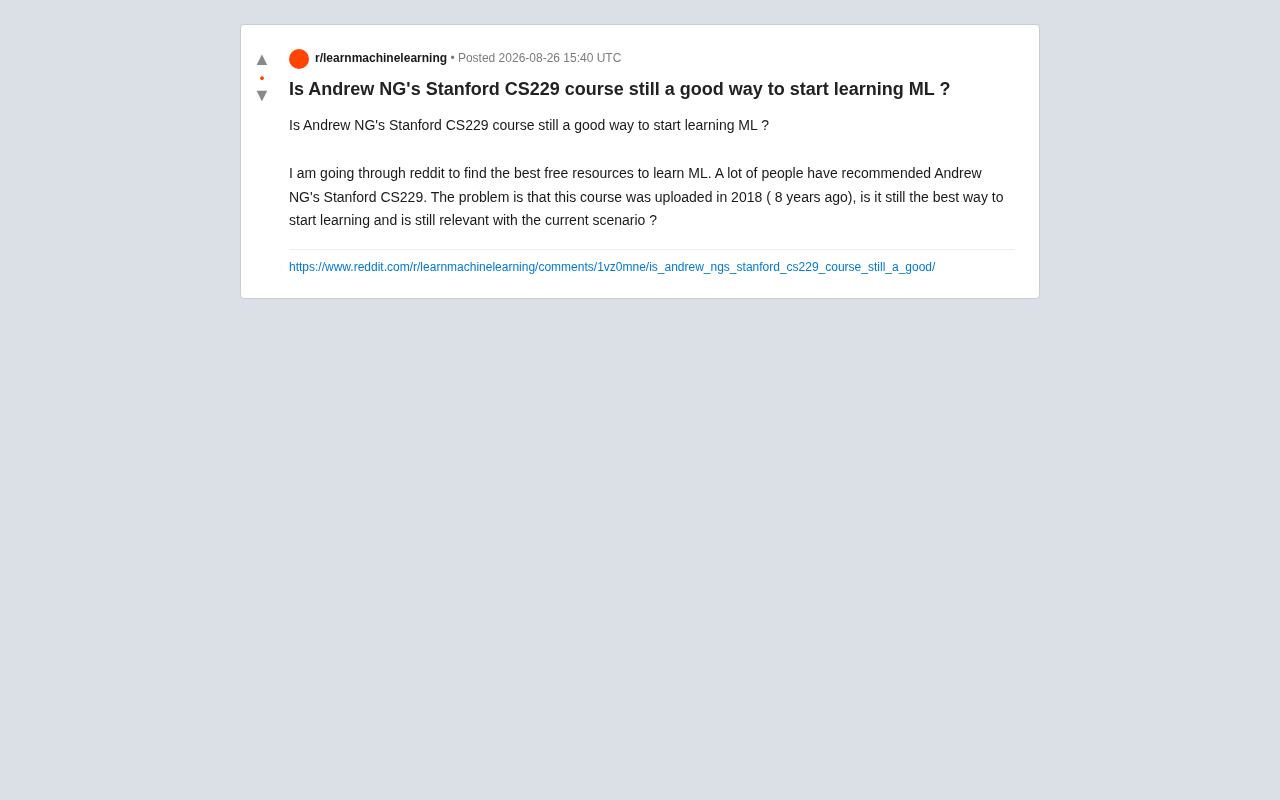
Recently, a learner in Reddit's machine learning community raised a highly representative question: Is Professor Andrew Ng's Stanford CS229 course still a good way to get started with machine learning?
The questioner's concern is practical—while searching for free learning resources, they found countless recommendations for CS229, but the course videos were recorded in 2018, several years ago now. In an era where AI technology changes daily and large language models are sweeping the globe, can a course from years ago still keep up with the times?
Behind this question lies a deeper topic: In an age where deep learning and generative AI are advancing rapidly, has foundational machine learning theory lost its value?
Breaking Down CS229's Core Content
To answer this question, we first need to understand CS229's positioning. It's not a course that chases trends—it's Stanford University's graduate-level foundational machine learning theory course.
CS229 is a graduate course offered by Stanford's Computer Science Department, first taught by Andrew Ng in 2003, with over 20 years of history. Ng himself is one of the foundational figures in machine learning—he's the former director of Stanford's AI Lab, co-founded the Google Brain project, and co-founded the online education platform Coursera. CS229 enjoys its stellar reputation because it's positioned as a theory-driven course that requires students to understand algorithms from mathematical first principles, rather than merely learning to use tools. The course has produced numerous ML practitioners who later became active in both industry and academia, and its course notes and assignments remain reference templates for many university ML courses to this day.
The course content covers several core modules:
Supervised Learning Fundamentals
This includes linear regression, logistic regression, Generalized Linear Models (GLM), Support Vector Machines (SVM), and generative learning algorithms (such as Gaussian Discriminant Analysis and Naive Bayes). These are cornerstones that every machine learning engineer must master.
Worth noting in detail: Generalized Linear Models (GLM) provide a unifying framework that subsumes seemingly different models like linear regression and logistic regression as special cases of exponential family distributions. This kind of mathematical abstraction ability is exactly the thinking style CS229 emphasizes. Support Vector Machines (SVM) were the go-to algorithm for many classification tasks before the deep learning era, and their core idea—finding optimal decision boundaries by maximizing margins—is still reflected in many regularization techniques today. Gaussian Discriminant Analysis, as a representative of generative models, contrasts with discriminative models, and understanding this distinction is crucial for grasping the theoretical foundations of modern generative AI (such as VAEs and diffusion models).
Learning Theory and Model Evaluation
This covers bias-variance tradeoff, VC dimension, regularization, model selection, and more. This section is where CS229 offers the most value compared to many crash courses—it teaches you why algorithms work, not just how to use them.
VC dimension (Vapnik-Chervonenkis dimension) is a core concept in statistical learning theory for measuring model complexity, proposed by Vladimir Vapnik and Alexey Chervonenkis in 1971. It quantifies the maximum number of samples a hypothesis space can "shatter," thereby providing theoretical upper bounds on generalization error. Although the deep learning era has seen the so-called "double descent" phenomenon—where extremely over-parameterized models generalize well—challenging the simple narrative of traditional bias-variance tradeoff, the analytical framework provided by VC dimension remains an important tool for understanding model behavior. In recent years, new tools such as PAC-Bayes theory and Neural Tangent Kernels (NTK) are attempting to bridge the gap between classical learning theory and deep learning practice.
Unsupervised Learning and Reinforcement Learning
This includes clustering (K-means), the EM algorithm, Principal Component Analysis (PCA), and foundational reinforcement learning frameworks (MDP, value iteration, policy iteration).
One detail worth mentioning: a key characteristic of CS229 is its mathematical derivation intensity. It requires learners to have solid foundations in linear algebra, probability theory, and calculus, with the course filled with rigorous derivations involving matrix calculus and probabilistic modeling.
Is CS229's Content Outdated? Analyzing Strengths and Limitations
This is the crux of the question. The answer is: The foundational theory is almost entirely still relevant, but the course's coverage does have limitations.
Core Value That Remains Effective
The mathematical foundations of machine learning are stable. Gradient descent, maximum likelihood estimation, regularization, bias-variance analysis—these concepts don't become invalid with the passage of time. In fact, understanding these underlying principles is precisely the prerequisite for mastering modern large models.
Whether it's training Transformers or RLHF (Reinforcement Learning from Human Feedback), these are all extensions and combinations of classical theories. Skipping fundamentals to jump straight into large models often leads to a "knowing what but not why" predicament.
Take the Transformer architecture as an example—proposed by Vaswani et al. in the 2017 paper "Attention Is All You Need," its core self-attention mechanism is essentially a weighted summation operation where weights are computed through query-key dot products. Understanding this mechanism requires solid linear algebra foundations (matrix multiplication, softmax normalization), and the cross-entropy loss function used in model training directly corresponds to maximum likelihood estimation—a concept CS229 repeatedly emphasizes. Additionally, techniques like Layer Normalization and residual connections in Transformers can be understood from an optimization theory perspective. Without CS229-level mathematical literacy, a learner's understanding of Transformers will remain at a "stacking blocks" level.
Looking at RLHF, it's one of the key steps in training modern large language models like ChatGPT. The pipeline includes: first training a base model with supervised fine-tuning, then training a reward model to simulate human preferences, and finally optimizing the language model's outputs using policy gradient algorithms like PPO (Proximal Policy Optimization). The theoretical foundation of this pipeline is precisely the Markov Decision Processes (MDP) and policy optimization taught in CS229. Without deep understanding of value functions, the policy gradient theorem, and variance reduction techniques, it's difficult to truly understand why RLHF works and when alignment issues like reward hacking emerge.
Limitations That Need Supplementing
The 2018 version of CS229 has relatively thin coverage of deep learning. It focuses more on classical machine learning methods, with limited depth on deep neural networks, CNNs, RNNs, and the later Transformer architecture.
This is exactly where learners need to be aware: CS229 can give you a solid foundation, but it won't take you through the entire building.
Optimal Machine Learning Learning Path
Combining community discussions with practical considerations, here's a more comprehensive beginner's plan.
Step One: Build a Solid ML Foundation
If you have a strong math background, you can dive directly into CS229. If your foundation is weaker, Andrew Ng's Machine Learning Specialization on Coursera (the newer version) has a lower barrier to entry and is more suitable for absolute beginners. The two complement each other—the Coursera version emphasizes intuition and application, while CS229 emphasizes theory and derivation.
Step Two: Fill in Deep Learning Knowledge
After building a solid classical ML foundation, you should supplement with deep learning content. Stanford's CS231n (computer vision) and CS224n (natural language processing) are excellent advanced choices, and these courses are continuously updated to cover modern architectures like Transformers.
CS231n (Convolutional Neural Networks for Visual Recognition), created by Professor Fei-Fei Li's team, systematically covers convolutional neural networks, image classification, object detection, and has added cutting-edge topics like Vision Transformers and diffusion models in recent years. CS224n (Natural Language Processing with Deep Learning), taught by Professor Christopher Manning, covers NLP technology evolution from Word2Vec to GPT and is one of the best academic courses for understanding large language models. Both courses assume students already have CS229-level ML foundational knowledge, making them a natural progression from CS229 rather than a replacement.
Step Three: Hands-on Practice and Project Building
Theoretical learning must be paired with code implementation. It's recommended to reproduce algorithms using PyTorch or scikit-learn during your studies and accumulate experience through practical projects like Kaggle competitions.
Conclusion: CS229 Is Still Worth Taking, But Position It Correctly
Returning to the original question—is CS229 still a good way to get started with machine learning?
The answer is yes, but you need to correctly position its role.
CS229 is an excellent theory-building course. The mathematical thinking and algorithmic principles it teaches don't become invalid because the version is dated. For learners who truly want to go deep in this field—rather than just calling APIs—this kind of theoretical training is extremely valuable.
But you also need to clearly recognize that CS229 alone won't keep you at the frontier of generative AI. It should be the starting point or middle segment of your learning path, not the endpoint. The ideal approach is: use CS229 to lay the foundation, then build the upper structure with more current deep learning courses and hands-on projects.
Technology iterates, but the value of mathematics and ideas often stands the test of time. This is probably the fundamental reason why a course from years ago continues to be repeatedly recommended today.
Key Takeaways
Related articles

Python 3.15 New Feature: Is the sentinel Type Better Than None?
Python 3.15 adds the sentinel type, using named unique sentinel objects to replace None and bare object(), resolving confusion among missing values, explicit emptiness, and invalid input while avoiding type hint failures.

Deep Learning's Three Architectures and the Universal Approximation Theorem: A Complete Guide to MLPs, CNNs, and Transformers
Explaining the inductive bias differences among MLP, CNN, and Transformer, the existence meaning of the Universal Approximation Theorem (UAT), and the role of Taylor expansion in approximation analysis, while clearing up common misconceptions.

GitLab Emergency Patch Release: Analysis of Critical Security Fixes
GitLab releases critical patch 19.5.1, sparking 355 points of discussion on Hacker News. This article analyzes the background, upgrade steps for self-hosted instances, and verification points to help DevOps teams respond quickly to security updates.