Is DeepLearning.AI Pro Worth Subscribing To? A Money-Saving Guide and Learning Path Breakdown
A comprehensive guide to saving money on DeepLearning.AI Pro and deciding if it's worth subscribing.
This article analyzes whether DeepLearning.AI Pro is worth the subscription cost, covering legitimate money-saving strategies like Coursera financial aid, official promotions, institutional partnerships, and free short courses. It helps AI learners and students make informed decisions based on their learning goals before committing to a paid plan.
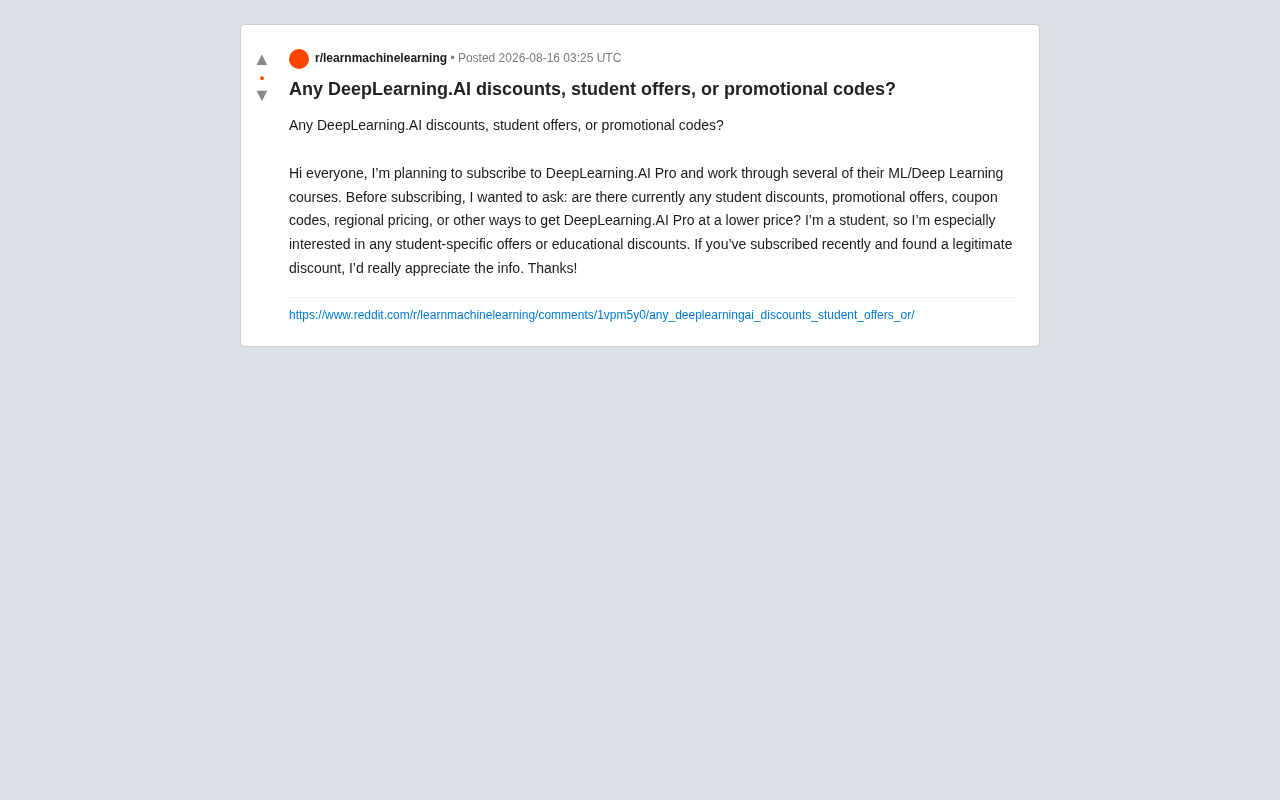
Recently, a student posted on Reddit asking: Are there student discounts, promo codes, or regional pricing options to save money on DeepLearning.AI Pro? While it seems like a simple cost-saving question, it reflects a real challenge that AI learners everywhere face today — how to access high-quality machine learning education at a reasonable cost. This article dives deep into DeepLearning.AI's subscription model, money-saving strategies, and whether a paid subscription is truly worth it.
What Is DeepLearning.AI and Why Does It Matter?
DeepLearning.AI is an online education platform founded by Andrew Ng, a leading authority in deep learning and co-founder of Google Brain. Andrew Ng is one of the most influential educators and researchers in artificial intelligence. He served as an Associate Professor in Stanford University's Computer Science Department, where he led groundbreaking research at the Stanford AI Lab. In 2011, he partnered with Google to launch the Google Brain project — one of Google's earliest deep learning research initiatives — which directly accelerated the large-scale adoption of deep learning in industry. In 2012, his team used deep learning to enable computers to autonomously recognize cats in YouTube videos, a breakthrough that made the front page of The New York Times and marked the moment deep learning entered public consciousness. He later joined Baidu as Chief Scientist, and in 2017 founded both DeepLearning.AI and Landing AI, focusing on AI education accessibility and industrial applications.
DeepLearning.AI is renowned for its high-quality machine learning and deep learning courses. From the beginner-friendly Machine Learning Specialization to the advanced Deep Learning Specialization, and more recently the wildly popular short courses on Generative AI, LangChain, and other cutting-edge topics, the platform covers the entire AI learning journey. His machine learning course on Coursera has attracted over 8 million learners, making it one of the most enrolled online courses in the world.
For students and professionals looking to systematically get started in AI, the reason DeepLearning.AI courses are so widely recommended comes down to their design — balancing theoretical depth with engineering practice. Andrew Ng's teaching style is clear and accessible, breaking down complex mathematical concepts into intuitive explanations. This is one of the key reasons his courses have consistently ranked among Coursera's most popular offerings.
Breaking Down the Pro Subscription Model
DeepLearning.AI Pro is the platform's paid subscription service, which typically includes full access to structured Specialization courses, hands-on coding assignment environments, and official certificates upon course completion. Compared to purchasing individual courses, the subscription model's advantage is that you can take unlimited courses within your subscription period — offering better value for learners planning to work through multiple subject areas consecutively.
Coursera was founded in 2012 by Stanford computer science professors Andrew Ng and Daphne Koller. It's one of the world's largest online learning platforms, offering courses from top universities and companies worldwide. The platform follows the MOOC (Massive Open Online Courses) model, allowing tens of thousands of learners to access the same course simultaneously. Coursera's business model has evolved from single-course purchases to a subscription model. In the early days, learners only paid for individual course certificates. Now, with the Coursera Plus subscription, learners pay an annual fee for unlimited access to over 7,000 courses. This subscription model borrows from the success of Netflix and Spotify and better serves lifelong learners who want to continuously upskill — but it also presents a new challenge: learners need stronger self-discipline to fully leverage their subscription's value.
Student Discounts and Money-Saving Options: A Complete Rundown
Addressing the original poster's core question — how to subscribe at a lower price — here's a breakdown of the most common and legitimate money-saving approaches available. Note that specific discount policies change over time, so treat these strategies as a reference.
1. Apply for Coursera Financial Aid
Many DeepLearning.AI courses are hosted on Coursera, which offers a Financial Aid program as a core mechanism for fulfilling its educational equity mission. Applicants need to answer two key questions: why they need financial assistance and how the course will help them achieve their career goals. The application form typically requires a 150–300 word statement, and the review team evaluates the applicant's financial situation, learning motivation, and course relevance.
Learners simply fill out an application describing their financial situation and learning goals. Approval typically comes within 15 days, granting free access to the course along with a certificate, usually valid for 6 months. According to data disclosed by Coursera, the approval rate for financial aid is quite high — most applications that sincerely express a learning need get approved. This mechanism is partially subsidized by course providers (such as universities or companies) and partially supported by Coursera's social responsibility fund. This is the most practical — and most often overlooked — money-saving method for students, especially those on a tight budget. It's worth noting that abusing the financial aid system (such as making false statements or reselling accounts) can result in permanent account suspension.
2. Watch for Official Promotional Cycles
Online education platforms commonly offer discounts during specific periods, such as New Year, Back to School season, Black Friday, and Cyber Monday. DeepLearning.AI and Coursera frequently have subscription discounts or first-month deals during these windows. Before subscribing, check the official website and sign up for email lists to catch promotions — avoid paying full price on impulse.
3. Institutional Partnerships and Regional Pricing
Some universities have institutional partnership agreements with Coursera (Coursera for Campus), allowing enrolled students to access a large number of courses for free through their school accounts. As a student, the original poster should first check with their school's library or computer science department to see if such resources are available. Additionally, Coursera implements differentiated pricing across countries and regions, so subscription costs in some areas may be significantly lower than the standard price.
4. Free Short Course Resources
It's especially worth highlighting that the DeepLearning.AI website hosts a large number of completely free short courses. These courses often focus on the latest AI engineering practices — covering hot topics like RAG, Agents, and Prompt Engineering — and are co-produced with leading industry teams.
RAG (Retrieval-Augmented Generation) has been one of the key technologies in large language model applications since 2023. It addresses the "hallucination" problem and knowledge currency issues in large models by combining external knowledge base retrieval with generative models. The process works like this: when a user asks a question, the system first retrieves relevant document fragments from a vector database, then feeds those fragments as context to the large model, which generates an answer grounded in real data. Agents refer to AI systems with autonomous decision-making and tool-calling capabilities — they can break complex tasks into multiple steps and dynamically choose to invoke tools like search engines, code interpreters, or API endpoints to complete them. OpenAI's Code Interpreter and Anthropic's Claude both demonstrate the powerful capabilities of Agents. Prompt Engineering is essentially the "programming language" for interacting with large models — by carefully designing input prompts, you can significantly improve model output quality, using techniques like few-shot learning and chain-of-thought reasoning.
For learners looking to quickly keep up with cutting-edge technologies, the value of these free resources is substantial — you can gain significant knowledge without subscribing to Pro at all.
Is a Pro Subscription Really Worth It?
Returning to the original poster's fundamental decision: before hunting for discounts, the more important question is whether you actually need a paid subscription.
Clarify Your Learning Goals Before Deciding
If your goal is to systematically master machine learning theory, complete coding assignments, receive structured learning feedback, and earn official certificates (e.g., for job applications or resume credentials), then investing in a paid subscription or specialized course is justified.
The value of online learning certificates is a hotly debated topic. Based on actual feedback from the job market, DeepLearning.AI and Coursera certificates hold value in these scenarios: 1) For career changers, certificates can serve as proof of systematic study, compensating for gaps in academic background; 2) For current students, certificates can enhance resumes and demonstrate self-directed learning ability; 3) In some companies' internal promotion systems, online certificates count toward continuing education credits. However, top tech companies (like Google and Meta) place more weight on actual project experience, open-source contributions, and technical interview performance — certificates alone are not a deciding factor. LinkedIn's 2024 Workplace Learning Report found that 62% of hiring managers view online certificates as valuable for "validating specific skills" rather than replacing degrees or work experience. Certificates can indeed add a nice touch in certain hiring scenarios, but they should be seen as "supplementary proof" of learning outcomes, not the sole objective of learning.
But if your goal is simply to understand concepts and quickly get hands-on with cutting-edge tools, then the combination of free short courses plus Coursera financial aid can cover most of your learning needs — no additional payment required. Blindly subscribing to Pro may actually lead to wasted resources — many people subscribe but never actually complete the courses.
Beware of Unofficial "Promo Codes"
One final word of caution: the internet is full of so-called third-party discount codes or "cracked subscription" channels. These sources often pose account security risks and may even be scam traps. Learners should always obtain discounts through official channels (DeepLearning.AI's official website, Coursera's official site). Financial aid applications and official promotions are the truly legitimate and sustainable money-saving paths.
Conclusion
As a benchmark platform in AI education, DeepLearning.AI's course quality is undeniable. For budget-conscious students, the optimal strategy isn't scouring the internet for discount codes. Instead: prioritize Coursera financial aid, make full use of official free short courses, watch for promotional cycles, and check for institutional partnership resources at your school. Once you've clarified your learning goals, then decide whether paying for a Pro subscription or certificates makes sense. A thoughtful investment in learning is always more valuable than simply chasing the lowest price.
Related articles

Chain of Thought Isn't Just for AI: How Humans Can Use CoT to Improve Thinking Quality
Chain of Thought isn't just a prompt trick for large models. Starting from a Hacker News discussion, this article analyzes why CoT works for human thinking too, breaks down actionable ways to transfer it, and highlights the key differences between human CoT and machine CoT.
Cloudflare Teams Up with OpenAI: Closi…
Cloudflare Teams Up with OpenAI: Closing the Loop from Vulnerability Discovery to Defense with AI
Cloudflare uses OpenAI Daybreak to investigate security vulnerabilities and generate reviewable remediation plans, while developers use Codex to boost coding efficiency and quality.

Orca Multi-Agent Orchestration in Practice: A Guide to Parallel Collaboration with Claude and Codex
Orca is Stable AI's free open-source agent workbench supporting 34 agents like Claude Code and Codex in parallel. Learn its Git worktree isolation, multi-model orchestration, and mobile management.