Is DRO Always Optimal? New Study Proposes MRO and SNR for Minimax Regret Rate in Wasserstein-Robust Regression

The paper reveals DRO's regret suboptimality in high dimensions and proposes MRO and SNR to achieve the minimax optimal rate.
This article examines the paper *Regret-Optimal Wasserstein-Robust Linear Regression*, which studies DRO's suboptimality in multivariate least-squares regression. As ε→0, DRO achieves the instance-optimal rate O(κε²), but for fixed ε and unbounded residual effective rank or high dimensions, it is suboptimal by a dimension-dependent factor. The authors propose MRO (with an exact convex reformulation) and SNR (with an accelerated proximal algorithm), both proven to achieve the minimax rate with finite-sample guarantees, validated by numerical experiments.
Title
Is DRO Always Optimal? New Study Proposes MRO and SNR for Minimax Regret Rate in Wasserstein-Robust Regression
Meta Description
This paper studies the regret suboptimality of DRO in Wasserstein-robust linear regression and proposes MRO and SNR as alternatives that achieve the minimax optimal rate, with convex reformulations and accelerated algorithms.
Article Content
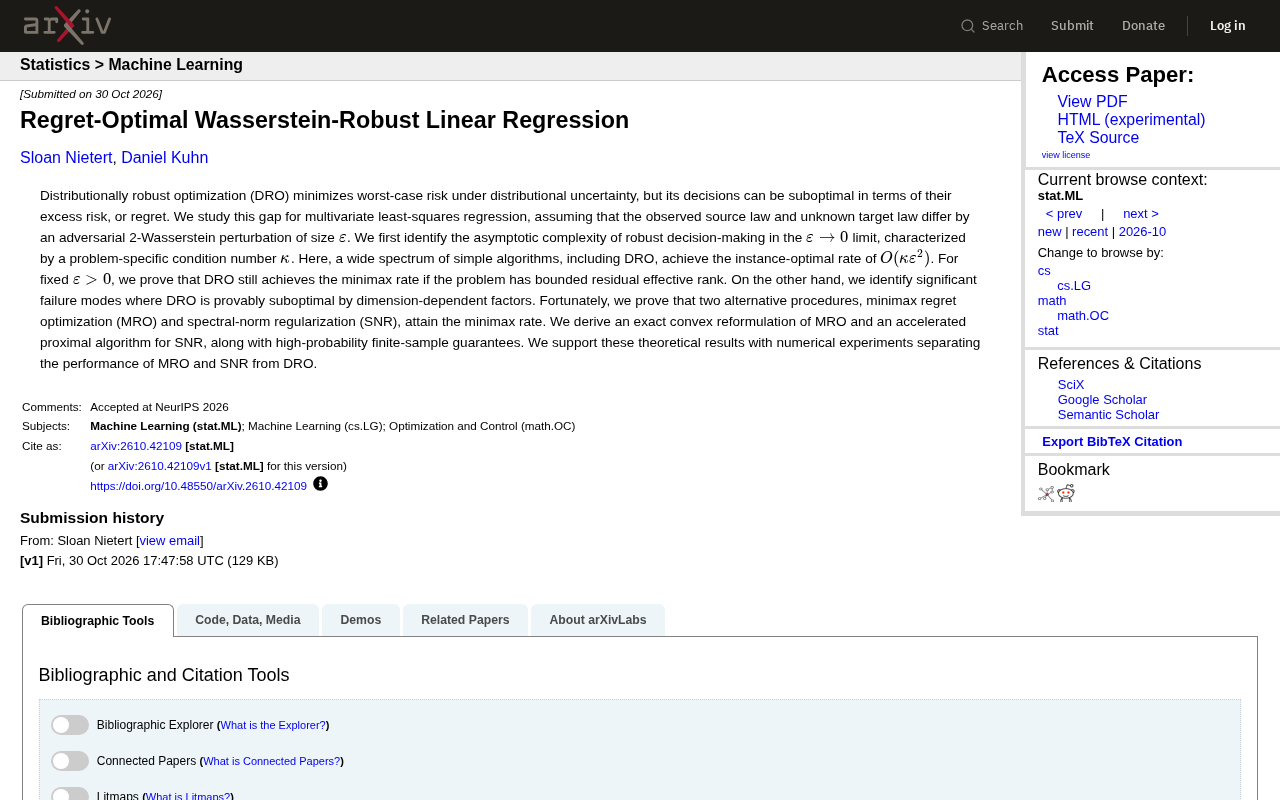
Distributionally robust optimization (DRO) improves model robustness by minimizing worst-case risk under distributional uncertainty, but the resulting decision "regret"—that is, excess risk—may not be optimal. A recent paper, Regret-Optimal Wasserstein-Robust Linear Regression, takes a deep look at the suboptimality of DRO in multivariate least-squares regression and proposes two alternatives: minimax regret optimization (MRO) and spectral norm regularization (SNR), which achieve the minimax optimal rate under broader conditions.
Background: When Robustness Meets Regret
In distributionally robust optimization, we assume an adversarial perturbation between the true distribution and the observed distribution, typically measured by the Wasserstein distance. In the specific case of linear regression, assuming a 2-Wasserstein perturbation of size ε between the source and target distributions, DRO minimizes the worst-case mean squared error. However, this conservative strategy may come at the expense of average performance, leading to significant regret relative to the optimal linear predictor when the true distribution is known.
The paper first analyzes the asymptotic limit as ε→0, identifying a condition number κ that determines the complexity of robust decisions. Interestingly, in this limit, a variety of simple algorithms—including DRO—can achieve the instance-optimal rate O(κε²). This means that when the perturbation is small, DRO's regret is controllable.
Wasserstein distance is a metric defined on the space of probability distributions that measures the minimum cost of "transporting" one distribution into another. Given two distributions μ and ν, their p-Wasserstein distance is defined as (W_p(\mu,\nu) = \inf_{\gamma\in\Gamma(\mu,\nu)} (\mathbb{E}_{(x,y)\sim\gamma}[|x-y|^p])^{1/p}), where (\Gamma(\mu,\nu)) is the set of all joint distributions with marginals μ and ν. In DRO, the Wasserstein distance is used to construct an "ambiguity set" centered at the empirical distribution with radius ε, that is, all distributions within distance ε of the empirical distribution. Compared with metrics such as KL divergence, the Wasserstein distance is aware of the geometric structure of the underlying space and is therefore more sensitive to perturbations of the support, making it particularly suitable for handling data distribution shift. The case p=2 corresponds to the squared Euclidean cost, which arises naturally in least-squares regression.
Instance-optimal rate refers to the convergence rate of an algorithm on each specific problem instance, rather than merely a uniform suboptimal rate in the worst case. By contrast, the minimax rate characterizes the worst-case optimality of an algorithm over all problem instances. The instance-optimal rate typically depends on the local geometric properties of the problem itself—such as the condition number κ and the effective rank of the residuals—and thus provides a finer performance characterization. In this paper, the O(κε²) achieved by DRO as ε→0 is precisely an instance-optimal rate: it degrades as the condition number κ grows, reflecting the direct impact of the problem's ill-conditioning on estimation difficulty. Distinguishing instance-optimal from minimax-optimal is key to understanding when DRO is "good enough" and when it is "suboptimal."
DRO's Failure Mode and Alternatives
For a fixed ε>0, the paper proves that DRO still achieves the minimax rate if the problem has bounded residual effective rank. However, in certain cases, DRO is proven to be suboptimal by a dimension-dependent factor—a significant failure mode of DRO.
To overcome this limitation, the authors propose two alternative procedures:
- Minimax regret optimization (MRO): directly minimizes the worst-case regret rather than the risk. The paper derives an exact convex reformulation of MRO, making it efficiently solvable.
- Spectral norm regularization (SNR): controls robustness by imposing a spectral norm penalty on the regression coefficients, and an accelerated proximal algorithm is designed.
Both methods achieve the minimax rate, and the authors provide high-probability finite-sample guarantees. Numerical experiments further separate the performance differences among MRO, SNR, and DRO, validating the theoretical findings.
Effective rank is a continuous measure of matrix rank used to characterize the "concentration" of a matrix's spectrum. For a positive semidefinite matrix (\Sigma), its effective rank is defined as (\mathrm{erank}(\Sigma) = \mathrm{tr}(\Sigma)/|\Sigma|_{\mathrm{op}}), the ratio of the trace to the spectral norm, taking values between 1 and the dimension d. When the eigenvalues are uniformly distributed, the effective rank approaches d; when a few eigenvalues dominate, the effective rank is much smaller than d. In the regression setting of this paper, "residual effective rank" refers to the effective rank of the residual covariance matrix. DRO's suboptimality arises precisely when the residual effective rank is unbounded or grows with the dimension: in this case, a dimension-dependent factor appears in DRO's error bound, causing non-negligible regret relative to the minimax optimal rate. This concept explains why DRO performs poorly in high-dimensional or heavy-tailed residual settings.
Spectral norm regularization refers to penalizing the spectral norm (|W|{\mathrm{op}}) (the largest singular value) of the regression coefficient matrix ((W\in\mathbb{R}^{d\times k}) in the multivariate case). Unlike Frobenius norm penalization, spectral norm penalization directly controls the maximum stretching of the mapping in all directions and is therefore naturally aligned with worst-case risk control. In this paper, SNR indirectly limits the model's sensitivity to distributional perturbations by penalizing (|W|{\mathrm{op}}), and its theoretical advantage lies in the fact that the dual structure of this penalty matches the dual form of the Wasserstein perturbation. The reason accelerated proximal algorithms (such as proximal gradient methods based on Nesterov acceleration) are applicable is that the proximal operator of the spectral norm can be solved in closed form via singular value thresholding (soft-thresholding), requiring only one SVD per iteration, thereby remaining scalable on large-scale problems.
Implications for Robust Machine Learning Practice
This study reminds us that DRO is not regret-optimal in all scenarios. When the residual effective rank is unbounded or the dimension is high, DRO may be significantly suboptimal. Practitioners who care about regret relative to the optimal solution under the true distribution should consider MRO or SNR as alternatives. MRO's convex reformulation makes it easy to integrate into existing optimization frameworks, while SNR's accelerated proximal algorithm is suitable for large-scale problems.
The paper's finite-sample guarantees also provide a reliability basis for practical applications. In the future, this regret perspective may extend to other robust learning problems, driving finer robustness-performance trade-offs.
Key Takeaways
- DRO can achieve the instance-optimal rate as ε→0, but for fixed ε it may be suboptimal by a dimension-dependent factor.
- MRO and SNR are proven to achieve the minimax rate and come with finite-sample guarantees.
- MRO has an exact convex reformulation, and SNR has an accelerated proximal algorithm; both have practical value.
- Numerical experiments validate the theoretical results and separate the performance of the different methods.
One-line Summary
The paper reveals that DRO is regret-suboptimal in high dimensions and proposes MRO and SNR to achieve the minimax optimal rate.
Paragraph Summary
This article centers on the paper Regret-Optimal Wasserstein-Robust Linear Regression, examining the suboptimality of distributionally robust optimization (DRO) in multivariate least-squares regression. It first reviews the DRO framework that constructs ambiguity sets using the Wasserstein distance, noting that in the asymptotic limit as the perturbation ε→0, DRO and various simple algorithms can achieve the instance-optimal rate O(κε²) depending on the condition number κ. However, for fixed ε>0, when the residual effective rank is unbounded or the dimension is high, DRO is suboptimal by a dimension-dependent factor, constituting a significant failure mode. To address this, the authors propose two alternatives: minimax regret optimization (MRO), which directly minimizes worst-case regret and has an exact convex reformulation; and spectral norm regularization (SNR), which controls robustness via a spectral norm penalty and is equipped with an accelerated proximal algorithm. Both are proven to achieve the minimax optimal rate and provide high-probability finite-sample guarantees, and numerical experiments validate their advantages over DRO.
Related articles

DeepSeek Harness Quick Start Guide: From Installation to 5 Real-World Cases
What is DeepSeek Harness? Based on a Bilibili tutorial, this article covers how this AI Agents software works, installation and setup, four working modes, and five real-world cases: a 3D racing game, official website, music player, science animation, and self-developed plugin—plus token money-saving tips.

Breaking Down DeepSeek's Super-agent Architecture: How Router+Worker Solves the Multi-Session Management Bottleneck
An analysis of DeepSeek's Super-agent paper: how the Router+Worker two-tier architecture uses Fast Pass, Chain of Recall, and storage-compute separation to solve multi-AI-session management bottlenecks, and how much it truly alleviates the human attention bottleneck and what engineering trade-offs it makes.

19K Stars in 5 Days: Why DeepSeek's Open-Source AI Programmer Went Viral
DeepSeek's open-source AI programmer hit 19K GitHub stars in 5 days. Why it went viral: the agent boom, AI writing its own code, and the shift from Q&A tools to AI employees.