Is Gemma 5 Coming Soon? Reddit Buzzes Over Google's Open-Source Model Cadence

Reddit buzzes over Gemma 5: community speculates on release timing, team ownership, and tech trickle-down.
This article reviews community reactions to a Reddit thread about Gemma 5. Users split between impatience with Google's release cadence and willingness to wait for delivery. Discussion covers team ownership, the "Gemini first, Gemma second" distillation path, speculation that pre-training is done with post-training underway, and the community's half-joking habit of decoding vague official signals.
Google's open-source Gemma model series has long drawn developer attention. Recently, a Reddit thread about Gemma 5 appeared with just one title: "Gemma 5 models soon ??" — yet it sparked widespread speculation about Google's open-source cadence, team collaboration, and marketing strategy.
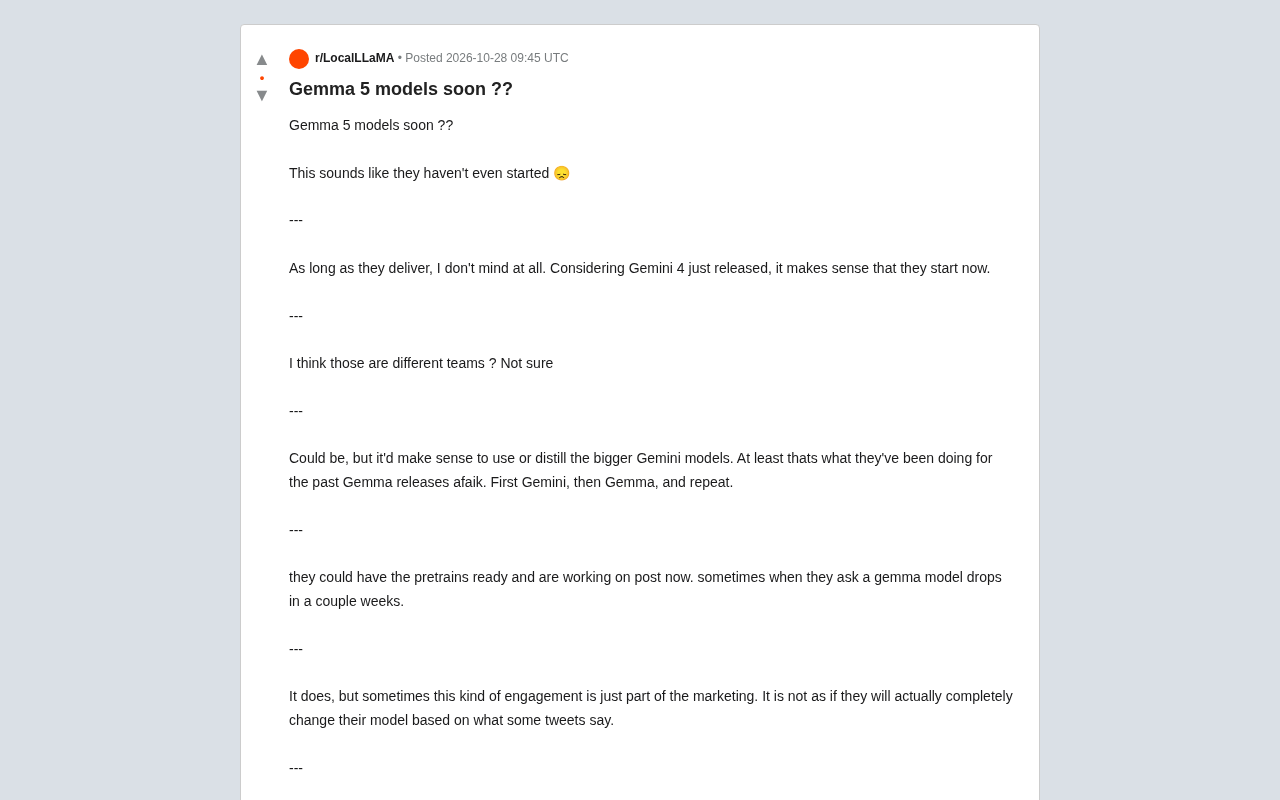
The Community's First Reaction: Hope and Skepticism Side by Side
At the start of the thread, one user put it bluntly: "This sounds like they haven't even started 😞" — it sounds like they haven't even gotten off the ground. That sentiment isn't hard to understand: it's been a while since the last Gemma update, and competing open-source models are clearly iterating faster.
But another camp is more forgiving: "As long as they deliver, I don't mind at all." As long as they deliver in the end, the wait doesn't matter. This user also noted that, considering Gemini 4 was just released, it's reasonable on the timeline for Google to only now be starting work related to Gemma 5.
This split actually reflects the open-source community's complicated feelings toward Google: they recognize its technical strength, yet lack patience with its release cadence.
The Team Debate: Are Gemma and Gemini the Same People?
An interesting branch of the discussion concerns team ownership. One user suggested "I think those are different teams ? Not sure," believing Gemma and Gemini may be handled by different teams.
Someone immediately pushed back: even if the teams differ, using the larger Gemini model to distill or guide Gemma is a natural approach. "At least thats what they've been doing for the past Gemma releases afaik. First Gemini, then Gemma, and repeat." — as far as they know, past Gemma releases have followed a "Gemini first, Gemma second" cycle.
This observation pinpoints the core logic of Google's open-source strategy: Gemma is not the product of independent R&D, but an extension of the Gemini tech stack into the downstream open-source market. If this pattern continues, Gemma 5's capability ceiling will largely depend on how much of Gemini 4's technology trickles down.
Pre-training Already Done? Technical Speculation from the Community
One user offered a relatively specific guess: "they could have the pretrains ready and are working on post now." Pre-training may already be done, and they may currently be in the post-training phase. He also mentioned that sometimes once the official account starts asking questions, the model ships within weeks.
This claim lacks official corroboration and is community speculation, but it fits the typical rhythm of large model releases — pre-training is a long-cycle engineering effort, while post-training and tuning are relatively compact. If Gemma 5 is indeed in the post-training phase, then "soon" may not be empty talk.
Still, some users poured cold water: this kind of interaction is sometimes just part of marketing, "It is not as if they will actually completely change their model based on what some tweets say." A model won't change course because of a few tweets.
The Division of Labor Between Pre-training and Post-training: Training a large language model is typically divided into two stages. Pre-training uses self-supervised learning (such as next-token prediction) on massive unlabeled text to let the model acquire language patterns and world knowledge; it is computationally enormous, with cycles often measured in months, and is the key link determining a model's capability ceiling. Post-training includes instruction fine-tuning (SFT), reinforcement learning from human feedback (RLHF/DPO), and more, aiming to teach the model to follow instructions and align with human preferences, requiring far less compute and time than pre-training. So the community's speculation that "pre-training is ready and post-training is underway" means the model's core capabilities are set, with remaining work leaning toward tuning and safety alignment — which is engineering-wise consistent with the claim of "release within weeks."
Knowledge Distillation: The distillation mentioned in the article refers to using a more capable large model (the teacher model, such as Gemini 4) to generate outputs or soft labels to train a smaller student model (such as Gemma). Compared with pre-training from scratch, distillation can significantly reduce compute costs and "pass down" part of the large model's capabilities to the smaller model. This is precisely the technical basis of the "Gemini first, Gemma second" release pattern: the capabilities of a new generation of Gemini are transferred to the open-source Gemma through post-training methods such as distillation.
The Community Sentiment Behind a Single Thread
At the end of the thread, a picture was attached with the caption "Feels like this is becoming a running gag at some point." — it feels like this is about to become a recurring meme.
This quip captures the general mindset of the open-source model community: whenever officials release even a vague signal, the community spontaneously enters "decoding mode," guessing release dates, parameter sizes, and capability boundaries. The less information there is, the more speculation there is, ultimately forming a half-joking collective ritual.
For developers, rather than agonizing over release dates, it's better to focus on a more practical question: can Gemma 5 continue the path of "Gemini technology trickling down" and remain competitive in the open-source camp? After all, the premise of the community's "as long as they deliver, I don't mind" is that what's delivered is worth the wait.
For now, everything about Gemma 5 remains at the level of community discussion, and Google has not given a clear timeline. This article will continue to follow subsequent developments.
One-line Summary
Reddit buzzes over Gemma 5: the community speculates about release cadence, team ownership, and the technology trickle-down path.
Paragraph Summary
This article rounds up the community reaction sparked by a Reddit thread about Gemma 5. User sentiment splits into two camps: one believes the project hasn't even started and lacks patience with Google's release cadence, while the other says they're willing to wait as long as it ultimately ships. The discussion extends to team ownership, with the community generally speculating that Gemma and Gemini are handled by different teams but continue the "Gemini first, Gemma second" technology trickle-down and distillation path. Some users guess pre-training is complete and the model is now in post-training, while others note official interaction may just be marketing. The article concludes that the community's collective decoding of vague signals has become a half-joking ritual, and what developers should really watch is whether Gemma 5 can continue the technology trickle-down path and stay competitive in open source.
Related articles

Anthropic IPO Explained: Fuel for the AI Boom or the Spark for a Bubble?
Anthropic files for an IPO under ticker ANT. Breaking down the prospectus: 80% of revenue from usage-based pricing, $72B of an $80.7B net loss being non-cash charges, 900% net revenue retention, and how past IPOs like SpaceX performed on day one and over three years — answering the AI bubble question.

Will AI Kill the Research Paper? Mathematicians Offer a New Answer
Mathematicians on the Lex Fridman podcast discuss whether AI will kill research papers—from journal review pressure to Lean formal verification, GitHub open source fatigue to Mathlib's crowdsourcing model, exploring the evolution of academic contributions and the future of mathematical knowledge verification.

Enterprise LLM Development: From RAG to Multi-Agent in Practice
A course breakdown of enterprise LLM application development: from prompt engineering and RAG to multi-agent engineering practice and FDE project delivery, helping developers understand why Agent technology is a key focus for enterprise deployment and learn systematically to avoid detours.