Is Grok Really the Most Truth-Seeking AI? A Deep Analysis
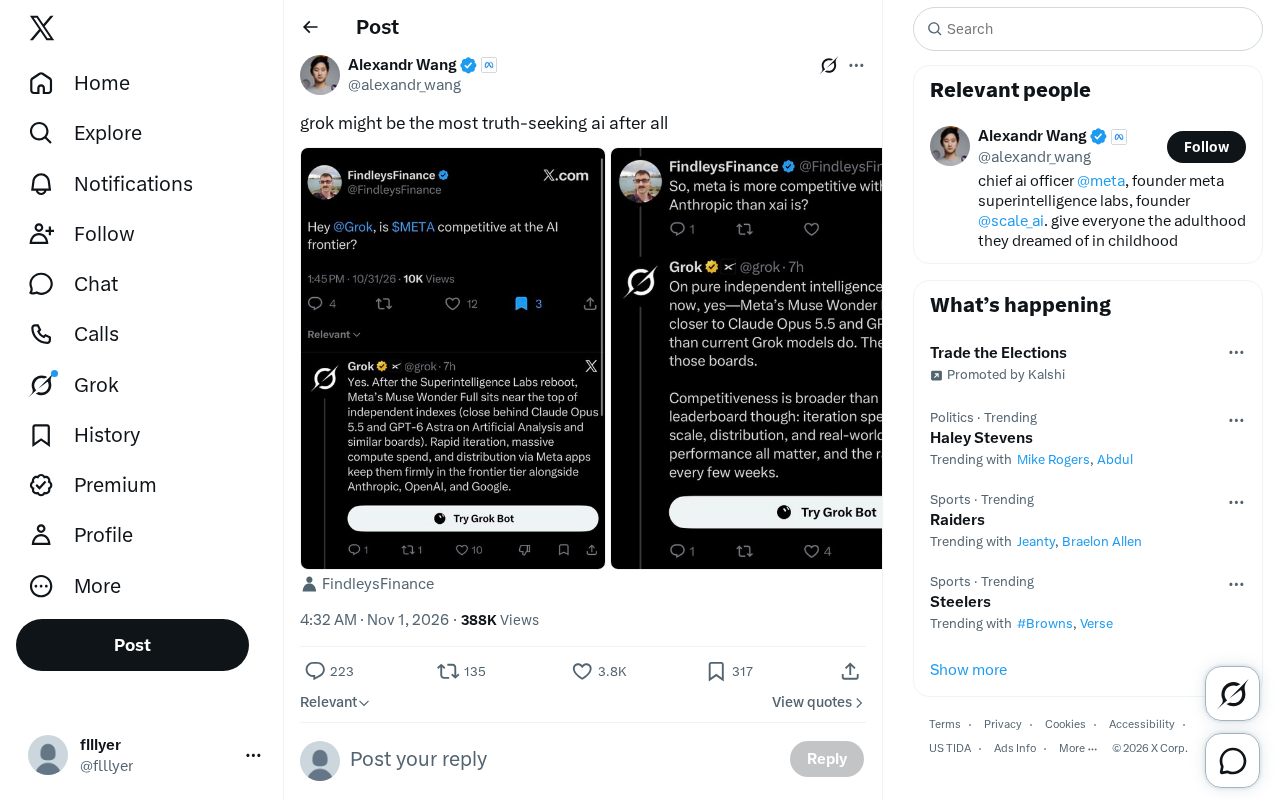
A tweet sparks debate on whether Grok is the most truth-seeking AI, but lacks systematic evaluation support.
The article analyzes a short tweet claiming "Grok might be the most truth-seeking AI." The author notes the tweet provides no cases, comparisons, or benchmark evaluations, so it can only be viewed as a user perception signal rather than a rigorous conclusion. The article unpacks the multiple meanings of "truth-seeking," proposing four measurement dimensions: factual accuracy, stance neutrality, uncertainty expression, and resistance to leading questions, arguing that the tweet mainly implies the latter three. Grok's "rebellious" product character and less preachy style easily create the impression of "daring to speak," but stylistic directness does not equal factual accuracy. The author advises users not to trust a single tweet but instead to test different models with the same set of questions to actually verify their honesty.
Is Grok Really the Most Truth-Seeking AI? A Deep Analysis
Key Points
- Some observers believe Grok stands out in "truth-seeking"
- This view was sparked by a discussion on Twitter but lacks systematic evaluation to support it
- "Truth-seeking" involves multiple dimensions such as factual accuracy, stance neutrality, and information completeness
- Different models show clear differences in their response strategies on sensitive topics
- Users need to judge whether a model "dares to tell the truth" based on specific scenarios
In today's world where AI assistants are everywhere, which model "dares to tell the truth" more has always been a hot topic among users. Recently, a short tweet on Twitter—"grok might be the most truth-seeking ai after all"—once again pushed xAI's Grok into the spotlight. No lengthy argument, no evaluation data, just a probing judgment that precisely struck a sensitive nerve in the public's perception of AI "honesty."
What the Tweet Says and What It Doesn't
The core message of this tweet is just one sentence: Grok might be the most truth-seeking AI. It provides no specific cases and no comparison with other models—it's more like an intuitive feeling based on usage experience. Because of this, we can't treat it as a rigorous conclusion, but we can view it as an observation point worth unpacking.
"Truth-seeking" itself is a vague expression. It could mean the model doesn't shy away from sensitive questions, or that answers are based on facts rather than pandering to users, or that the model dares to admit uncertainty. The tweet doesn't define it, and that's precisely where the value of the discussion lies—when we say an AI is "truth-seeking," what exactly are we talking about?
Why Grok Gets Tagged as "Truth-Seeking"
Grok has carried a "rebellious" quality since its inception. xAI positions it as an assistant that maintains some distance from the user's stance, emphasizing less preaching and more directness. This product character easily gives users the impression that "it dares to speak."
On the other hand, Grok tends to leave more room for discussion in its answers, not rushing to give a single standard answer. For users accustomed to the "safety-first" style of mainstream models, this difference gets amplified and interpreted as "more honest." But it's important to note that directness in style does not equal factual accuracy—the two cannot be conflated.
xAI is an artificial intelligence company founded by Elon Musk in 2023, and Grok is its conversational model. The name comes from a slang term in the science fiction novel Stranger in a Strange Land, meaning "deep understanding." When releasing Grok, xAI positioned it as an assistant "with a sense of humor and not fully consistent with mainstream safety alignment paradigms," allowing it to give more direct responses on some sensitive topics. This strategy contrasts with the "helpful, harmless, honest" alignment approach emphasized by companies like OpenAI and Anthropic. Grok has been integrated into the X platform and released in multiple versions. Its training data and system prompt design retain fewer refusal templates—this is an important product background for why users get the impression that "it dares to speak."
Four Dimensions for Measuring "Truth-Seeking"
To judge whether an AI is truly "truth-seeking," we can observe at least four dimensions.
Factual Accuracy
Whether the model provides verifiable, correct information is the bottom line. A model that dares to express itself but gets facts wrong is further from the truth, not closer.
Stance Neutrality
When facing controversial topics, does the model present multiple perspectives rather than catering to a specific user group? Neutrality doesn't mean having no stance—it means not hiding the complexity of information.
AI safety alignment is the technical process of making model behavior conform to human values and safety norms, typically including reinforcement learning from human feedback (RLHF), constitutional AI, refusal training, and other methods. Alignment is a necessary measure to reduce the risk of harmful output, but over-alignment can bring "avoidance" side effects: models tend to give templated balanced statements, refuse to answer, or handle things vaguely when encountering controversial topics. What users mean by "daring to tell the truth" is often actually a complaint about this excessive avoidance. Understanding alignment mechanisms helps distinguish two situations: one is the model actively converging due to safety norms, and the other is the model fabricating due to insufficient knowledge or training bias. The former is a strategic choice, while the latter is an accuracy issue—the two must not be conflated.
Expressing Uncertainty
Whether the model honestly says "I don't know" at the boundaries of its knowledge. Overconfident fabrication is the opposite of truth-seeking.
Resistance to Leading Questions
When facing questions with preset conclusions from users, does the model insist on answering based on facts rather than following the user's lead?
The "truth-seeking" implied by the tweet likely points mainly to the latter three dimensions—users feel that Grok is less "stiff," but this requires more systematic comparison to confirm.
What a Single Tweet Can Prove
It must be acknowledged that this tweet contains very limited information. It provides no comparative tests, cites no benchmark evaluations, and specifies no particular scenarios. Treating it as a conclusion is dangerous, but treating it as a signal is reasonable: at least some users have developed the perception that "Grok dares to speak" through their usage.
This perception deserves attention because it reflects users' genuine demand for AI honesty. Mainstream models invest heavily in safety alignment, which sometimes manifests as avoidance or vague handling, leaving some users dissatisfied. If Grok can reduce unnecessary avoidance while maintaining accuracy, it would indeed create differentiation.
Practical Advice for Users
Don't conclude that a certain model is "the most truth-seeking" just because of one tweet. A more pragmatic approach is: on topics you care about, test different models with the same set of questions and observe their factual accuracy, stance presentation, and expression of uncertainty. Truth isn't what a model claims about itself—it emerges through comparison.
Whether Grok is truly the most truth-seeking remains undetermined. But this tweet reminds us that AI "honesty" is becoming a more important competitive dimension than parameters.
Related articles
 Tech Frontiers
Sherlock: An Open-Source Tool for Tracking Usernames Across Social Networks
Sherlock is an open-source Python tool that tracks social accounts across networks by username. This article covers its core features, why developers love it, typical use cases, and privacy compliance considerations.
 Tech Frontiers
GitHub Daily·Nov 07: Agent-Ready and Context Compression
GitHub Trending Nov 07: meta's agent-ready design system astryx, billion-context's 5x context compression, sherlock nearing 100k stars, plus local-first localthings and bare-metal GPU orchestration nvke.
 Tech Frontiers
Buoyant Open-Sources Kinference: An Inference Control Plane for vLLM on K8s
Buoyant open-sources Kinference, an inference control plane for vLLM on Kubernetes, with declarative routing, KV-cache-aware load balancing, and per-tenant metrics—claiming 95% lower median TTFT in official benchmarks.