Is Grokbot Worth Subscribing To? A Clear-Eyed Breakdown for Claude Code Users

Grokbot sells polished packaging, but Claude Code users already have everything inside the box.
A deep dive into Grokbot's agent team product reveals its core value proposition — a persistent shared virtual machine — is outweighed by single-model lock-in, premium-tier gating, and false needs like real-time agent chat. For developers already using Claude Code or Codex, the framework-first approach offers more flexibility, and Grokbot's key ideas can be replicated with existing tools tonight.
What Is Grokbot Actually Selling?
Your feed has probably been flooded lately with a product called Grokbot. The pitch sounds impressive: you can create a bunch of agents, assign each one a personality and task, and let them all live together on a shared virtual machine. Even when you close your laptop, they keep running, chatting, and sharing files on that machine.
The "Agent" here refers to one of the hottest paradigms in AI right now. Unlike traditional chat-based AI, Agents can autonomously plan, call tools, and interact with their environment — they don't just answer questions, they break down tasks, call APIs, read and write files, execute code, and form a complete workflow loop. Understanding this context is key to seeing how much Grokbot actually adds on top of existing capabilities.
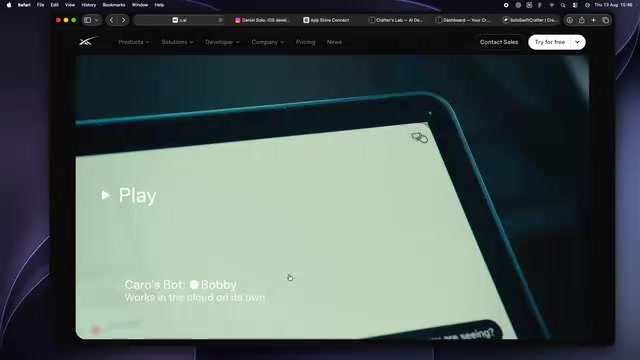
This is a productized attempt at the "agent team" concept. The iOS app is well-made, with integrations for Slack, GitHub, and the entire Google ecosystem — many features work out of the box. The packaging is genuinely polished.
But Daniel, a seasoned indie iOS developer, offered a blunt assessment in his video: If you're already using Claude Code or Codex, Grokbot is basically a waste of time. Because everything inside the box? You already have it.
Grokbot's Core Product: That "Always-On Virtual Machine"
Daniel cuts straight to the point: Grokbot's real core isn't the agents, the skills, or the routines — that always-running shared virtual machine is the product itself.
At its essence, this is a pre-configured cloud sandbox. The concept is nothing new: GitHub Codespaces, Gitpod, Replit, and others have long offered "open a browser and start coding" cloud development environments, and OpenAI's Codex spins up an independent sandbox container for each task. Grokbot's differentiator is that it persistently deploys multiple Agents within a single virtual machine, letting them share a file system and runtime state. The convenience of this architecture is real — you don't need to manage Docker containers or cloud servers yourself. But the cost is equally real: all your workflows, data, and context accumulate on someone else's infrastructure, and migration costs grow exponentially with depth of use.
Agents with personalities and specializations? That's just "a skill tailored to a specific job." Agents that can talk to each other? In 2025, Anthropic has officially launched the Agent-to-Agent (A2A) protocol, allowing different Agents to delegate tasks and exchange information through standardized interfaces. Google previously proposed a protocol with the same name, and the industry is forming consensus. This means inter-Agent collaboration no longer requires a specific platform to "broker" it — it's becoming an infrastructure-level capability. Those jaw-dropping demos are essentially "traps optimized for screenshots," not capabilities built for real work.
After checking off every item on the list, the only real differentiator left is that always-on machine, plus "someone already did the deployment for you."
Two Dealbreakers: Model Lock-in and Premium Pricing
Dealbreaker #1: Single Model Lock-in, No Mixing Allowed
The first problem is right there in the name — Grokbot, literally. Every agent on your team runs the same model. No mixing, no choosing.
For Daniel, this is a "veto-level" flaw. His workflow is built on a "framework first, model second" principle: agents running on OpenCloud and Hermes don't care which lab's model sits underneath.
This "framework first, model second" approach is an increasingly important design principle in AI application architecture. The core idea: abstract business logic, tool calling, and context management into a model-agnostic framework layer, where the underlying model is just a swappable "inference engine." Key implementations include LangChain, LlamaIndex, and Anthropic's recommended Model Context Protocol (MCP) — MCP defines a standard protocol that lets AI models connect to external data sources and tools in a unified way, regardless of whether the underlying model is Claude, GPT, or open-source. Adopting this architecture means: when a lab releases a stronger new model, you just swap an API endpoint instead of rewriting your entire workflow.
Different models have different tastes, different levels of eagerness, and different failure modes —
- Scary refactors go to the large frontier model;
- Boring batch work goes to the cheap, token-efficient one.
This isn't paranoia — it's a core strategy in current AI engineering practice. Frontier models (like Claude Sonnet 4, GPT-4o) excel at complex reasoning and large-scale refactoring, but each call carries high token costs and greater latency. Lightweight models (like Claude Haiku, GPT-4o mini) offer exceptional cost-efficiency for format conversion, batch text processing, and other "grunt work." Mature AI workflows typically set up a router layer that automatically selects the model based on task complexity — this architecture is known as "Model Cascade" or "mixture-of-experts scheduling." Being locked into a single model doesn't just mean runaway costs — it means you can't implement differentiated fault tolerance for different failure modes.
The right model for the right job. Grokbot blocks this entire approach: whatever the lab ships is what your entire team runs. By contrast, Claude Code and Codex users can freely choose their model mix.
Dealbreaker #2: Core Features Locked Behind the Highest Tier
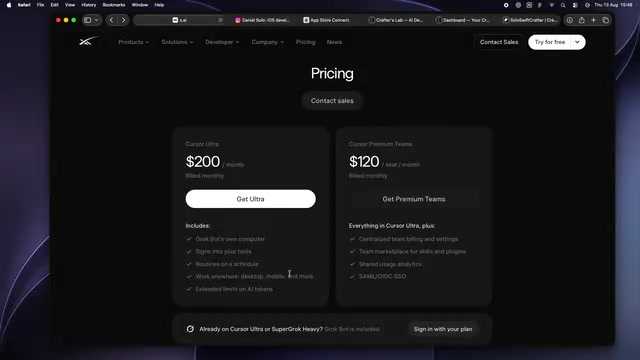
Pricing always reveals what a lab is truly betting on. The shared virtual machine that the entire value proposition depends on is locked behind the highest subscription tier — a monthly expense that would make any indie developer wince.
Daniel's complaint is spot-on: "Either sell me the machine, or don't." When the feature you want always sits just above the tier you're willing to pay for, that tells you everything you need to know.
Agent-to-Agent Chat Is a False Need: Document Handoffs Are the Real Answer
"Agents talking to each other" is the feature that draws the most gasps, but Daniel offers a counterintuitive lesson from experience.
He runs a real army of agents through a Slack channel, working in actual codebases every day, but they almost never need to talk to each other in real time. Work flows through documents: a brief goes in, a work log comes out, and the next agent picks up where the last one left off.
"This isn't a workaround — it's actually better. Because afterward, you can read the handoff notes, but you can't read telepathy."
This "document handoff" pattern has deep theoretical roots in software engineering. One of the core principles of Unix philosophy is "programs communicate through text streams" — the pipe mechanism lets each tool do one thing, chaining them into powerful workflows through standardized input/output. The same idea appears in modern microservice architecture as "event-driven" and "message queue" patterns: services don't talk directly — they collaborate asynchronously through persistent message records. The advantage of this pattern lies in auditability and fault tolerance — if any step fails, you can trace back to the specific handoff document instead of trying to reconstruct the scene from two Agents' real-time chatter. For AI Agents, this is especially critical because large language models have context window limitations, and documented handoffs ensure each Agent receives precisely trimmed, maximally relevant context information when it takes over.
For Agents, context management is the real key. Documented handoffs mean every agent that comes in knows what happened before, and credit is recorded — far more reliable than real-time chat.
What Grokbot Really Sells Is "The Setup Weekend You Didn't Have to Spend"
If the agents, skills, and orchestration aren't differentiators, what is Grokbot actually charging for? Daniel honestly acknowledges an uncomfortable truth:
What Grokbot really sells isn't intelligence — it's a finished configuration, the weekends it saves you.
He spent enormous amounts of time and countless frustrations building his own elaborate setup. The friction of configuration is real — that's why many people are willing to pay top dollar to never touch a config file.
But here's the paradox: the developers who desperately want to build an AI agent team — even at a premium price — are exactly the people who are perfectly capable of building it themselves. If you're sitting in front of a terminal right now with a half-written skill file in some folder, Grokbot probably isn't for you.
The Real Damage AI Hype Cycles Do to Indie Developers
This analysis transcends any single product and deserves every developer's attention.
Gartner's Hype Cycle describes a recurring pattern: new technologies pass through the "Peak of Inflated Expectations," then fall into the "Trough of Disillusionment," before eventually reaching the "Plateau of Productivity." The AI developer tools space is in the acceleration phase of this cycle — between 2024 and 2025, we've witnessed AutoGPT's explosion and fade, rapid iterations of multiple AI coding assistants, and the launch and abandonment of countless "Agent frameworks." Historical parallels include the JavaScript framework fatigue of the 2010s (the constant migration from Backbone to Angular to React) and the consolidation of container orchestration tools (Docker Swarm and Mesos ultimately giving way to Kubernetes). In every cycle, developers who bet on deeply mastering underlying capabilities ended up outperforming those who chased hot trends.
Hype cycles are always competing for your mindshare. Every new launch feels like progress because it's "momentum" — but often it's just lateral movement. The warning signs are clear:
- Your terminal, your machine already meet your needs;
- Grokbot asks you to "move into its house";
- You're going deeper and getting better at Claude Code, then suddenly you're a beginner again with a new tool.
"The cost of starting over is a currency you can't top up — your depth."
How to Replicate Grokbot's Core Ideas with Your Existing Tools
Daniel's advice: Don't subscribe to Grokbot — steal its ideas tonight. The only real idea inside the box is this: "a team with clearly defined roles beats a single overloaded chat window." So build it within the Claude Code or Codex environment you already have:
- Open new threads alongside your main thread;
- Give each agent only one job with its own skill set;
- Pass work between them via a document (written records, not telepathy).
Almost stupidly simple, but this is the entirety of the Grokbot experience — minus the model lock-in and top-tier tool bundling.
A Prediction Worth Remembering: Polished Packaging Sells Lock-in
Daniel makes a confident prediction:
Every truly popular AI framework will eventually get a polished wrapper from some lab. And every wrapper sells the same deal — easy to get in, locked in to get out.
The developers who come through unscathed are the ones who already have configuration skills. Because skills transfer, but subscriptions don't. This is the practical significance of the "framework first, model second" architectural philosophy — when your workflow doesn't depend on any specific platform or model, you have true technical autonomy. No matter which lab releases a stronger model in the future, you just swap the inference engine, while your accumulated prompt engineering techniques, context management strategies, and toolchain configuration experience remain fully intact.
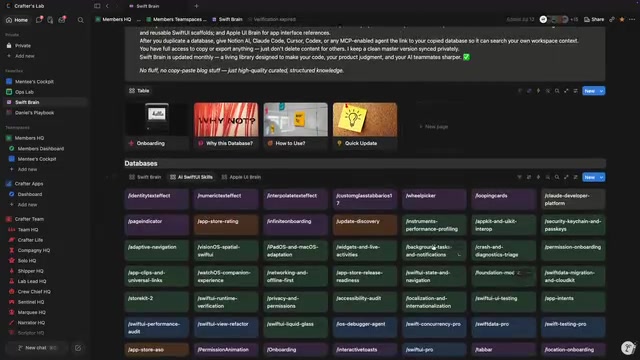
His practical philosophy is refreshingly simple: treat AI as a real teammate, not a button to mash or a vending machine. Context is preserved through documentation, tools are decoupled through frameworks — so that whatever comes next (Claude Code, Codex, Cursor), it all stays compatible.
Conclusion: Depth Compounds, Hype Resets
Grokbot isn't a scam, and it's not even a bad product. It's just not for you if you've already mastered your toolchain — because what it's selling has been sitting in your terminal all along, just wearing less marketing polish.
Daniel leaves an open question that's worth asking yourself: Is "having everything done for you" worth being locked in? There's no definitive answer.
But next time your feed starts hyping up a new AI agent product, run it against this checklist: the question is never "Is it impressive?" but "Can it do something my current tech stack can't?" And most of the time, the honest answer is — no, it can't.
Depth compounds. Hype resets. Dig deeper, don't look sideways.
Related articles

RAG Getting Started in Practice: From Principles to Building an Enterprise Knowledge Base
Bilibili RAG course highlights: from retrieval-augmented generation principles, document chunking and vectorization, to five accuracy factors and enterprise knowledge base boundaries, with fine-tuning vs RAG selection advice.

AI Model Selection Guide: DeepSeek vs. Qwen3 in Practice
How should AI developers choose models? Based on a Bilibili tutorial, this article breaks down the Function Calling differences between DeepSeek V3 and R1, Qwen3's programmatic thinking mode switching and agent capabilities, and outlines a multi-model learning path and practical selection logic.

Anchoring, Loss Aversion, and Nudges: 5 Psychological Tactics Retailers Use to Make You Spend
Behavioral economics reveals how retailers use anchoring, framing, loss aversion, and nudge theory to manipulate your spending decisions. This article breaks down 5 common psychological tactics and offers counterstrategies like slowing down decisions and setting your own anchors to see through the pricing design behind discounts.