Is It Time for Pandas to Step Aside? Rethinking the Data Analysis Toolchain
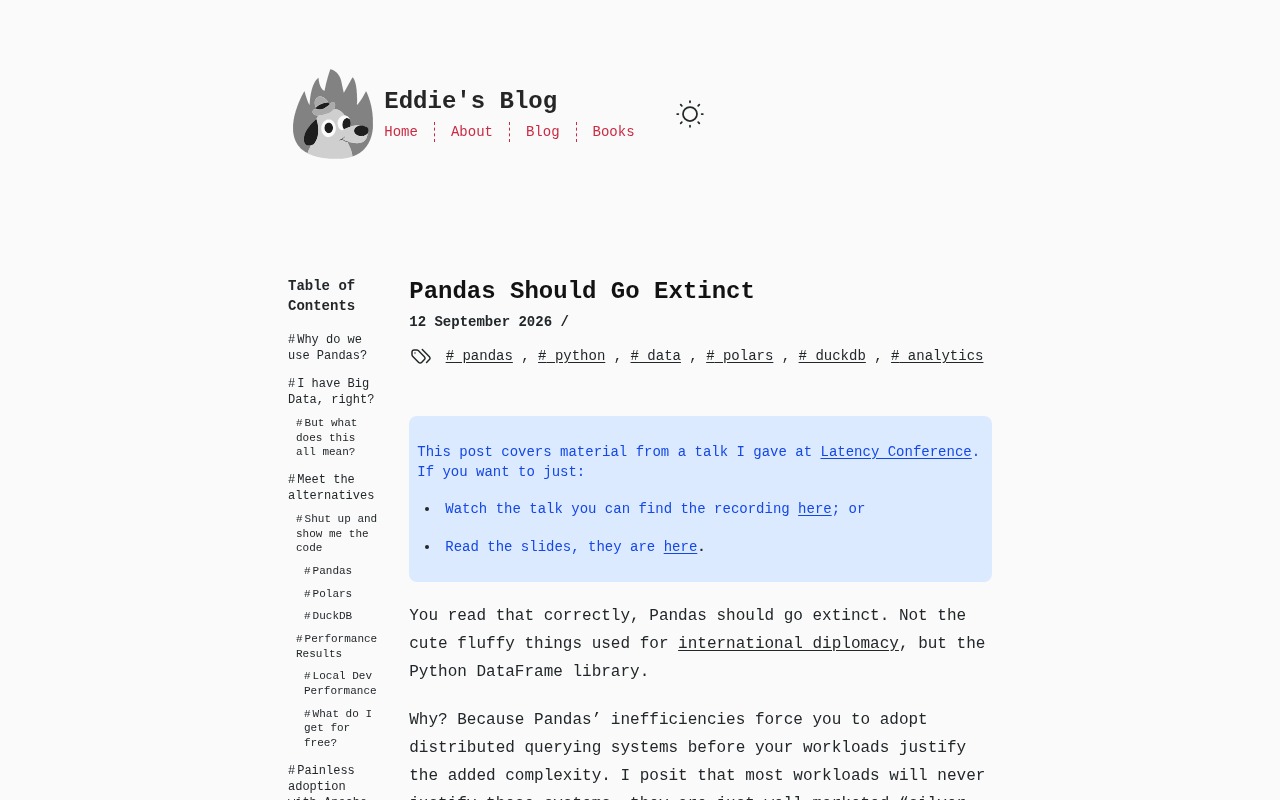
A viral post arguing Pandas should die sparks debate on Polars, DuckDB, and whether the ecosystem can move on.
A blog post titled 'Pandas Should Go Extinct' sparked major debate on Hacker News, centered on Pandas' single-threaded, memory-bound design struggling to meet modern large-scale data demands. Tools like Polars (Rust-based, multi-threaded, lazy evaluation) and DuckDB (embedded SQL analytics) offer clear advantages in performance and API consistency. Yet Pandas' vast ecosystem — spanning scikit-learn, visualization libraries, and enormous amounts of existing code — creates powerful migration inertia. The community consensus leans toward coexistence rather than replacement: Pandas for exploration and small data, Polars or DuckDB for performance-critical workloads, with Apache Arrow bridging the gap between tools.
In the Python data science ecosystem, Pandas is almost every practitioner's first lesson. It has dominated data processing for over a decade, becoming the default choice in countless tutorials, courses, and production codebases. Yet a blog post titled Pandas Should Go Extinct has sparked heated debate on Hacker News — racking up 181 upvotes and 94 comments. The discussion touches on a long-overlooked question: has our reliance on Pandas reached a point where it deserves serious re-evaluation?
The Core of the Controversy: Why Some Want Pandas Gone
The author isn't dismissing Pandas' historical contributions outright. The argument is that its design can no longer keep pace with modern data workflows. Pandas was born in an era of single-machine, memory-abundant computing, and its API carries the weight of that history — the same operation often has multiple valid syntaxes, the indexing mechanism is complex and opaque, and SettingWithCopyWarning has tripped up nearly every user at some point.
The deeper issues lie in performance and scalability. Pandas is fundamentally single-threaded and memory-resident, struggling badly once data exceeds available RAM. For today's datasets that routinely run into gigabytes or even terabytes, Pandas frequently becomes the bottleneck of the entire analysis pipeline. The author's position: rather than endlessly patching a tool with inherent structural limitations, it's time to embrace modern alternatives built with performance and scale in mind from day one.
The Rise of Modern Alternatives
In recent years, a new generation of data processing libraries has emerged to challenge Pandas' dominance. Polars is the most talked-about — built on Rust, it leverages multi-threaded parallel execution and lazy evaluation, often delivering performance several times faster than Pandas on large datasets, with a more consistent and modern API design.
DuckDB approaches the problem from a different angle, using an embedded SQL analytics engine to process columnar data, allowing users already familiar with SQL to perform analytical tasks with exceptional efficiency. Dask offers distributed computing capabilities, and a suite of tools built around the Apache Arrow standard aims to unify in-memory columnar data formats, reducing the cost of data conversion between different tools.
What these tools share is a common philosophy: they no longer treat "fits in single-machine memory" as a design constraint. Instead, they rethink data processing abstractions from the ground up — prioritizing scalability, type safety, and execution efficiency.
The Community Divide: Inertia vs. Migration Cost
Among the 94 comments on Hacker News, opinions split sharply into two camps. Those in favor of migrating argue that tools like Polars genuinely offer a better experience and are worth the learning investment — especially for new projects, which should consider them first.
Those opposed or skeptical emphasize real-world constraints. Pandas has an enormous ecosystem: from scikit-learn to virtually every Python visualization library, almost all Python data tools accept Pandas DataFrames as their default input/output format. This network effect means that even if Pandas itself has numerous shortcomings, the entire ecosystem built around it cannot realistically be replaced in the short term. On top of that, the sheer volume of existing code, tutorials, and practitioners' muscle memory creates massive migration inertia.
A third, middle-ground perspective argues that "extinction" is far too dramatic a framing. The more realistic path is coexistence: use Pandas for quick exploration and small-scale data processing, use Polars or DuckDB for performance-sensitive large-scale tasks, and flow data between them seamlessly via the Arrow format.
What This Debate Actually Means
The headline is provocative, but "Pandas should go extinct" reflects a healthy signal: data science tooling is maturing and diversifying. When any single tool dominates a domain for too long, it can stifle innovation. Pandas was a massive leap forward in its time — it liberated data processing from tedious native Python loops, and that contribution is undeniable.
But technological progress shouldn't stop there. For practitioners, the real takeaway isn't to blindly chase the newest thing, nor to cling stubbornly to the familiar. It's about understanding the appropriate boundaries of each tool — data scale, team skill set, ecosystem dependencies, and performance requirements all factor into the optimal choice. When a project has hard performance requirements, trying Polars or DuckDB might deliver a pleasant surprise. In teaching, prototyping, and lightweight analysis scenarios, Pandas' maturity and ubiquity remain advantages that are hard to match.
Rather than debating who should "go extinct," it's more productive to focus on choosing the right tool for the specific task at hand. Tool transitions are a natural part of technological progress — and the fact that Pandas has sparked this conversation is itself a sign that this field remains very much alive.
Related articles
One Year of Dioxus Fullstack in Production: Gains and Pain Points
A developer shares a year of real-world experience running the Dioxus fullstack framework in production, covering type-safety gains in fullstack Rust, plus pain points like compile times and ecosystem maturity, as a reference for technology selection.

The Hidden Faith of AGI Leaders: Humans Are Nothing Special?
Vergecast podcast reveals the hidden belief within AGI leadership circles: humans are nothing special, consciousness is just computation. Exploring how computational functionalism shapes the worldview of tech elites and the future of AI.
GM Shifts Toward Hybrids: From an All-Electric Bet to a Pragmatic Parallel Strategy
GM once skipped hybrids to bet on pure EVs; now it plans hybrid SUV versions. This article analyzes the strategic shift, its significance for SUVs, and consumer impact.