Is Multi-Agent Debate Actually Effective? Small-Model Experiments Reveal It's Just Ensemble Sampling

Large-scale experiments show multi-agent debate gains are just ensemble sampling, not cognitive diversity.
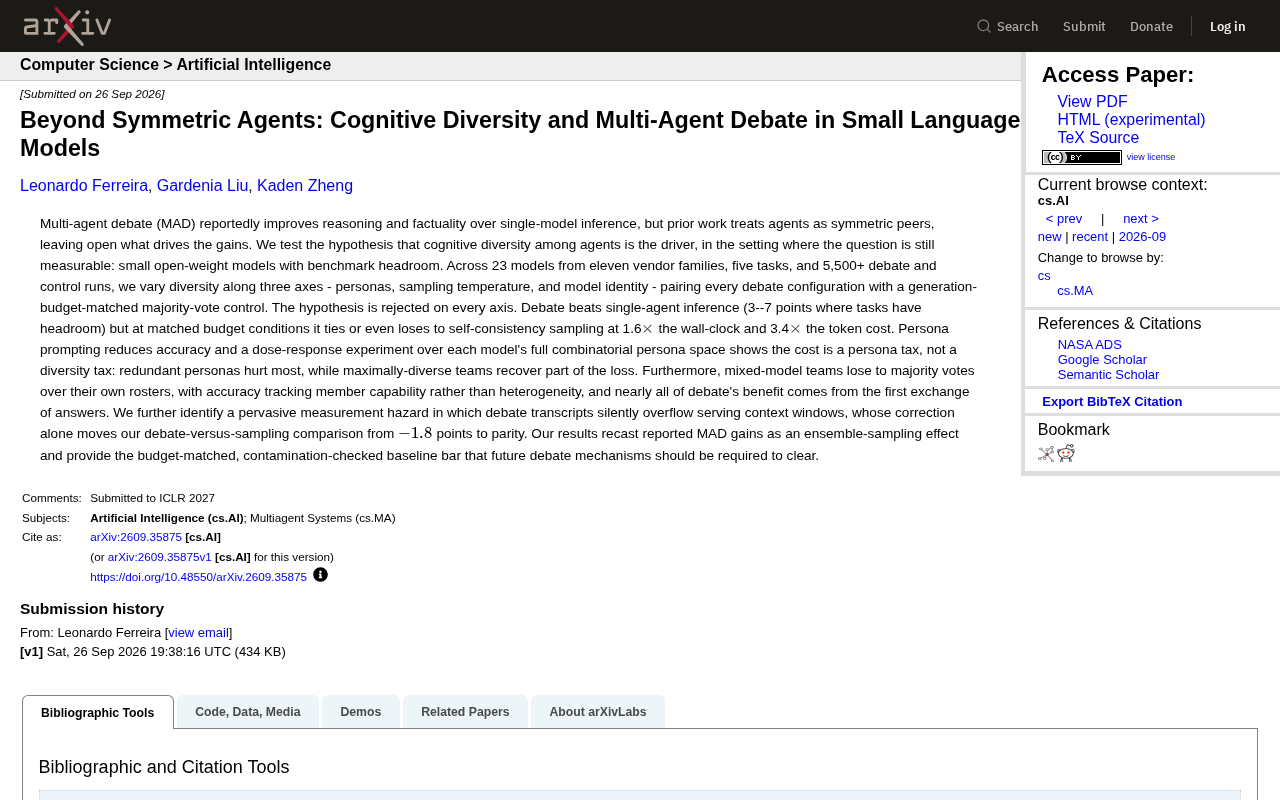
A new arXiv paper systematically deconstructs the source of multi-agent debate (MAD) gains through experiments spanning 23 models, 5 tasks, and over 5,500 runs. By introducing diversity across personas, sampling temperature, and model identity — with generation budget-matched majority-vote controls — researchers found debate fails to outperform self-consistency sampling at equal compute, while costing 1.6× the time and 3.4× the tokens. Persona prompting hurts accuracy via a "persona tax," mixed-model teams lose to simple majority voting, and nearly all gains come from the first round of answer exchange. The paper also flags context window overflow as a hidden measurement trap and calls for budget-matched, contamination-checked baselines in all future MAD research.
Is Multi-Agent Debate Overrated?
Multi-Agent Debate (MAD) has been widely regarded as an effective approach to improving large language model reasoning and factual accuracy. The core idea is intuitive: have multiple model instances challenge and debate each other like peer experts, ultimately arriving at more reliable answers than a single model could produce. However, a recent arXiv paper raises sharp questions about this widely accepted assumption.
The researchers point out that prior work has largely treated participating agents as symmetric peers, without truly answering a critical question: where do the gains from debate actually come from? Do they stem from cognitive diversity among agents, or simply from the fact that more compute budget is being spent?
Large-Scale Experimental Design: Decomposing Cognitive Diversity into Three Dimensions
To test these hypotheses in a measurable setting, the authors chose small open-weight models with room for improvement on benchmarks as their experimental subjects — these models haven't yet saturated on the test tasks, so any improvements can be clearly observed.
The experimental scale is substantial:
- 23 models spanning 11 vendor families
- 5 tasks
- Over 5,500 debate and control experiments
The researchers systematically introduced diversity along three dimensions: personas, sampling temperature, and model identity. Crucially, each debate configuration was paired with a generation budget-matched majority-vote control group, ensuring that comparisons were made under equivalent compute — not simply trading money for performance.
Generation budget matching is the core methodological control in this study. In multi-agent debate, N models interacting over R rounds generate far more tokens than a single inference pass. Directly comparing against a single inference would mean any improvement could simply reflect more compute being spent. The budget-matching approach tallies the total tokens consumed across an entire debate configuration, then uses that same token budget to have a single model perform multiple independent samples followed by majority voting. This design decouples "whether the collaborative mechanism itself works" from "whether more compute helps" — a necessary condition for determining whether the multi-agent paradigm has independent value.
Core Finding: The Cognitive Diversity Hypothesis Is Comprehensively Rejected
The conclusions are striking — across all three dimensions, the hypothesis that cognitive diversity drives gains was rejected across the board.
Debate does outperform single-agent reasoning, delivering 3 to 7 percentage point improvements on tasks with room to improve. But once budgets are matched, debate performs at best on par with — and often worse than — self-consistency sampling, while costing 1.6× wall-clock time and 3.4× the token budget.
In other words, debate appears effective in isolation, but its cost-effectiveness falls far short of simply sampling multiple times and voting.
Persona Prompting Is a "Persona Tax," Not a Diversity Dividend
One particularly insightful finding in the paper is that assigning different personas to agents actually reduces accuracy. Through dose-response experiments across the full space of persona combinations for each model, the authors demonstrate that this cost is a persona tax, not a diversity tax.
Specifically, redundant and repetitive personas cause the most harm, while well-configured teams that maximize difference can recover some of the loss. This suggests the problem isn't with the idea of having models play different roles per se, but rather that forcing role assignments interferes with models' native reasoning capabilities.
Mixed-Model Teams Lose to Their Own Majority Vote
Another set of experiments is equally illuminating: mixed teams composed of different models lost to directly majority-voting across those same models. Accuracy depended more on the capability of individual members than on the degree of team heterogeneity.
Even more revealing: nearly all of the gains from debate came from the first round of answer exchange. Subsequent debate rounds provided no meaningful improvement — further suggesting that so-called debate gains are fundamentally an ensemble effect, not genuine "clash of ideas."
Self-Consistency Sampling, proposed by Wang et al. (2022), is a reasoning enhancement method that requires no multi-model collaboration: for a given question, sample multiple times at a higher temperature to generate several independent reasoning chains, then select the answer by majority vote. Its core advantage is cost control, low latency, and the need for only a single model instance. Self-consistency sampling has been shown to reliably improve accuracy on tasks like mathematical reasoning and commonsense QA, making it a natural baseline for evaluating whether any multi-agent collaboration scheme is "worth the cost." This paper uses it as exactly that reference point, revealing that the debate framework delivers no additional gains over self-consistency sampling under the same token budget.
A Measurement Trap That's Been Overlooked: Context Window Overflow
Beyond refuting the hypothesis, the paper also identifies a pervasive measurement hazard: conversation history during debates can silently overflow the server-side context window.
This technical detail may seem minor, but it directly affects the credibility of experimental conclusions. The authors found that simply correcting for this overflow shifted the debate-vs-sampling comparison from -1.8 points back to parity. This serves as a reminder to researchers running related experiments: failing to control for context window overflow can produce systematically biased conclusions.
Context window overflow is especially insidious in multi-turn multi-agent scenarios: as debate rounds accumulate, the token count of historical conversation can easily exceed the maximum context length set by the model's serving infrastructure. Different platforms handle this differently — some silently truncate the earliest messages, some truncate from the middle, and some return empty responses. These behaviors typically don't trigger explicit errors, leading researchers to mistakenly believe the model has "read" the full history. When truncation occurs, agents are effectively responding with incomplete information — equivalent to a noisy single inference — which systematically suppresses debate accuracy and artificially inflates the negative gap between debate and sampling. Once the authors corrected for this issue, the previously observed -1.8-point disadvantage disappeared, further underscoring the importance of controlling the experimental environment.
Research Implications: Establishing a Baseline for Future Debate Mechanisms
The greatest contribution of this research lies in reframing how reported MAD gains should be interpreted — attributing them to an ensemble-sampling effect rather than any unique advantage from cognitive diversity.
The authors accordingly propose a clear baseline requirement: any future debate mechanism claiming effectiveness must first clear a budget-matched and contamination-checked baseline threshold. In other words, new methods cannot merely be compared against a single model — they must be compared against self-consistency sampling under equivalent compute, or their true value remains undemonstrated.
For practitioners, this finding has direct cost implications: in budget-constrained settings, rather than building a complex multi-agent debate framework, simply sampling a single model multiple times and voting is both cheaper and faster. For researchers, this paper provides a more rigorous evaluation paradigm that deserves to be incorporated into the standard workflow for future MAD research.
Related articles

Python 3.15 New Feature: Is the sentinel Type Better Than None?
Python 3.15 adds the sentinel type, using named unique sentinel objects to replace None and bare object(), resolving confusion among missing values, explicit emptiness, and invalid input while avoiding type hint failures.

Deep Learning's Three Architectures and the Universal Approximation Theorem: A Complete Guide to MLPs, CNNs, and Transformers
Explaining the inductive bias differences among MLP, CNN, and Transformer, the existence meaning of the Universal Approximation Theorem (UAT), and the role of Taylor expansion in approximation analysis, while clearing up common misconceptions.

GitLab Emergency Patch Release: Analysis of Critical Security Fixes
GitLab releases critical patch 19.5.1, sparking 355 points of discussion on Hacker News. This article analyzes the background, upgrade steps for self-hosted instances, and verification points to help DevOps teams respond quickly to security updates.