Is Perplexity Pro Student Plan Worth $10/Month?

Analyzing whether Perplexity Pro's $10/month student plan delivers enough value given recent usage limits.
This article examines the value proposition of Perplexity Pro's student plan at $10/month, comparing it with ChatGPT Plus and Claude Pro pricing. It explains recent usage limit changes, why AI services impose caps due to high API costs, and provides a framework for students to decide based on their actual research intensity and needs.
The AI Search Tool Value Debate: Should You Subscribe to Perplexity Pro Student Plan?
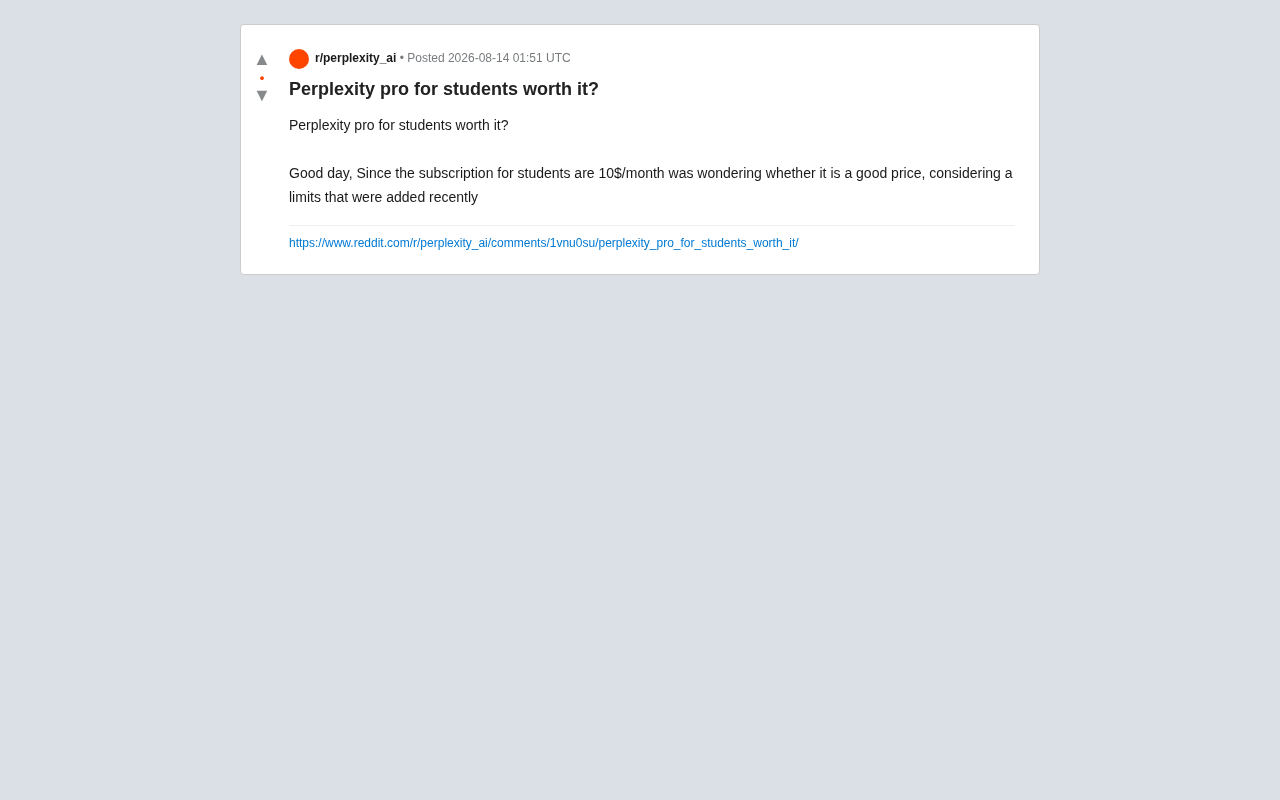
As generative AI search tools become mainstream, Perplexity—a product combining large language models with real-time search capabilities—has gradually become a popular choice among students and researchers. Recently on Reddit, a user raised a highly representative question: Is Perplexity Pro's student plan at $10/month actually worth it, especially considering the platform's recently added usage limits?
Generative AI search tools represent a convergence trend between traditional search engines and large language models. Traditional search engines (like Google) return lists of webpage links based on keyword matching and PageRank algorithms, requiring users to read and filter information themselves. Generative AI search tools, on the other hand, leverage RAG (Retrieval-Augmented Generation) technology—first retrieving relevant information from the internet in real-time, then using large language models to understand, synthesize, and reorganize the results, ultimately presenting structured answers in natural language. This approach dramatically shortens the path from "asking a question" to "getting an answer," making it particularly suited for complex queries that require synthesizing multiple information sources.
Behind this question lies a core contradiction in today's AI subscription services: the balance between feature value and usage limitations. This article provides an in-depth analysis from the perspectives of product positioning, pricing logic, usage limits, and target audience.
What Are Perplexity Pro's Core Features?
Key Upgrades Over the Free Version
Compared to the free version, Perplexity Pro offers enhanced capabilities in several areas:
- Access to more powerful AI models: Pro users can typically choose to use cutting-edge models like GPT-4 and Claude, rather than being limited to default models.
- Pro Search: Capable of multi-step reasoning and deeper information retrieval, ideal for complex academic questions.
- Higher file upload and analysis quotas: Particularly useful for students who need to process papers and PDF documents.
- Additional features like image generation: Meeting certain creative and presentation needs.
Pro Search's multi-step reasoning is essentially an Agent workflow. When a user poses a complex question, the system doesn't perform a single retrieval—instead, it breaks the question into multiple sub-questions and conducts searches and reasoning sequentially. For example, when a student asks "How significant is the threat of quantum computing to existing cryptographic systems," the system might first retrieve current quantum computing progress, then search for affected encryption algorithm types, and finally provide a comprehensive threat assessment. This Chain-of-Thought approach significantly improves the accuracy and depth of answers to complex academic questions, but each step involves model inference and web retrieval, making the computational cost far higher than a single Q&A interaction.
Core Appeal for Students
For students, Perplexity's biggest draw is its ability to provide answers with cited sources, which effectively reduces the time cost of tracing information when writing papers or conducting research. Compared to traditional search engines that require clicking through links one by one, Perplexity's "answer + citation" model genuinely improves efficiency.
It's worth understanding that the academic value of this feature lies in partially solving the "hallucination" problem of large language models—where models generate information that appears plausible but doesn't actually exist. By linking each key claim to a specific web source, users can verify the authenticity of information. However, it's important to note that these citations typically point to web pages rather than peer-reviewed academic databases (such as Web of Science or PubMed). Therefore, in formal academic paper writing, these citations are better used as leads and starting points rather than direct references. Students should view it as an efficient information discovery tool, not a complete academic citation solution.
Understanding Perplexity Pro's Recently Added Usage Limits
What the Limits Look Like
The original poster specifically mentioned "limits that were added recently," which is a key variable in the current subscription decision. Many AI subscription services adjust their usage policies as their user base grows due to cost pressures.
Perplexity's recent adjustments likely involve:
- Daily/monthly caps on Pro Search: Even paid users may face quota limits on advanced search functionality.
- Usage controls on specific model calls: Access to the most advanced models may have thresholds.
- Tighter file processing limits: Affecting the experience of heavy document analysis users.
The introduction of these limits has shattered the expectation of "unlimited use," prompting many users to reassess the actual value of their subscription.
Why Do AI Subscription Services Set Usage Caps?
From an industry perspective, this isn't unique to Perplexity. The API costs for calling top-tier models like GPT-4 and Claude are extremely high, and AI companies generally face the dilemma of "more users, bigger losses." Setting usage caps is essentially a compromise between user experience and business sustainability.
Specifically, API call costs for frontier models like GPT-4 represent the core financial challenge for AI subscription services. Taking GPT-4 as an example, input token pricing is approximately $30 per million tokens, and output tokens cost about $60 per million tokens (prices vary by version and time period). A single complex Pro Search may involve processing thousands to tens of thousands of tokens, and if a user performs dozens of such queries daily, the monthly API cost for a single user could approach or even exceed their subscription fee. This is why virtually all AI services offering frontier model access must set usage caps—it's not simply "restricting user experience" but a necessary measure to keep the business model running. As a middleware service provider, Perplexity bears both model call costs and its own search infrastructure maintenance expenses, making profitability pressure particularly acute.
Therefore, when evaluating value for money, users need to honestly assess whether their actual usage frequency will hit these ceilings.
Pricing Analysis: Perplexity Pro Student Plan at $10/Month
Comparison with ChatGPT Plus and Similar Products
Looking at horizontal comparisons, the $10/month student price falls within a reasonable range for AI subscription services:
| Product | Monthly Fee | Student Discount |
|---|---|---|
| Perplexity Pro | ~$20 | Student plan $10 |
| ChatGPT Plus | $20 | Typically no student discount |
| Claude Pro | ~$20 | Typically no student discount |
The current AI subscription market has formed a multi-layered competitive landscape. ChatGPT Plus focuses on general conversation and code generation capabilities, boasting the largest user base and richest plugin ecosystem; Claude Pro is known for long-text processing ability and safety, capable of handling over 100,000 tokens in a single session; Google Gemini Advanced leverages Google's search ecosystem with natural advantages in factual queries; while Perplexity focuses on the "AI search" niche, emphasizing real-time results and citation transparency. For student users, the key decision factor isn't which product is "best," but which product's core capabilities best match their primary use case—if it's paper writing and literature research, Perplexity's search-oriented design does offer a differentiated advantage.
From a pure pricing perspective, getting multi-model access plus professional search capabilities for $10 offers defensible value for money for students who frequently need to research and write reports.
The Key Is Whether Usage Intensity Matches
Whether a subscription is worthwhile ultimately depends on individual use cases:
Situations where subscribing to Perplexity Pro makes sense:
- Frequently conducting academic research and literature reviews
- Needing credible answers with cited sources
- Regularly processing PDFs, papers, and other documents
- Having genuine needs for multi-step reasoning search
Situations where it may not be worth subscribing:
- Low usage frequency where free tier quotas are sufficient
- Primary needs are simple Q&A that regular search engines can handle
- Already subscribing to ChatGPT Plus or other services with overlapping features
Subscription Decision Advice: How to Make a Rational Judgment
Try the Free Version First
For students who are on the fence, the most rational approach is to fully utilize the free version first and observe whether you frequently encounter feature limitations. If your free quota is regularly exhausted and you have clear needs for Pro Search and advanced models, then the $10/month investment is justified.
Additionally, Perplexity occasionally offers free trials or discounts through partnerships with educational institutions, so it's worth checking for better deals before subscribing.
Subscribe Monthly and Watch for Policy Changes
It's important to note that AI subscription service policies change frequently. What's "worth it" today could change tomorrow if quotas are tightened. Therefore, committing to long-term plans upfront isn't recommended—subscribing monthly and evaluating dynamically is a safer strategy.
Conclusion: Is Perplexity Pro Student Plan Actually Worth It?
Perplexity Pro's student price of $10 is competitive in itself, but whether it's "worth it" has no universal answer—it depends on each user's actual usage intensity and needs. In an era where AI tools are increasingly common and subscription limits are gradually tightening, the rational approach is: anchor on your actual needs, explore with the free version, then decide whether to pay for premium features.
For truly heavy research-oriented students, this investment is likely well worth it; for light users, the free version may already be sufficient.
Related articles

Chain of Thought Isn't Just for AI: How Humans Can Use CoT to Improve Thinking Quality
Chain of Thought isn't just a prompt trick for large models. Starting from a Hacker News discussion, this article analyzes why CoT works for human thinking too, breaks down actionable ways to transfer it, and highlights the key differences between human CoT and machine CoT.
Cloudflare Teams Up with OpenAI: Closi…
Cloudflare Teams Up with OpenAI: Closing the Loop from Vulnerability Discovery to Defense with AI
Cloudflare uses OpenAI Daybreak to investigate security vulnerabilities and generate reviewable remediation plans, while developers use Codex to boost coding efficiency and quality.

Orca Multi-Agent Orchestration in Practice: A Guide to Parallel Collaboration with Claude and Codex
Orca is Stable AI's free open-source agent workbench supporting 34 agents like Claude Code and Codex in parallel. Learn its Git worktree isolation, multi-model orchestration, and mobile management.