Is Spacetime Made of Something? Six Possible Answers from Quantum Gravity
Spacetime may not be made of smaller parts but emerges from quantum geometry, causal order, or collective phenomena.
The article surveys the main candidate routes in quantum gravity regarding the nature of spacetime: it may have no deeper structure; geometric quantities may be quantized like energy, described by spin network connectivity rather than a grid of small blocks; causal set theory argues causal order is more fundamental than distance, with spacetime emerging from partial order relations among discrete events; spacetime may be a collective phase of many underlying quantum degrees of freedom, like temperature or wetness; dualities in string theory suggest geometry itself may be derivative; and asymptotic safety attempts to keep gravity well-defined at extreme energies without introducing microscopic constituents. All these proposals lack experimental confirmation, and the very question "what is spacetime made of" may presuppose the wrong picture—emergent spacetime is more like a wave than water molecules.
We're used to taking the world apart: a watch yields gears, a cell yields molecules, an atom yields electrons and a nucleus, and the nucleus yields quarks. This "drill down" approach has worked for over a century, almost always finding smaller components. So, what's left if you take apart the space itself in a room?
This is one of the most fundamental questions in quantum gravity. A science channel recently systematically explored this question in a video—from "spacetime has no deeper structure" to "spacetime is an emergent collective phenomenon"—and presented several mathematically serious but experimentally unconfirmed candidate answers. Here's a breakdown of the main routes.
Why Spacetime Isn't Like an Ordinary Thing
First, a thought experiment: evacuate the air, atoms, and photons from a sealed box. The box still has volume, and there's still a measurable distance from one wall to the opposite wall. Empty space is not the same as no space.
General relativity goes further. It doesn't treat spacetime as a passive coordinate grid: spacetime bends, expands, and can carry gravitational waves. Add enough mass, and spacetime curves enough to form a horizon; move mass, and gravitational waves propagate outward, carrying energy away. Gravitational waves are ripples of spacetime itself, and unlike sound waves, they don't need a medium to propagate—it's precisely the "absence of a medium" that forced physics to rethink old notions of space and motion.
The "spacetime is a fabric" metaphor quickly breaks down: a rubber sheet bends in space, but when space itself bends, there's no larger room for it to bend into.
Candidate 1: Spacetime Is Fundamental, with No Deeper Layer
The simplest possibility: there is no deeper layer. Physics expects hidden structure because this strategy has repeatedly worked—water is molecules, atoms have nuclei, nuclei contain protons and neutrons. But decomposition doesn't have to be infinite. The electron, so far, has no observable internal structure; the Standard Model treats it as a fundamental particle. "What is an electron made of" may be a question with no answer.
Spacetime might be similar. General relativity describes spacetime with geometry; matter and energy affect the geometry, and the geometry determines how matter moves. This description doesn't require microscopic geometric building blocks underneath.
But physicists have good reasons not to stop there: quantum mechanics is never absent at sufficiently deep levels. The electromagnetic field is quantum, matter fields are quantum, and the other fundamental interactions are quantum—gravity is the awkward exception. In the very early universe or near black holes, gravity and quantum effects should both dominate, and general relativity predicts singularities in these situations—the theory breaks down, some quantities diverge, essentially a "warranty void" for the mathematical model. This usually means the theory has been pushed beyond its domain of validity.
The Standard Model is the quantum field theory framework describing the strong, weak, and electromagnetic interactions and all known fundamental particles; it treats quarks, leptons, and other particles as point-like fundamental particles with no internal structure. It does not include gravity, so the absence of a quantum description of gravity is precisely the problem quantum gravity research aims to solve. The Standard Model is extraordinarily successful experimentally for the electromagnetic, weak, and strong forces, but it cannot describe gravity, which gives physicists reason to suspect that gravity also requires a similar quantum treatment rather than remaining a classical geometric description.
Candidate 2: Geometry Itself Is Quantized
The most literal guess is that geometry comes in discrete pieces. When people hear "discrete spacetime," they often picture a 3D grid, like a chessboard or blocks in Minecraft. But serious theories don't use this picture.
Loop quantum gravity predicts that geometric quantities like area and volume have discrete spectra—similar to how bound electrons in an atom can only take specific energy values, geometric quantities cannot take continuous values. It describes this quantum geometry using spin networks: what matters is not where the nodes are, but which nodes are connected and how the connections are arranged. Area and volume emerge from the network's connectivity structure, not from the arrangement of small blocks. Crucially, this network does not float in some deeper space—the network is the deeper structure, and ordinary space is just how it appears on macroscopic scales.
This avoids pushing the question down a level: if space is made of tiny adjacent blocks, what does "adjacent" mean? Before space exists, what tells a block which block is next to it? Position itself must arise from something that doesn't presuppose position.
The Planck length is often misrepresented as the "smallest possible length," which is inaccurate. It is a scale constructed from fundamental constants; quantum gravity effects are expected to become important at this scale, strongly suggesting that our everyday description of smooth spacetime breaks down at extremely small scales. The ratio of a Planck length to an atom is roughly the ratio of an atom to the solar system. No one has actually "zoomed in and seen pixels," nor has any ruler refused to measure shorter distances.
The Planck scale is constructed from three fundamental constants: the gravitational constant G, the reduced Planck constant ℏ, and the speed of light c. The Planck length is about 1.6×10⁻³⁵ meters, and the Planck time is about 5.4×10⁻⁴⁴ seconds. At this scale, quantum effects of gravity are expected to be comparable to quantum fluctuations of spacetime geometry itself, and the smooth spacetime picture of general relativity no longer applies. It's important to emphasize that the Planck length is not a proven minimum length but a theoretical estimate of the characteristic scale where quantum gravity effects become important; any claim that "space is discretized into Planck-sized cells" goes beyond the reliable predictions of current theories.
Candidate 3: Relations Before Distances
Causal set theory goes further: it treats causal order as the fundamental ingredient, with position and distance emerging later.
Imagine a sequence of historical events: Rome precedes the steam locomotive, which precedes the Moon landing. You don't need to know how far apart they are geographically to order them. Stronger still: ask which events could possibly influence which other events. Rome, the train, and the Apollo mission all lie in our causal past and can influence the present; but a supernova thousands of light-years away that exploded before Rome—its light may not have reached Earth yet, so it has no causal connection to us now. Relativity partitions events precisely by this kind of causal relation, and a substantial part of spacetime structure is encoded in this causal pattern.

Causal set theory starts from very little: a set of events, plus a rule specifying which events can influence which. Influence is one-way—Rome shaped the world in which railways were invented, but the invention of railways cannot retroactively influence Rome. Accumulate enough one-way relations, and something like spacetime may emerge. Roughly speaking, causal order tells you the shape of spacetime, and event counting tells you its scale.
This also conveniently solves a grid problem: a fixed grid singles out special directions and special states of motion, whereas relativity has insisted for over a century that nature has no invisible coordinate paper marking "absolute rest."
In causal set theory, "causal order" is a partial order relation: it satisfies reflexivity, antisymmetry, and transitivity, but does not require any two events to be comparable. If two events have no causal connection, they are incomparable in the partial order. This structure corresponds directly to the causal structure of Minkowski spacetime. The core assumption of causal set theory is that a set of discrete events and their partial order relation are sufficient to encode the geometric information of continuous spacetime; the dimension, distance, and volume of spacetime should all be approximately recoverable from this discrete causal structure. The main challenges facing the theory include how to recover smooth Lorentzian geometry from a discrete causal set, and how to explain why the approximation of continuous spacetime is so accurate on macroscopic scales.
Candidate 4: Spacetime Is an Emergent State of Matter
Water molecules themselves are not wet, and temperature does not exist inside any individual molecule—temperature is a collective description of the statistical behavior of many particles. Spacetime might be similar: individual underlying degrees of freedom look nothing like space, but when there are enough of them and interactions are sufficiently rich, the collective state acquires properties like distance, volume, and even dimension.
Group field theory is a representative of this route. In some of its models, the underlying quantum components do not individually possess spatiality, but when many components act together, space emerges as a macroscopic property; there even exists a "spaceless vacuum" ground state—ordinary space is something that needs to emerge, not a default background. This is like water cooling and freezing, or heating and vaporizing: the H2O molecules remain the same, but the collective behavior changes dramatically; spacetime may correspond to a particular phase of some deeper quantum system.
If so, asking "what is spacetime made of" is like asking "what is temperature made of"—you won't find temperature particles hidden between molecules.
Candidate 5: String Theory—Geometry May Be Derivative
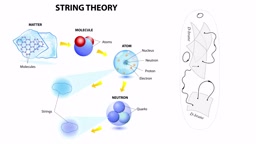
String theory replaces point-like fundamental particles with extended strings; different vibrational modes appear as different particles, like the same guitar string playing different notes. One mode corresponds to the graviton, which is a key reason string theory is closely tied to quantum gravity.
But the statement "spacetime is woven from strings" is too simplistic. Some of string theory's most interesting developments actually suggest that spacetime geometry itself can be derivative: in certain dual descriptions, physics that looks like gravity and geometry in one formulation can be represented in a completely different way in another. Given that string theory is famous for introducing extra spatial dimensions, this conclusion is somewhat ironic—geometry may not be the fundamental layer.
The connection between information and spacetime (entanglement, holography, black hole entropy) is another important clue; the video indicates a separate episode will discuss this, so we won't elaborate here.
Duality in string theory, most famously the AdS/CFT correspondence, refers to two seemingly completely different physical theories being mathematically equivalent: on one side, string theory in a higher-dimensional anti-de Sitter space that includes gravity; on the other, a lower-dimensional conformal field theory without gravity. This duality suggests that the spatial geometry in one theory may be completely equivalent to non-geometric quantum field theory data in another, so geometry may be derivative rather than fundamental. The holographic principle further states that all physical information within a region of space can be encoded on its boundary; black hole entropy being proportional to horizon area rather than volume is a key clue to this idea. These results suggest a deep connection between spacetime geometry and quantum entanglement, but extending this to our approximately de Sitter universe remains an unsolved problem.
Candidate 6: Maybe There Are No "Spacetime Atoms" at All
Quantum gravity does not automatically mean spacetime is composed of smaller parts. The asymptotic safety scenario asks a different question: does gravity change character at extremely high energies, entering a stable quantum fixed point that keeps the theory usable, without replacing smooth spacetime with atoms, networks, or causal chains?
This route is not friendly to popular science animations—there are no visible microscopic bricks to draw. But nature is under no obligation to provide good teaching illustrations for humans.
The Zoo and the Testing Challenge
Once spacetime is allowed to be emergent, the candidate list expands rapidly: causal dynamical triangulations (CDT) assemble possible spacetimes from discrete geometric building blocks; research shows that continuous smooth geometry can emerge from simple discrete ingredients—but those building blocks are mathematical constructs, and no one has found microscopic tetrahedra under the carpet; noncommutative geometry explores algebraic structures where coordinate-like quantities no longer commute, and the deepest description may look more like algebra than a landscape; there are also spin foams, matrix models, tensor models, and Wheeler's "spacetime foam" picture—from afar the sea surface looks smooth, but up close you find waves, bubbles, and molecular thermal motion.
These proposals differ in persuasiveness, maturity, and testability. More troublesome is testing: the scales where quantum gravity effects are significant are far beyond what ordinary experiments can directly resolve. But direct observation is not physics' only tool—we have never sent a probe into the Sun's core, yet we can infer its interior from surface oscillations, neutrinos, and more. The early universe and black holes are the main "hunting grounds": black hole entropy being proportional to horizon area directly links microscopic states, information, and geometry—a strong hint in itself. Gravitational wave observations allow us to directly test whether spacetime's own ripples strictly match general relativity's predictions.
There's also a conceptual reminder: mathematical elegance is not data. No proposal currently has the experimental confirmation of general relativity or the Standard Model.
Maybe the Question Itself Is Wrong
Back to the original question: what is spacetime made of? You could answer quantum geometry, causal relations, strings, quantum condensates, discrete geometry, noncommutative structures, information—or nothing. But all these answers share the same grammatical flaw: saying a chair is made of wood means smaller objects arranged in space; but when asking what space itself is made of, we cannot assume this picture still holds.
The underlying stuff may have no position, no distance, not even time in the ordinary sense. Position, distance, and time may only appear when the underlying structure is large enough and ordered enough. Like ocean waves: a wave can span thousands of kilometers and have enough energy to batter coastlines, but the wave near Hawaii and the wave near Japan are not the same water molecules—a wave is a pattern passing through water, not another substance floating on it.
If spacetime emerges in a similar way, then "what is spacetime made of" is closer to "what is a wave made of": there is indeed physics underneath, but the thing you're naming is a pattern, not a small object. The answer may still exist, just not at all like what everyday language trains us to expect.
There's also an unresolved connection: space is expanding, and dark energy seems to be accelerating that expansion. If dark energy is like a cosmological constant—a property of empty space—then as the universe grows, the space possessing this property continually increases. Whether this means, at the deepest level, that new components of spacetime are constantly appearing, or that the whole picture is wrong, currently has no answer.
Figuring out what spacetime is may answer a stranger question than "what is in the universe": what does it even mean for anything to be "somewhere"?
Related articles

How the Grok Team Hits 11,000 PRs a Month: Replacing Manual Review with Deterministic Constraints
Inside the Grok team's formula for 11,000 monthly PRs at a 0.5% rollback rate: Lint rules, type systems, and formal verification as deterministic constraints.

After GTA 6, Where Does the Game Industry Go?
The Vergecast talks with Game File's Stephen Totilo about GTA 6's impact on gaming: billion-dollar budgets, console market struggles, cloud gaming tests, and the future of microtransactions—and whether it marks the end of an era.

How Muscle Cars Reshaped America: From Prohibition to National Treasure
From Prohibition moonshiners' modified cars to the birth of the Rocket 88, GTO, and Mustang, and the end of the golden age by emissions rules and oil crises—how muscle cars became an American symbol of freedom and rebellion.