is.team: AI Agents That Join Your Project Board as Real Teammates

is.team embeds AI agents into an infinite canvas project board as genuine collaborating teammates via MCP.
is.team is a collaboration tool that merges infinite canvas, task management, and AI agents — currently at 73 upvotes on Product Hunt. Its core differentiator: via the MCP (Model Context Protocol), AI agents join the board as real team members that proactively create tasks, join discussions, and drive projects forward. It also includes voice rooms, real-time collaboration, and GitHub/Slack/Calendar integrations. Pricing is a flat $16/month for up to 15 users, free to start with no credit card required — clearly targeting startups and small teams. As an early product, real-world AI agent performance and canvas usability at scale remain to be seen.
In an era where collaboration tools are increasingly alike, a key question has emerged: how do you make AI a genuine part of everyday team workflows, rather than just an isolated chat window? A new Product Hunt entry called is.team offers one answer: let AI agents join your project board as actual teammates — creating tasks, joining conversations, and moving work forward alongside human team members.
The product has earned 73 upvotes and 21 comments on Product Hunt, ranking 16th, and is categorized under Productivity, Task Management, and Artificial Intelligence.
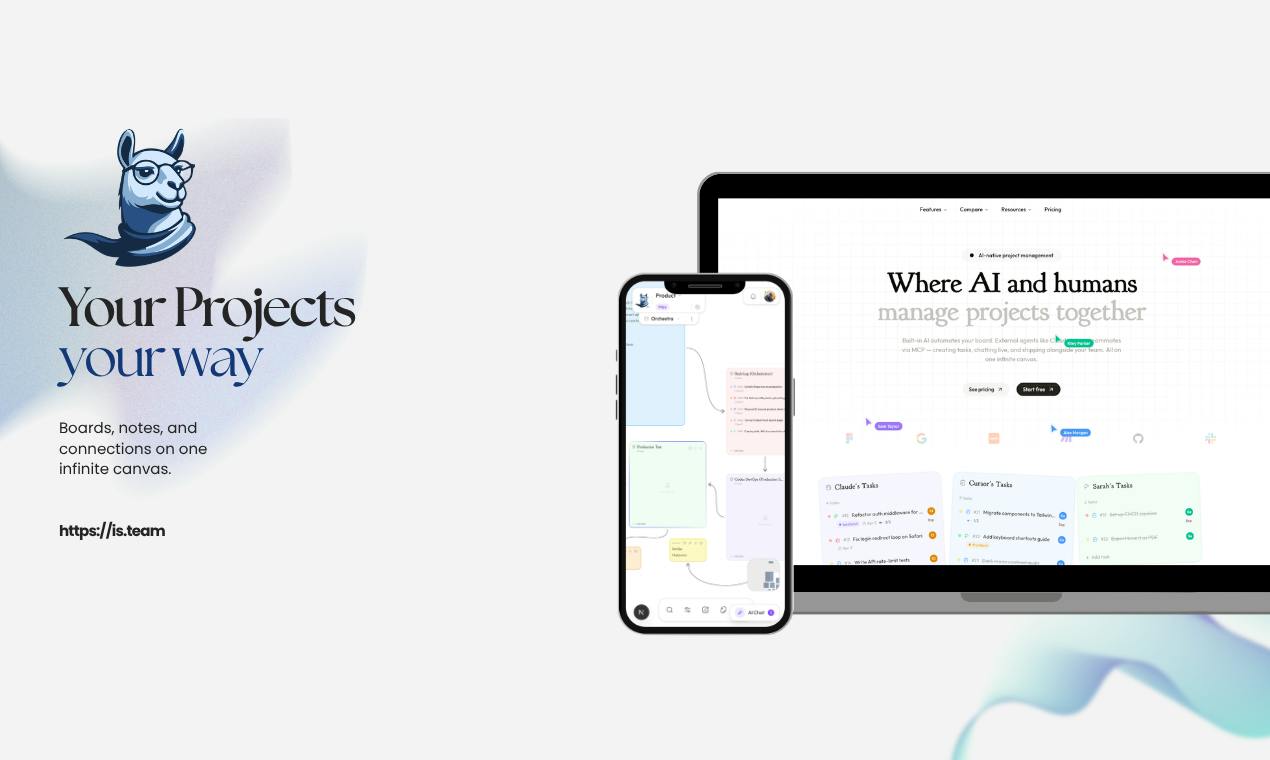
Spatial Collaboration on an Infinite Canvas
At its core, is.team is built around an infinite canvas — a spatial workspace where teams can drag kanban boards and notes, making planning, building, and delivery all visually tangible.
This design philosophy has been gaining momentum in recent years. From Miro and FigJam to countless whiteboard tools, free-form spatial layouts are increasingly replacing rigid linear lists. The key advantage is breaking free from fixed structures: teams can organize information the way they actually think — grouping related task cards together, annotating with contextual notes, and holding both the big picture and the fine details in the same view.
is.team combines this spatial collaboration with task management, aiming to bridge the gap between "planning" and "execution" — no more context-switching between two entirely different tools.
Background: The Infinite Canvas Paradigm
The infinite canvas as an interaction model was popularized first in creative and design tools — think Miro (online whiteboard collaboration), Muse (iPad note-taking), and game engine editors. The core idea is to eliminate the scrolling boundaries of a two-dimensional plane, letting users extend content in any direction and zoom freely between a bird's-eye view and focused detail.
Bringing this paradigm into task management is relatively new. Traditional project management tools (like Jira and Asana) rely on lists and swimlanes; Linear is known for its streamlined lists; and Notion's nested pages follow a tree-like hierarchy. The challenge with infinite canvases is that as projects scale, free-form layouts can lead to "information entropy" — team members struggle to locate what they need quickly, and maintaining an organized canvas becomes a cognitive burden in itself. Whether is.team can strike the right balance between freedom and usability will be a key factor in its retention among larger teams.
AI Agents as "Real Teammates"
The product's biggest differentiator lies in how it positions AI agents. Rather than tucking AI into a sidebar like many tools do, is.team connects AI agents through the MCP (Model Context Protocol), letting them participate as genuine team members.
Specifically, these AI agents can:
- Create tasks: Proactively generate to-do items on the board
- Join conversations: Participate in team discussions rather than waiting passively for commands
- Deliver work: Advance projects side by side with human teammates
This shift toward "AI as teammate" is worth paying attention to. It means AI is no longer an external tool requiring constant context-switching and copy-pasting — it's an ongoing participant embedded directly in the collaboration workflow. The adoption of MCP also signals a move toward standardized AI integration, theoretically enabling connections with different models and agents.
That said, whether AI agents can truly live up to the "teammate" label depends on their autonomy, reliability, and depth of understanding of project context — something only real-world use can validate.
Background: What is MCP (Model Context Protocol)?
MCP is an open protocol proposed and open-sourced by Anthropic in late 2024, designed to address the fragmented integration of AI models with external tools and data sources. Its core idea is to define a universal "socket" standard for AI agents: any tool or service that supports MCP can be called directly by a compatible model, without requiring custom adapters for each one.
Think of MCP for AI integration the way USB is for peripheral connections — a standardized interface that dramatically reduces interoperability costs. For is.team, adopting MCP means the platform can theoretically connect with any MCP-compatible AI model (such as Claude, GPT series, etc.) without being locked into a single vendor. It also means AI agents can read and write board data, create tasks, and send messages in a structured way — rather than just generating text for humans to copy and paste.
The MCP ecosystem is expanding rapidly. Tools like Cursor and Replit have already adopted it, and is.team's embrace of the protocol reflects its growing foothold in the productivity tool space.
Built-In Collaboration and Third-Party Integrations
Beyond the core canvas and AI capabilities, is.team offers a full suite of collaboration infrastructure:
- Voice rooms: Built-in real-time voice communication
- Real-time collaboration: Simultaneous multi-user editing
- Third-party integrations: GitHub, Slack, and Calendar
For development teams, GitHub integration means code-related tasks can stay in sync with the board; Slack integration preserves existing communication habits; and Calendar integration helps align tasks with scheduling. These integrations lower the barrier to adoption, making it easier for is.team to slot into an existing toolchain rather than demanding a full teardown and rebuild.
Pricing: $16/Month Flat for Up to 15 People
is.team has adopted an attractive pricing strategy: a flat $16 per month for up to 15 users, with a free tier that requires no credit card.
Breaking it down, that's roughly $1 per person per month for a 15-person team — highly competitive against comparable collaboration tools, where per-seat pricing at that team size often runs several times higher. This "flat rate, small team" model is clearly aimed at startups and small workgroups, using a low barrier to entry to drive early user growth.
The free-to-start approach also reduces the cost of experimentation, letting teams validate the value of AI teammates on real projects before committing to a paid plan.
Promising, but Still Unproven
is.team brings together spatial canvas, task management, and the concept of "AI teammates" into a single package — a direction that aligns well with the broader trend of AI-native collaboration tools. Its differentiation isn't about any single feature, but about repositioning AI from a supporting tool to an active collaborator.
That said, as an early-stage product, the challenges are real: Can the AI agents actually deliver on the promise of being a "teammate"? How usable is the infinite canvas when projects get complex? And how does it compete against established tools like Notion and Linear? For teams willing to experiment, the free tier and low-cost paid plan offer a low-risk way to find out.
Related articles

Databricks Genie: The AI Analytics Assistant That Tripled a Marketing Team's Data Usage
Databricks' AI analytics assistant Genie tripled marketing team data usage. Discover how this conversational NL2SQL tool lowers the data access barrier and what it means for enterprise AI adoption.

How The Oregon Trail Became a Cultural Icon for Generations
How The Oregon Trail grew from educational software into a multigenerational cultural icon — through classrooms, "You have died of dysentery," and shared childhood memories.

Health Benefits Platform Thatch Hits $1B Valuation as Healthcare Costs Surge
Thatch raises $108M and hits a $1B valuation, backed by a16z, Index Ventures, and General Catalyst, as surging U.S. healthcare costs drive demand for flexible benefits platforms.