Is the AI Black Box Actually Transparent? Interpretability Research Upends Conventional Wisdom

Neural networks aren't black boxes; polysemanticity may be an illusion from visualization tools and architectural flaws.
Based on Nick Camerota's research "Neural Networks Are Already Clean," this article challenges the AI community's long-held "black box" and "polysemanticity" assumptions. Seemingly mixed neurons in early vision models were actually artifacts of visualization tools' optimization algorithms—Inception V1's 4E.55 is really a V-shape detector. Camerota proposes "recursive generalization" to explain how neurons expand their response range along semantic proximity, and bottleneck experiments show that when space is constrained, models choose coarser generalization rather than chaotic superposition. The article also reveals how the SwiGLU double-negative flaw fabricates polysemanticity, advocates shifting from enumerative to exploratory interpretability, and concludes that if model internals are highly readable, alignment risk lies not in hidden intentions but in whether we learn to read its geometric map.
Title
Is the AI Black Box Actually Transparent? Interpretability Research Upends Conventional Wisdom
Meta Description
Goodfire's new research "Neural Networks Are Already Clean" challenges the AI black box myth: polysemanticity may be an illusion caused by visualization tools and the SwiGLU double-negative flaw. Neural networks self-organize through recursive generalization and are inherently clean and readable. This article provides an in-depth interpretation of its implications for AI interpretability and alignment.
Article Content
For years, AI has been portrayed as an impenetrable black box—even its creators can't explain how it works internally. But a study from Goodfire by author Nick Camerota, titled Neural Networks Are Already Clean, proposes a颠覆性 hypothesis: neural networks are inherently clean; the chaos we see may simply be smudges on our observational tools.
Based on an in-depth解读 from a YouTube tech channel and cross-validated with multiple sources, this article outlines how the research dismantles the "black box myth" and explores its profound implications for AI interpretability and alignment research.
The Origin of the Black Box Myth: Polysemanticity and Superposition Theory
The AI research community has long believed in a phenomenon called "polysemanticity": a single neuron handles multiple unrelated tasks simultaneously. To explain this bizarre behavior, researchers proposed "superposition" theory—networks have many parameters, but concepts are even more numerous. When space is insufficient, the model acts like a cluttered drawer, compressing unrelated concepts into the same neuron.
The "smoking gun" for this theory came from neuron 4E.55 in the early vision model Inception V1. Visualization tools showed it responding strongly to cat faces and car fronts, appearing to be a classic "cat-car hybrid neuron."
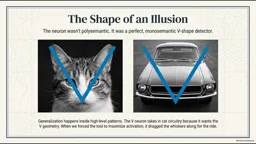
But after re-examining the architecture, Camerota found that this neuron is actually just a V-shape detector: cat whiskers, car chrome hoods, fox faces, and the water jets from fireboats all form V shapes, while circular objects suppress its activation. The so-called "cat-car hybrid" was an artifact of the visualization tool taking shortcuts when generating images with optimization algorithms—the training data contained abundant cat and dog photos, so the tool used animal faces to maximize activation of the V-shape pathway. The chaos isn't in the network; it's in the tool.
Polysemanticity refers to the phenomenon where a single neuron responds to multiple semantically unrelated inputs. In deep neural networks, researchers have found through feature visualization that many neurons are not sensitive to just one type of concept, but are simultaneously activated by cat faces, cars, text, and other stimuli—viewed as evidence of "entanglement" in the network's internal representations.
Superposition is a theoretical explanation: models have limited parameter dimensions, while the number of concepts to represent far exceeds the dimensions. Thus the network compresses multiple concepts onto the same set of neurons, coexisting in an approximately orthogonal manner. The theory predicts that when sparsity is high enough, the network will actively choose superposition to save capacity. This framework has long dominated interpretability research's interpretation of "neuronal chaos."
Recursive Generalization: The True Learning Mechanism of Neural Networks
If neurons aren't randomly stuffing concepts, how do we explain neurons that seem to cover a vast number of concepts? Camerota proposes "recursive generalization": during training, neurons branch out like tree limbs, extending outward based on relationships rather than sitting in isolated rigid boxes.
The paper tracked a language model neuron: early on it only detected the letter combination "IY," then generalized to "Miyazaki," then to "DIY," and finally activated strongly for the complete phrase "do it yourself"—even though "IY" no longer appears. Similarly, a planetary geology neuron activates for both lunar crust and Martian crust, as well as for the JavaScript library Cesium JS. On the surface it looks like a junk drawer, but tracing the vector space: Cesium is a chemical element, chemical elements relate to geology, and geology is the basis of planetary crust. The model is wandering between semantically neighboring nodes, not mixing randomly.
Recursive generalization describes the phenomenon where a neuron gradually expands its response range along semantic relationship chains during training. It differs from simple pattern matching: a neuron first becomes sensitive to a local feature (such as the letter combination "IY"), then generalizes through shared relational structures to longer phrases containing that feature, and ultimately responds to semantically equivalent full expressions. This process resembles a random walk on a graph, where each step extends outward based on established neighboring relationships, so the apparent "multi-concept response" is actually the endpoint of a traceable semantic path.
Bottleneck Experiment: When Space Is Scarce, Models Choose "Generalization" Over "Chaos"
To verify this mechanism, researchers conducted a bottleneck experiment: a layer in a vision model originally used 480 specialized neurons to detect various curves and angles, which they compressed to just 10 neurons and retrained. According to superposition theory, the model should start mixing concepts haphazardly. But the opposite happened—the neurons simply became coarser, forming broad "curve and loop" detectors.
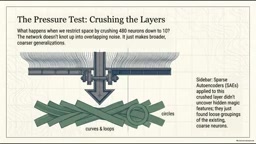
Scale comparisons confirm this: a small model with 92,000 parameters has only a coarse "ground vehicle" neuron in its final layer, mixing cars, golf carts, and trains together; while a large model with 28.6 million parameters has room to distinguish sports cars from station wagons. Same logic, different resolution.
Negative Polarity: Neurons Are Control-Flow Gates, Not Nouns
A key misconception is thinking of neurons as "nouns"—a car detector lights up when it sees a car. But mathematically, a neuron is a control-flow gate, and its identity is equally defined by negative polarity. The commonly used ReLU activation function suppresses negative values to zero, acting as a hard filter.
The paper uses the "Santa Claus puzzle" to illustrate: the prompt describes the morning of December 25th, eaten cookies, an empty milk glass, soot on the carpet, and sleigh bells on the roof. The model correctly answers "Santa Claus," but the most important neuron internally is running strongly negative—by actively excluding concepts that don't fit the clues, it leaves Santa Claus as the residual geometric truth.
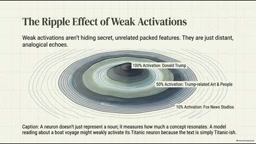
The CLIP model example is equally intuitive: a neuron that strongly activates for photos of Donald Trump has weaker activations that systematically spread to MAGA hats, related figures, and even Fox News studios. This only illustrates that the network organizes concepts by relationships, with no political stance implied.
The SwiGLU Double-Negative Flaw: Fabricated Polysemanticity
If the network is so clean, why have researchers at institutions like Anthropic and OpenAI long believed models are messy? The answer points to a mathematical "glitch" in modern architectures.
The most typical is the SwiGLU double-negative flaw. SwiGLU neurons multiply a "gate" vector and a "value" vector. When the network wants to close the gate (producing a negative value) and the value vector happens to be negative too, multiplying two negatives yields a positive output—creating a false activation signal. Researchers see a neuron that detects both Russian and relates to the Book of Colossians and conclude polysemanticity, when it's actually just a multiplication echo. After fixing this mathematical flaw, the neuron returns to being a clean single-function detector.
SwiGLU is a gated activation unit commonly used in Transformer architectures, computed as (\text{SwiGLU}(x) = \text{Swish}(xW_g) \otimes (xW_v)), i.e., the gate branch and value branch multiplied element-wise. Since both branches can take negative values, when the gate branch outputs a negative value and the value branch is also negative, the product is positive, producing a positive activation that shouldn't occur. This "two negatives make a positive" multiplication echo is misread as a neuron's response to unrelated concepts, fabricating the illusion of polysemanticity. Fixes include imposing a non-negative constraint on the gate branch or switching to a one-sided gating structure, restoring the neuron to a single function.
From Enumeration to Exploration: A Paradigm Shift in Interpretability
Camerota advocates abandoning "enumerative interpretability"—trying to build an exhaustive table for every feature in the network—in favor of "exploratory interpretability": treating the network as a well-organized city, zooming through vector space like Google Maps, following traffic flows rather than counting every brick.
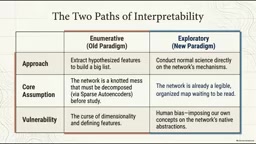
The larger the model, the more specialized and clearer the regions. The danger is that researchers might forcibly carve AI's own map using human categories (cat neurons, car neurons) and declare the city chaotic when they can't find them. AI organizes the world by geometry and vector proximity; we need to learn its language—gradients, vector proximity, negative polarity.
Implications for AI Alignment
The most profound implication of this research: if the model's internal circuits are this readable, deceptive or runaway behavior cannot hide in invisible superposition dimensions. If it were plotting something, it would have to use circuits and would inevitably be exposed on the high-dimensional map. The real risk isn't that AI hides intentions in a black box, but whether we are willing to learn to read the map before it becomes unreadable.
Neural networks are not magic; they are mathematics. They have already organized themselves to be readable enough—we just need to wipe the smudges off the microscope.
One-line Summary
Neural networks are not black boxes; polysemanticity may be an illusion created by observational tools and architectural flaws.
Paragraph Summary
Based on Nick Camerota's research Neural Networks Are Already Clean, the article challenges the AI community's long-held assumptions about "black boxes" and "polysemanticity." The author points out that seemingly mixed neurons in early vision models were actually artifacts of visualization tools' optimization algorithms cheating—for example, Inception V1's 4E.55 is really a V-shape detector. Camerota proposes a "recursive generalization" mechanism to explain how neurons gradually expand their response range along semantic proximity, and through bottleneck experiments demonstrates that when space is constrained, models choose coarser generalization rather than chaotic superposition. The article also reveals how the SwiGLU double-negative flaw fabricates polysemanticity, advocates shifting from enumerative to exploratory interpretability, and concludes that if the model's internals are highly readable, the alignment risk lies not in hidden intentions but in whether we learn to read its geometric map.
Related articles

WorkBuddy Full Guide: How an AI Coworker Takes Over Workplace Automation
What is WorkBuddy? This article analyzes the core capabilities of this full-scenario AI agent: autonomous execution with deliverable results, local file processing, multi-agent parallelism, and workplace automation workflows, helping you judge its essential difference from ordinary AI chat tools.

The Truth About AI Agents: A Hundred Lines of Code + an LLM, Deconstructing the Agent's Underlying Logic
AI agents aren't a new AI species—just a language model plus tools, a loop, and a goal. Here's the underlying logic: how 100 lines of Python hit a 75% fix rate, why the harness beats the model, and Gartner's "agent washing."

AI Agent Deployment: Three Things Developers Should Do
AI Agent deployment doesn't require rushing into multi-agent systems. This article outlines an actionable deployment path and engineering acceptance thresholds for developers, covering human baselines, bounded single-agent scope, and a controlled code-modification loop.