Is the CSS alpha() Function Just Syntactic Sugar? Comparing Three Transparent Color Approaches

CSS adds alpha()—syntactic sugar, but concise syntax that improves semi-transparent color readability.
The article examines whether CSS's new alpha() function is necessary. Previously, semi-transparent colors were handled by stripping color functions and concatenating alpha, which easily caused ambiguity from omitted units; modern solutions color-mix() and relative colors are more elegant but require declaring color spaces and are unfriendly to newcomers, respectively. alpha() only needs a color and alpha value, automatically follows the original color's space, eliminates judgment cost, and offers clearly better readability. Functionally it is indeed syntactic sugar with no new capabilities, but the author calls it "good syntactic sugar" with real value in high-frequency use. The article also notes alpha()'s browser support is just starting and relative colors need about six months for wide availability, and it raises the question of whether CSS should prioritize polish or filling gaps.
CSS has gone through rapid iteration in the way it handles colors over the past few years. From color-mix() to relative colors, developers already have two ways to make colors transparent. So why is CSS introducing a brand-new alpha() function? Is it truly necessary, or just syntactic sugar that makes code more readable?
The Limitations of the Traditional Approach
Before color-mix() and relative colors appeared, developers handled semi-transparent colors in a rather primitive way. The most common approach was to strip the color function, keep only the HSL or RGB values, and then concatenate the alpha value on the outside.
This approach has a notable flaw: CSS now allows color values to omit units, so a unitless numeric value can be interpreted either as HSL or as RGB, causing the same variable to render as completely different colors in different contexts. According to a YouTube tech channel's analysis, this is precisely "one of the biggest drawbacks" of the traditional approach.
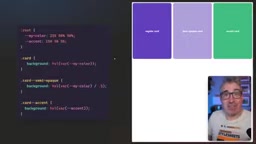
Another problem is that embedding variables inside color functions is awkward in and of itself. It works, but it's hard to maintain and difficult to handle scenarios where multiple color formats are mixed together.
To understand where this ambiguity comes from, you first need to know the history of "omitting units" in CSS color values. Early CSS only supported a handful of color functions like rgb() and hsl(), and the values inside the parentheses usually needed units (such as %) or had to follow a fixed order. The later CSS Color 4 specification greatly relaxed the syntax: both rgb() and hsl() accept bare numbers, and commas can be omitted, so rgb(255 0 0) and hsl(255 0 0) are both valid. The problem is that the same --color: 255 0 0 variable, when placed in rgb(var(--color)), is treated as red, but when placed in hsl(var(--color)), is interpreted as a completely different color (hue 255, saturation 0, lightness 0 — that is, black). This "same numbers, different semantics" writing style is the root of why the traditional approach is hard to maintain, and it is exactly the pit that new syntaxes like color-mix() and relative colors try to avoid by "explicitly declaring the color space."
color-mix() and the Relative Colors Approach
Modern CSS provides two more elegant alternatives.
color-mix() works by declaring a color space and then mixing the target color with transparent in a given ratio. For example, mixing 75% of the primary color with 25% transparent color yields a semi-transparent effect. Its compatibility is already quite stable, making it the safest choice at present. But its downside is also obvious: you need to explicitly declare the color space, and many developers aren't sure which one to choose; moreover, the declaration itself is long and readability is only average.
Relative colors allow you to reference an original color inside any color function and then directly modify the alpha channel. Its advantage is that it can operate across color spaces — referencing an RGB color with an OKLCH function works perfectly fine. However, according to the channel's analysis, relative colors "will need about another six months to reach wide availability." And developers encountering relative color syntax for the first time are often confused by notations like hsl(from ...).
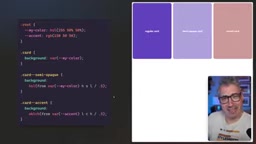
The "color space" mentioned in the article is key to understanding these two approaches. A color space determines how color values are interpreted mathematically, with common examples being sRGB, HSL, OKLCH, and Display P3. Different color spaces cover different gamut ranges: sRGB is the most universal, Display P3 can represent more vivid colors, and OKLCH is a perceptually uniform space where adjusting lightness or hue feels more linear to the human eye. The in oklch in color-mix(in oklch, ...) specifies "in which space the mixing operation is performed." Since mixing the same set of colors in different spaces yields different results, developers must choose explicitly — which is exactly why color-mix() seems verbose and has a relatively high barrier to entry. Relative colors (such as hsl(from ...) and oklch(from ...)) also involve space conversion: the original color referenced after from can first be converted to the color space of the target function, and then a particular channel can be extracted or modified.
What alpha() Brings
The usage of alpha() is extremely intuitive: specify a color, then give the alpha value, and that's it. No need to declare a color space, no need to append color model parameters — it automatically follows the color space that the color itself is in.
This eliminates the judgment calls that make developers hesitate with color-mix() and relative colors. You just say "generate a semi-transparent version of this color," and the code's intent is crystal clear.
In terms of browser support, the screenshot shows that relative colors "will reach wide availability about six months after this episode was recorded."
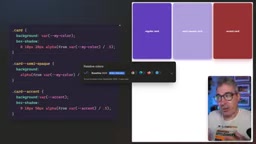
Support for alpha(), meanwhile, has only just begun. According to the channel, alpha() reached widely available status just one month before recording (September), with the recording taking place on October 1st. This means its practical availability is still not ideal and needs to be carefully evaluated in projects.
"Widely available" is a browser compatibility grading term used by documentation platforms such as MDN, replacing the old practice of listing version numbers for each major browser one by one. It roughly corresponds to support in the latest several major versions of mainstream browsers (Chrome, Edge, Firefox, Safari), usually meaning coverage above 90% and safe for production use. There are also statuses such as "newly available" and "experimental." When the article says alpha() has just reached widely available and relative colors need about another six months, it refers to the time gap under this grading system. It's worth noting that alpha(), being a newer function, will simply fail in older browsers, causing colors to fall back to opaque or to render incorrectly, so in real projects it usually needs to be paired with @supports queries or fallback color values to ensure robustness.
Syntactic Sugar, But the Good Kind
Back to the core question: is alpha() just syntactic sugar?
From a functional standpoint, yes. It doesn't introduce any capability that color-mix() or relative colors can't achieve. But the channel believes this is "a very good kind of syntactic sugar."
The reason is readability. Relative color syntax is unfriendly to newcomers, color-mix() declarations are verbose and require knowledge of color spaces, whereas alpha()'s three elements — color, alpha, done — require almost no learning curve. It makes code cleaner and intent clearer.
The channel also raises a question worth the community's consideration: should CSS continue to focus on these nice-to-have features, or should it prioritize solving problems that don't yet have a ready solution? There's no standard answer to this question, but it points to a more fundamental discussion — where the boundaries of language design lie.
alpha() won't change what you can do, but it changes your experience when writing code. In high-frequency usage scenarios, this improvement in experience itself has real value.
One-line Summary
CSS's new alpha() function, though syntactic sugar, improves the readability of semi-transparent colors with extremely concise syntax.
Paragraph Summary
The article discusses whether the newly introduced CSS alpha() function is necessary. Previously, developers handled semi-transparent colors mainly by stripping the color function and then concatenating the alpha separately, which easily caused ambiguity due to omitted units. Modern approaches like color-mix() and relative colors are more elegant, but they require declaring the color space and are unfriendly to newcomers, respectively. alpha() only requires specifying a color and an alpha value, automatically follows the color space of the original color, eliminates decision-making cost, and is clearly more readable. Functionally, it is indeed syntactic sugar and does not bring new capabilities, but the author considers it "good syntactic sugar" with real value for the experience in high-frequency usage scenarios. The article also notes that browser support for alpha() has only just begun, and relative colors will need about six months to become widely available, and it raises the question of whether CSS should prioritize nice-to-have features or fill in remaining gaps.
Related articles

Python 3.15 New Feature: Is the sentinel Type Better Than None?
Python 3.15 adds the sentinel type, using named unique sentinel objects to replace None and bare object(), resolving confusion among missing values, explicit emptiness, and invalid input while avoiding type hint failures.

Deep Learning's Three Architectures and the Universal Approximation Theorem: A Complete Guide to MLPs, CNNs, and Transformers
Explaining the inductive bias differences among MLP, CNN, and Transformer, the existence meaning of the Universal Approximation Theorem (UAT), and the role of Taylor expansion in approximation analysis, while clearing up common misconceptions.

GitLab Emergency Patch Release: Analysis of Critical Security Fixes
GitLab releases critical patch 19.5.1, sparking 355 points of discussion on Hacker News. This article analyzes the background, upgrade steps for self-hosted instances, and verification points to help DevOps teams respond quickly to security updates.