Is the ImageCLEF 2021 Hand-Drawn Wireframe Dataset Gone for Good? A Roundup of Alternative YOLO Training Solutions

ImageCLEF 2021 hand-drawn wireframe dataset taken down; YOLO practitioners can adapt via organizers, alternatives, or self-annotation.
A Reddit help post highlights a common academic dataset lifecycle problem: the ImageCLEF 2021 DrawnUI Wireframe dataset was removed from AIcrowd, stalling a graduation team training YOLO for hand-drawn UI wireframe recognition. The article covers the dataset's value and four alternatives: contacting organizers, finding mirrors on Zenodo or Kaggle, using RICO or VINS UI screenshot datasets, or self-annotating 200-500 samples with synthetic data. It urges early local backups, version tracking, and a Plan B.
A Dataset Crisis Sparked by a Graduation Project
A recent help-seeking post appeared on Reddit: a group of computer science students were working on their graduation project, needing to train a YOLO model to recognize hand-drawn UI wireframes, only to discover at a critical moment that their target dataset—the ImageCLEF 2021 DrawnUI Wireframe Dataset—had been taken down from the AIcrowd platform and was no longer available for download.
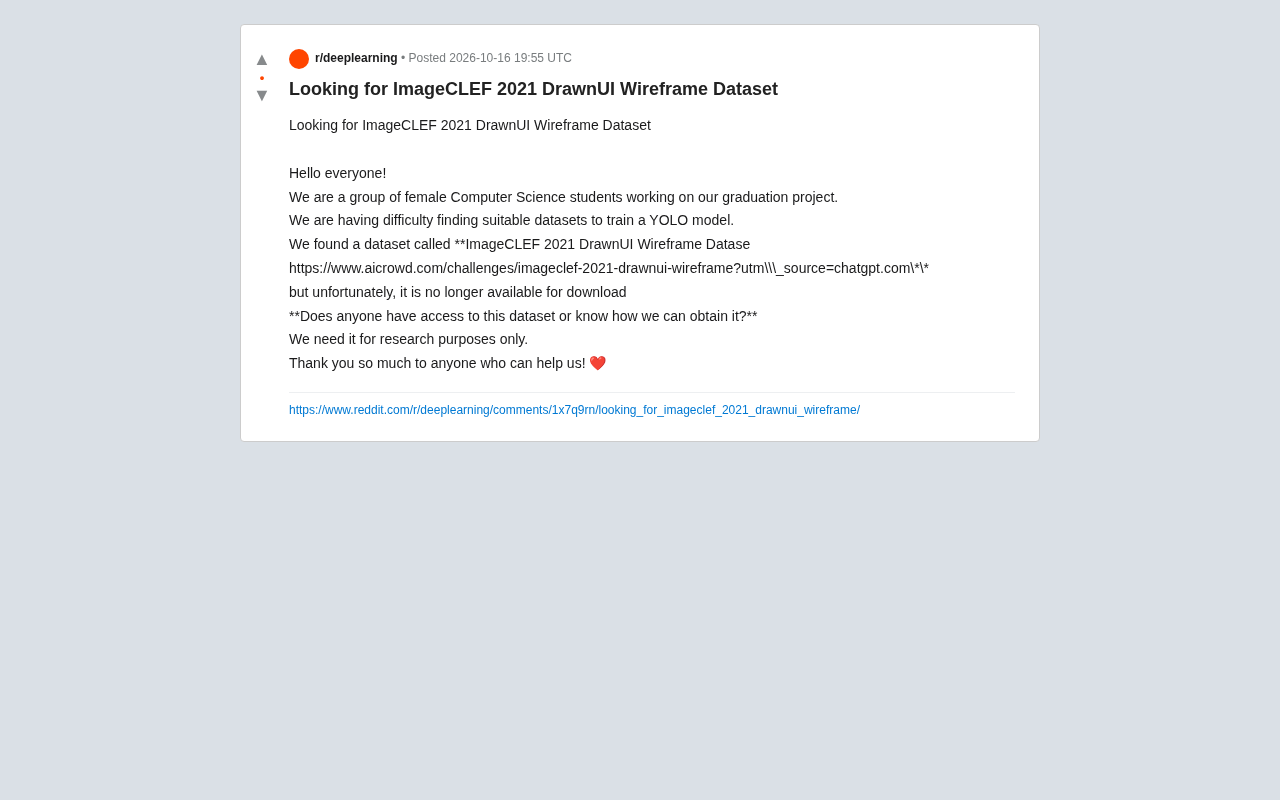
On the surface, this post is a request for a single resource, but it reflects a more widespread dilemma: the lack of lifecycle management for academic competition datasets, which has forced many reproduction studies and teaching projects that depend on old data to grind to a halt. For student teams without backup channels, this is almost fatal.
Why the ImageCLEF Hand-Drawn Wireframe Dataset Matters So Much
Hand-drawn wireframe recognition is one link in the UI intelligence pipeline. If the sketches that product managers draw during the requirements phase can be automatically parsed by a model into usable UI components, the time from paper to prototype can be greatly shortened.
The ImageCLEF 2021 DrawnUI task was organized by academia and provided an annotated dataset of hand-drawn UI elements, supporting object detection and classification tasks. Its value lies in:
- Authentic hand-drawn style: not clean vector graphics, but real human sketches with stroke jitter and perspective deviation
- Fine annotation granularity: covering common UI components such as buttons, input fields, and text areas
- Competition-grade benchmark: with a public leaderboard and paper citations, suitable as a baseline for academic research
Because of these characteristics, even after the competition ended, the dataset continued to be cited by follow-up research. The problem is that the citation links are still there, but the download entry point is gone.
ImageCLEF is a cross-language image evaluation series hosted by CLEF (Conference and Labs of the Evaluation Forum), organizing multiple image retrieval and recognition competitions each year since 2003. Its subordinate DrawnUI task (first established in 2021) focuses on the special visual domain of "hand-drawn UI wireframes," requiring participating systems to detect and classify mobile UI components such as buttons, input fields, and dropdown menus under real pen-and-paper sketch conditions. It is one of the few public evaluation benchmarks in academia targeting "low-fidelity design drafts." After the task ends, the organizers usually only open data downloads through the AIcrowd platform during the competition period. Although the event archive page retains papers and leaderboards, the original data packages often no longer provide direct links, which is precisely the root cause of this kind of competition dataset being "findable but unobtainable."
After the Dataset Disappears, What Else Can Be Done for YOLO Training
Looking for Mirrors and Academic Channels
The most direct approach is to contact the original dataset maintainers. ImageCLEF series tasks are usually organized jointly by multiple universities, and the task homepage will include contact information for the organizers. Sending an email explaining the research purpose can sometimes result in a direct share.
Another channel is open data platforms such as Zenodo, Figshare, and Kaggle Datasets. Some researchers upload their own organized datasets as secondary copies. Although completeness is not guaranteed, it is worth searching.
Turning to Alternative Datasets
If the original dataset cannot be found, consider the following directions:
- RICO: contains a large number of Android UI screenshots, which can be used to train basic features for UI component detection
- VINS dataset: focuses on annotation of visual elements in UI screenshots
- Synthetic data generation: use tools to generate hand-drawn style wireframes and automatically annotate them to train YOLO
The advantage of synthetic data is that the annotation cost is almost zero and the data distribution can be controlled. The disadvantage is that the generated hand-drawn style may have a distribution gap from real user sketches, so a small number of real samples need to be added for fine-tuning.
RICO, short for Resources for Interaction and Conversation, is a mobile UI interaction dataset jointly released in 2017 by Google, CMU, and other institutions. It covers about 72,000 Android interface screenshots along with corresponding interaction trajectories and view hierarchy information. Its scale is far larger than most UI detection datasets, and it is often used as a pretraining source for UI element detection and interface layout understanding. VINS (Visual Interface aNnotationS) is a UI screenshot annotation dataset publicly released in 2021, focusing on fine-grained bounding boxes for visual elements such as icons, text, and images. Compared with RICO, its annotations are more regular and its category definitions are closer to visual detection tasks. It should be noted that both RICO and VINS are screenshot-domain data (pixel-level clarity, no perspective distortion), and there is an obvious domain gap from the stroke noise and non-closed lines of hand-drawn wireframes. When transferring directly, it is recommended to use them only to pretrain the backbone network, then fine-tune with a small number of hand-drawn samples; otherwise, the model will overfit to screenshot features.
Annotate a Small-Scale Dataset Yourself
For a graduation project, training a working YOLO model does not require massive amounts of data. Using LabelImg or CVAT to annotate 200-500 hand-drawn wireframes, combined with data augmentation (rotation, scaling, stroke perturbation), is enough to obtain a demo-level model that can be presented.
An additional benefit of this route is that the copyright of the self-annotated dataset is clear, and the paper can fully describe the annotation process and standards, which instead becomes part of the methodology.
LabelImg is a classic rectangular box annotation tool that outputs both Pascal VOC and YOLO formats, making it suitable for teams to get started quickly; CVAT (Computer Vision Annotation Tool) is maintained by the OpenCV team and supports polygons, keypoints, attribute annotation, as well as multi-person collaboration and task assignment. It is more suitable for scenarios that require detailed definition of "UI component boundaries" (for example, whether an input field should include placeholder text). At a sample size of 200-500, YOLO series models (such as YOLOv8n and YOLOv8s) can usually converge to usable accuracy, but the key lies in consistency of category definitions: buttons, cards, and list items in hand-drawn wireframes often have nesting and ambiguous boundaries. It is recommended to clarify in the annotation manual the "unique criteria for determining each component" and the "handling rules when nested," and to provide screenshots of typical positive and negative examples in the paper appendix. This is not only a guarantee of data quality but also an important part of methodological reproducibility.
The Warning of Academic Dataset Extinction
This help-seeking post received attention not only because someone needed help, but because many people realized the same problem. Competition datasets usually depend on project funding and server resources. Once the project ends and funding runs out, the dataset may go offline.
For researchers who rely on public datasets, there are several principles to follow:
- Download and back up locally as early as possible: save a usable dataset the moment you see it; do not wait until you are writing a paper to look for it
- Record the data version and acquisition date: note the dataset acquisition time and specific version in the paper
- Prepare a Plan B: consider at the research design stage what the alternative is if the dataset becomes unavailable
The open-source community is also trying to solve this problem. Some institutions have begun hosting competition datasets on long-term preservation platforms, but coverage is still limited.
The consensus mechanisms in academia for long-term preservation of research data include the FAIR principles (Findable, Accessible, Interoperable, Reusable) and DOI (Digital Object Identifier) permanent links. However, competition datasets are often hosted by the organizers themselves on campus servers or short-term cloud resources after the task ends, without assigning a DOI or transferring them to platforms such as Zenodo or Figshare that have long-term archival commitments (Zenodo promises preservation for at least the lifespan of CERN experiments). Funding frameworks such as the EU's Horizon have begun requiring projects to submit data management plans (DMPs) upon completion, but enforcement varies greatly by region and discipline. For researchers, incorporating a "dataset archiving strategy" into the experimental design stage has become a necessary consideration on par with compute budgets.
Practical Advice for YOLO Practitioners
If you are facing a similar situation, it is recommended to act in the following priority order:
- First contact the original dataset organizers and explain the academic purpose
- At the same time, search Kaggle and Zenodo for mirrored versions
- Evaluate whether alternative datasets can satisfy the core research question
- Prepare a small-scale self-annotated dataset as a fallback
The key to a graduation project is to complete the research process end to end, not to reproduce the SOTA results of a specific competition. If the dataset changes, the research question and methodology still hold.
One-line Summary
After the ImageCLEF 2021 hand-drawn wireframe dataset was taken down, YOLO practitioners need to break through by contacting organizers, using alternative datasets, or self-annotating.
Paragraph Summary
A Reddit help-seeking post reveals a common dilemma in academic competition dataset lifecycle management: the ImageCLEF 2021 DrawnUI Wireframe dataset has been removed from AIcrowd, leaving a graduation project team that relied on it to train YOLO for recognizing hand-drawn UI wireframes stalled. The article analyzes the dataset's value—authentic hand-drawn style, fine-grained annotation, and competition-grade benchmark—and offers four alternative paths: contact the original organizers for a share, look for mirrors on platforms such as Zenodo or Kaggle, switch to UI screenshot datasets such as RICO or VINS, or complete the full process through synthetic data and self-annotation of 200-500 samples. The article further points out that competition datasets going offline when funding ends is a systemic problem, and recommends that researchers back up locally as early as possible, record data versions, and prepare a Plan B at the design stage.
Related articles

Hands-On with the Gemini 4 Argon API: Thinking Levels and Background Mode Explained
A Free Code Camp crash course on the Gemini 4 Argon API: from getting a key and sending your first request to controlling reasoning costs with thinking levels, enabling multi-turn chat with previous_interaction_id, and generating a Breakout game in background mode—plus a Google engineer's take on the model's capabilities.

Reinforcement Learning Takes On Getting Over It: Distributed Training Strategies Behind 63% Progress
A developer uses deep reinforcement learning to tackle Getting Over It. The agent climbs from the bottom to 63% progress but gets stuck at the anvil. The project is open-sourced, using divide-and-conquer training and CPU-only training, seeking community collaboration to break the bottleneck.

Sigma FP2 Released: The World's Smallest Full-Frame Camera Gets Sensor and Screen Upgrades
Sigma launches the FP2 full-frame camera, retaining its smallest-and-lightest design with three key upgrades: improved sensor, articulating LCD screen, and longer battery life—built for portable video creators.