Itch.io Expands Generative AI Disclosure Filters, Elevating AI Transparency on the Indie Game Platform
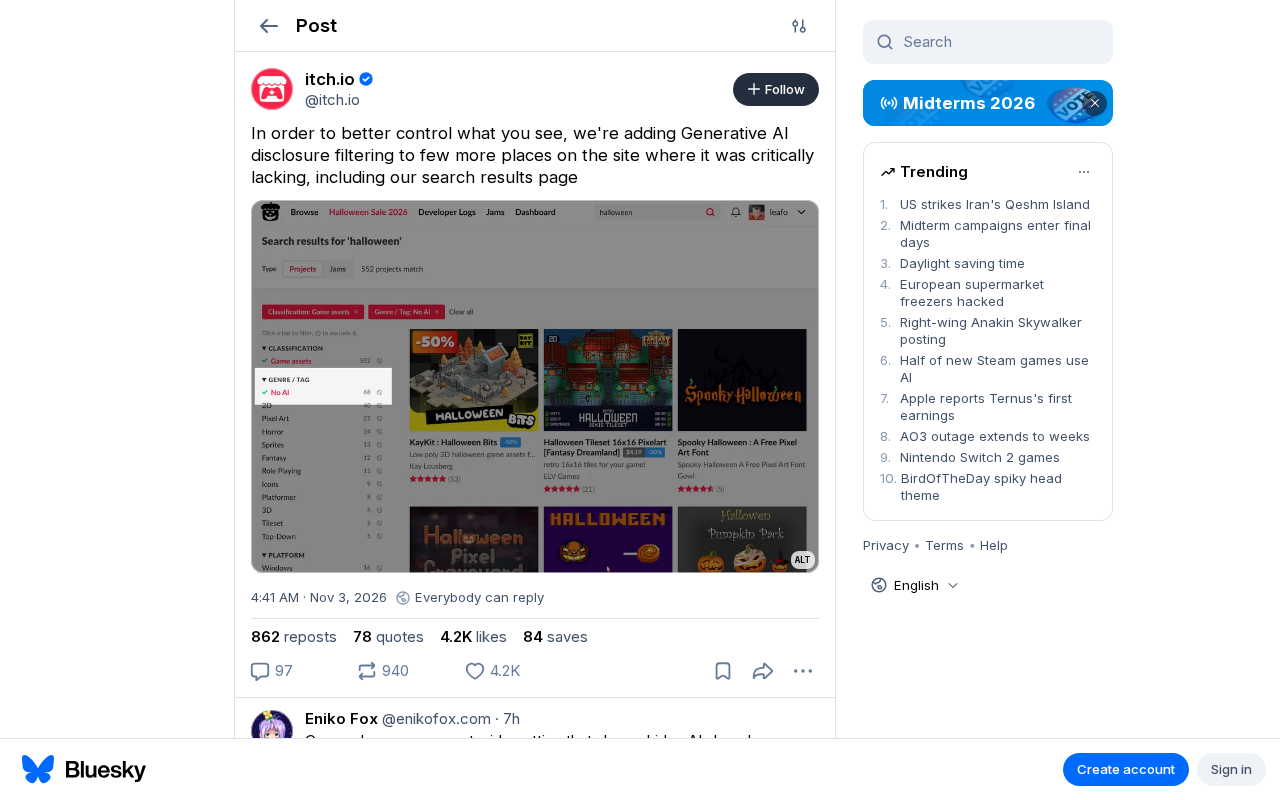
Itch.io expands AI disclosure filters to more pages, responding to users' sensitivity to AI creation with transparency.
Itch.io has expanded its generative AI disclosure filter from local pages to more places on the site, enabling users to identify whether content involves AI across core browsing paths such as game detail pages and search listings. This small product update reflects the transparency challenges facing the indie game community amid the AI wave: indie creators value handcrafted polish and originality, and are particularly sensitive to undisclosed AI use. The filtering mechanism gives users choice, but relies on honest creator disclosure and lacks mandatory verification—it is essentially a community contract rather than technical enforcement. The article argues that this gradual governance leaves room for creators and users to adapt, but may lag behind the growth of AI content. In the long run, transparent disclosure is becoming an important part of creator credibility in the AI era, and Itch.io's experiment offers the industry a reference path that balances information disclosure and user choice.
Indie game platform Itch.io is expanding its generative AI disclosure filter feature to more places across the site. Though a small move, it reflects the transparency challenges the indie game community faces amid the AI wave.
From Local to Global: The Expansion of AI Disclosure Filtering
According to a discussion on Hacker News, Itch.io has added generative AI disclosure filtering to "more places" on the site. Previously, the platform already required creators to disclose whether they used generative AI when publishing content, and allowed users to filter based on this disclosure information. This expansion means that the visibility and filterability of AI disclosure tags are no longer limited to the initial few pages or scenarios, but cover a broader range of browsing paths.
Although the specific newly added locations were not detailed, it is reasonable to infer that core browsing interfaces such as game detail pages, search listings, and tag pages are the focus of the expansion. For users, this means they can quickly identify whether content involves generative AI in more scenarios, thereby making choices that better align with their personal preferences.
Generative AI disclosure refers to content creators proactively declaring which parts of their work were created with the involvement of generative artificial intelligence (such as text generation models, image generation models, etc.) when publishing. This practice is related to broader AI content labeling initiatives, such as the metadata standards promoted by the Content Authenticity Initiative (C2PA), and the "AI-generated" labels adopted by some platforms. Disclosure typically covers modalities such as art assets, code, narrative text, and audio, with the aim of letting audiences understand the division of labor between humans and AI in the creative process. For platforms, the disclosure mechanism is the infrastructure of transparency governance; for users, it is the basis for filtering and decision-making. However, the voluntary nature of disclosure means its effectiveness depends on creator honesty, and platforms often find it difficult to verify each item.
Why the Indie Game Community Is So Sensitive to AI Disclosure
The indie game community differs significantly from AAA studios in its attitude toward AI. Creators on Itch.io are mainly individual developers and small teams, and their works often emphasize handcrafted polish, personal expression, and artistic originality. The intervention of generative AI—especially for art assets, code generation, or narrative text—directly touches the sensitive nerve of "what creation is."
This sensitivity is not unfounded. Over the past period, the gaming community has repeatedly seen controversies triggered by undisclosed AI use, and players and creators are particularly averse to the behavior of "AI disguised as handcrafted creation." Itch.io's disclosure filtering mechanism is essentially providing an institutional solution to this trust problem at the platform level: it does not prohibit AI use, but requires transparency.
Indie games usually refer to game works developed by individuals or small teams that do not rely on funding from large publishers. Their core characteristics include limited budgets, flexible development cycles, and an emphasis on authorial expression and artistic experimentation. The indie game community (such as Itch.io, the Steam indie section, and Game Jolt) has formed a cultural identity that prides itself on handcrafted polish, pixel art, and narrative innovation. The intervention of generative AI may lower the barriers to art and code, but it may also dilute the scarce value of "handcrafted creation," sparking debates about originality, labor ethics, and artistic sincerity. This cultural background explains why the indie community is particularly sensitive to AI disclosure: disclosure is not just an information issue, but also concerns the maintenance of community members' consensus on "what creation is."
The Practical Impact and Limitations of the Filtering Feature
From a product logic perspective, AI disclosure filtering gives users autonomy—you can choose to view only works explicitly labeled "no AI-generated content," or you can be inclusive of AI-assisted creation. This "opt-in/opt-out" model is more flexible than a one-size-fits-all ban, and better fits the diverse values of the indie community.
However, the effectiveness of this mechanism depends heavily on creators' honest disclosure. The platform does not (and cannot easily) verify the authenticity of disclosures, which means the filtering feature is more of a community contract than a technical enforcement. For users who value AI transparency, disclosure tags are an important basis for decision-making; but for users who do not care, it may just be a small marker on the page.
The Gradual Path of Platform Governance
Itch.io's approach represents a gradual governance mindset: first establish a disclosure framework, then gradually expand its visible scope, rather than imposing strict restrictions from the outset. The advantage of this path is that it leaves room for both creators and users to adapt, while collecting feedback through product iteration. The disadvantage is that progress is slower, and against the backdrop of rapidly growing AI content, transparency building may lag behind actual needs.
Opt-in/opt-out is a common pattern in product design that gives users autonomous control. In the context of AI disclosure filtering, users can choose to browse only works labeled "no AI-generated content" (opt out of AI content) or be inclusive of AI-assisted creation (opt in). This model is more flexible than a platform's one-size-fits-all ban and respects the diversity of user preferences, but it also shifts the filtering cost to users. Its effectiveness depends on the accuracy and coverage of tags; if disclosures are incomplete or tags are missing, filtering results may be biased. In addition, opt-in/opt-out mechanisms may create "filter bubbles," gradually splitting user groups with different preferences and affecting the overall communication and discovery efficiency of the community.
Long-Term Implications for the Indie Game Ecosystem
Itch.io's expansion of AI disclosure filtering may seem like a small product-level change, but it actually concerns the trust infrastructure of the indie game ecosystem. As AI tools become increasingly widespread and the barrier for creators to use AI continues to lower, "whether to use AI" will gradually shift from an exception to the norm. By then, the value of the disclosure mechanism will not lie in "marking the outliers," but in helping users understand the creative process—which parts are led by humans and which are assisted by AI.
This direction contrasts with the practices of some commercial platforms. Some platforms choose stricter restrictions or classification of AI content, while Itch.io leans more toward information disclosure and user choice. Both paths have their adherents, and the indie community's experiment will provide valuable reference for the entire gaming industry.
For indie developers, proactively and honestly disclosing AI use may reduce some users in the short term, but in the long term it helps build a trustworthy creator image. Transparency is becoming part of creative credibility in the AI era.
Conclusion
Itch.io's expansion of generative AI disclosure filtering to more places is a small step for the platform in AI transparency, but an important signal of the evolution of trust mechanisms in the indie game community. At a time when the boundary between AI and handcrafted creation is increasingly blurred, keeping users informed and giving them autonomous choice may be a pragmatic way to balance innovation and trust.
One-line Summary
Itch.io expands AI disclosure filtering to more pages, responding to users' sensitivity to AI creation with transparency.
Paragraph Summary
Itch.io has expanded its generative AI disclosure filter feature from local pages to more places on the site, enabling users to identify whether content involves AI across core browsing paths such as game detail pages and search listings. This small product update reflects the transparency challenges facing the indie game community amid the AI wave: indie creators value handcrafted polish and originality, and are particularly sensitive to undisclosed AI use. The filtering mechanism gives users choice, but relies on honest creator disclosure and lacks mandatory verification—it is essentially a community contract rather than technical enforcement. The article argues that this gradual governance leaves room for creators and users to adapt, but may lag behind the growth of AI content. In the long run, transparent disclosure is becoming an important part of creator credibility in the AI era, and Itch.io's experiment offers the industry a reference path that balances information disclosure and user choice.
Related articles
 Tech Frontiers
Gemini Omni 1.2 Flash: AI Video Moves Toward Draft-Style Editing
Google's Gemini Omni 1.2 Flash update enables conversational, draft-style editing of the same video—swap scenes while keeping products, adjust lighting while keeping characters. Clips up to 15s, 720p costs 30% less than the previous Flash—ideal for e-commerce ads, previs, and short-asset production.

Codex Tutorial: One-Command Install and Run Your First Task
Codex tutorial: one-command install and run your first task. Covers the four Codex forms, sandbox and approval guardrails, AGENTS.md and MCP configs, cloud network policy, and the iron rule of human review—everything you need to get started with this autonomous coding agent.
 Tech Frontiers
Localix: An Open-Source Agentic Development Environment with Multi-Model and Local AI Integration
Localix is an MIT open-source Agentic Development Environment (ADE) supporting seamless Claude Code plugin loading, multi-model cloud and local execution, Mini Apps extensions, and agent context management—an open AI collaboration workbench for developers.