J-Code: A Free AI Coding Agent Rewritten in Rust, 20x More Efficient

J-Code rewrites the AI coding tool middle layer in Rust, achieving 20x efficiency and 63x speed, completely free.
This article introduces how the new project J-Code solves the problem of traditional tools getting slower over time by rebuilding the underlying architecture of AI coding agents in Rust. Traditional agents rely on a middle layer called the harness to manage tool calls and context memory, which produces "computational traffic jams" as task scale grows. J-Code tears out this layer entirely and rebuilds with Rust's zero-cost abstractions and memory safety features, achieving 20x efficiency and 63x speed improvements. Its lightweight architecture also unlocks multi-agent parallel collaboration, allowing multiple auxiliary agents to run on the same codebase without conflicts.
The AI coding tools market is being squeezed by both expensive subscriptions and bloated underlying architectures. A new project called J-Code offers a different answer: completely free, rebuilt from the ground up in Rust, and claiming 20x efficiency and 63x speed improvements.

Why Traditional AI Coding Agents Get Slower the More You Use Them
When a developer sends a complex request to an AI coding assistant—say, asking it to analyze historical context across multiple files and generate a modification plan—that request doesn't go straight to the AI model. Before the model, there's a middle layer responsible for managing tool calls, memory systems, and context passing. The industry typically calls this middle layer the "harness."
The problem lies precisely here. Traditional harnesses try to automatically remember all historical context; every additional file or conversation record adds another computational and storage burden to the middle layer. According to the project's analysis, this leads to a severe "computational traffic jam." The larger the task scale, the worse the congestion, ultimately manifesting as sluggish responses and skyrocketing resource usage.

This isn't a problem unique to any single tool—it's a common bottleneck across the architecture of today's mainstream AI coding agents. Whether the harness is built on Python or Node.js, it struggles to avoid performance degradation when facing large-scale codebases.
What is a harness?
A harness is the "middleware layer" in an AI coding agent's architecture, sitting between user requests and the underlying large language model. It doesn't generate code; instead, it handles a range of supporting tasks: parsing user intent, deciding which tools to invoke (such as file read/write, terminal execution, code search), maintaining context memory of conversations and the codebase, and assembling tool return results into model-readable prompts.
You can think of the harness as the agent's "operating system"—the model is the CPU, and the harness handles scheduling. Its design quality directly determines whether the agent can scale efficiently. Most current open-source agents (such as projects based on LangChain or AutoGPT ideas) write their harness in Python or Node.js, relying on dynamic languages and heavy object serialization, which easily produces extra overhead under large-scale context.
It's precisely because the harness carries so many state management responsibilities that it becomes a hotspot for performance bottlenecks. J-Code's entry point is exactly this layer, not the model itself.
J-Code's Solution: Tear Out the Middle Layer, Rebuild in Rust
J-Code's core idea can be summed up in one sentence: rather than optimizing that bloated middle layer, tear it out and rebuild from the foundation.

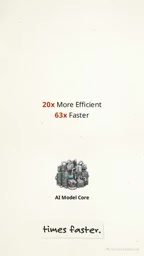
The project chose Rust as its underlying language—a decision that directly affects performance. Rust's zero-cost abstractions and memory safety features allow J-Code to maintain efficient control over tool calls and context management while removing redundant middle layers. According to official figures, the same request is processed 20x more efficiently on J-Code, with speed reaching 63x.
These numbers need to be understood in context. If a traditional agent takes 63 seconds to process a complex code analysis request, J-Code could theoretically complete it in about one second. For developers who frequently call on AI coding assistants, this gap directly changes the rhythm of their workflow.
Why Rust's zero-cost abstractions are critical
"Zero-cost abstraction" is one of Rust's core design philosophies: when using high-level language features (such as iterators, generics, trait objects), the compiled machine code performs almost identically to hand-written low-level code. By contrast, Python's abstraction layers introduce the overhead of interpreted execution and dynamic type checking, while Node.js is constrained by its single-threaded event loop and GC pauses.
For a middle layer like a harness that frequently handles tool calls, context serialization, and concurrent scheduling, language-level performance differences are significantly amplified. Rust also eliminates data races at compile time through its ownership model, enabling multiple agents to execute in parallel without relying on lock mechanisms to guarantee memory safety.
This explains why "rewriting the language" alone can bring order-of-magnitude improvements—not because the algorithms are smarter, but because every layer of abstraction no longer incurs extra runtime costs. A substantial portion of the 63x speed improvement comes precisely from eliminating language runtime overhead.
Multi-Agent Parallelism: The Chain Reaction from Speed Advantages
After removing the middle layer bottleneck, J-Code unlocked a capability that traditional architectures struggle to achieve: running multiple auxiliary agents simultaneously on the same codebase without conflicts.
The reason traditional agents struggle with this is precisely that the middle layer needs to maintain global context consistency. When multiple agents simultaneously modify or analyze the same codebase, the harness easily falls into state conflicts and deadlocks. J-Code's lightweight architecture fundamentally eliminates this constraint—without that cumbersome global middle layer, multiple agents can operate independently and synchronize results when needed.
This means that when facing a large codebase, J-Code can dispatch multiple agents to handle different modules separately and then aggregate results instantly. This parallel capability is especially valuable in scenarios like code review, large-scale refactoring, and cross-file dependency analysis.
Why do multi-agent systems easily experience state conflicts?
When multiple agents operate on the same codebase simultaneously, traditional harnesses need to maintain a globally shared context state (including file versions, conversation history, and tool call locks). If multiple agents read and write this state concurrently, complex locking and consistency protocols are required—otherwise conflicts like "Agent A generates modifications based on an older file version and overwrites content Agent B just wrote" will occur.
Even trickier is deadlock: Agent A waits for Agent B to release a lock on some file, while B waits for A to release another resource. This is especially difficult to debug in dynamic languages.
By removing the cumbersome global hash tables and lock mechanisms, J-Code lets each agent hold only the minimal context fragment it needs, with results synchronized through lightweight channels. This "shared-nothing" design is a pattern that Rust's ownership model naturally suits—and one of the fundamental reasons it outperforms Python/Node.js approaches.
The Product Logic Behind the Free Strategy
J-Code explicitly positions itself as "completely free" and claims to outperform the market's most expensive paid tools in performance. There's a logic worth noting behind this: when the underlying architecture is efficient enough, operating costs themselves drop significantly. Traditional agents waste computation on the middle layer, requiring more compute to maintain the same response speed—a cost ultimately passed on to users. J-Code compresses this overhead through architectural optimization, making a free model commercially viable.
Of course, free doesn't mean costless. Multi-agent parallel execution itself consumes more computational resources, and J-Code's actual usage cost depends on how users configure and schedule these agents. Developers need to find this balance point themselves through practical use.
Potential Impact on the AI Coding Tools Market
J-Code's emergence raises a sharp question: when a free tool achieves 20x the efficiency of paid products, what is the pricing basis for paid AI coding tools?
Most mainstream AI coding assistants on the market today are built on similar tech stacks, with performance differences mainly coming from model capabilities and product polish rather than disruptive optimization of the underlying architecture. By choosing to start from the harness layer, J-Code effectively bypasses the arms race in model capabilities and finds a breakthrough in engineering efficiency.
Whether this path can succeed depends on several factors: the maintenance cost of the Rust rewrite, the actual stability of multi-agent collaboration, and whether the community can build a sustainable ecosystem around the project. But at least from a technical roadmap perspective, J-Code offers a new approach different from "stacking more model parameters."
For developers who use AI coding assistants daily, J-Code is worth keeping an eye on. Its value lies not just in its current feature performance, but in the possibility it validates: perhaps the efficiency bottleneck of AI coding tools isn't in the model itself, but in that overlooked middle architecture layer.
One-line Summary
J-Code rewrites the middle layer of AI coding tools in Rust, achieving 20x efficiency and 63x speed improvements, completely free.
Paragraph Summary
This article introduces how the new project J-Code solves the problem of traditional tools getting slower over time by rebuilding the underlying architecture of AI coding agents in Rust. Traditional agents rely on a middle layer called the harness to manage tool calls and context memory, which produces "computational traffic jams" as task scale grows. J-Code tears out this layer entirely and rebuilds with Rust's zero-cost abstractions and memory safety features, achieving 20x efficiency and 63x speed improvements. Its lightweight architecture also unlocks multi-agent parallel collaboration, allowing multiple auxiliary agents to run on the same codebase without conflicts. J-Code positions itself as completely free, supporting its business model by compressing operating costs through architectural optimization. The article argues that it validates that the efficiency bottleneck of AI coding tools may not be in the model layer, but in the overlooked middle architecture layer.
Related articles

Huberman's Rational Supplement Guide: A Five-Layer Health Framework and Scientific Decision-Making
Stanford neurobiology professor Huberman proposes a rational supplement framework: behavior and nutrition are the foundation, basic combination supplements serve as insurance, and sleep/hormonal/cognitive directions should stick to single-ingredient experiments. Omega-3 is the top single-ingredient choice, and melatonin is not recommended.

The Unsung Painter Behind Gilded Age Manhattan Interior Design
HN discussion highlights the painter behind Gilded Age Manhattan interiors: he created murals and decorative paintings but was long overlooked as his work was seen as architectural appendage.

Can AI Agents Be Socially Engineered? Understanding Prompt Injection and Tool Permission Risks
Through Invariant Lab's GitHub Issue injection and Brave's AI browser attack, this article analyzes how Prompt Injection induces AI Agents to perform unauthorized actions, and offers protection advice across three layers: least privilege, tool validation, and operation auditing.