Jackery Launches Its Smallest Portable Power Station Ever: Explorer 100D Weighs Just 1.87 lbs

Jackery launches the Explorer 100D, its smallest portable power station ever, entering the carry-anywhere segment with a 1.87 lb design and LFP battery.
Jackery has introduced the Explorer 100D, which at 4.6×3.4×3.4 inches and 1.87 lbs is the smallest portable power station in its lineup. Instead of piling on capacity specs, it makes "willing to carry out" the design premise for hiking, short camping, and emergency backup. Its LFP battery shows the tech has trickled down from flagships to entry-level models, though size constraints mean capacity and output are limited.
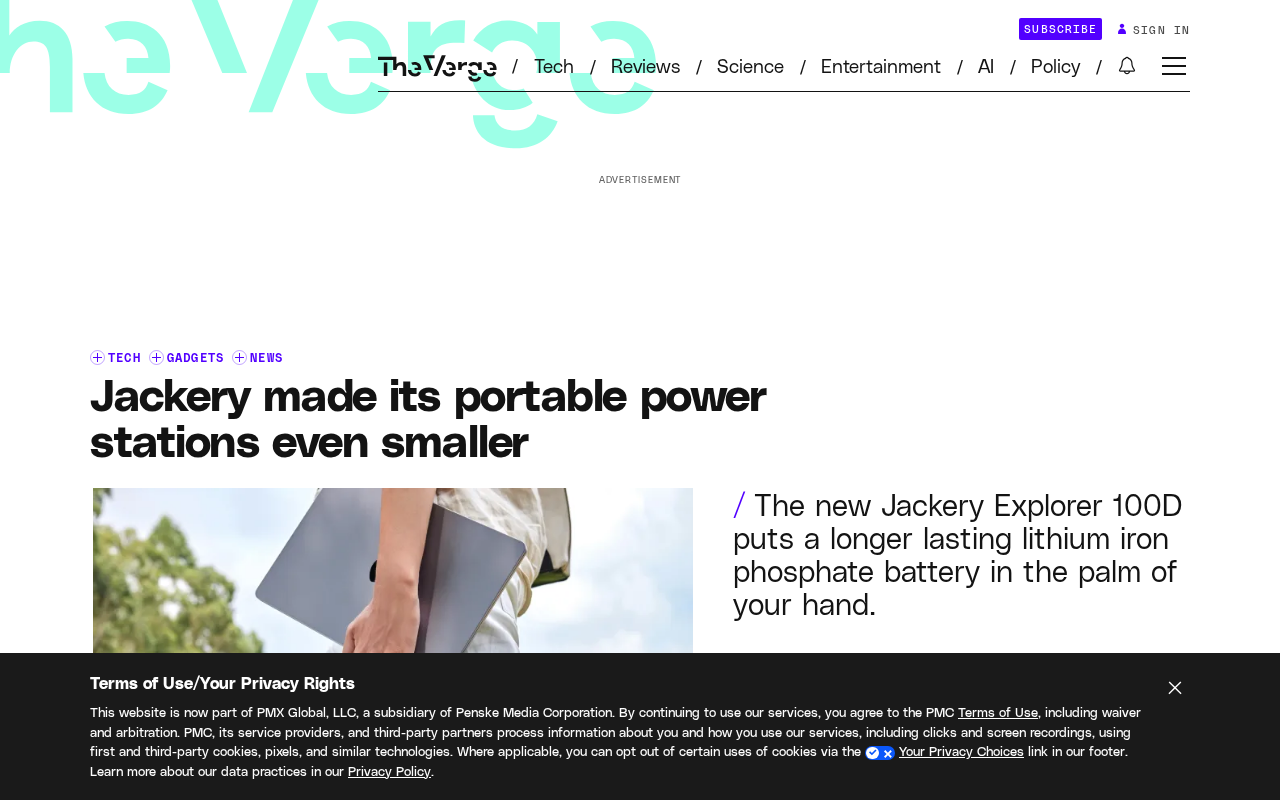
The portable power station market is in the middle of a "slimming" race. Jackery's newly announced Explorer 100D compresses the size of a portable energy storage product to an unprecedented degree—a 4.6 × 3.4 × 3.4 inch body weighing just 1.87 lbs makes it the smallest model in Jackery's lineup. It's even a bit smaller than many people's thermoses, slipping effortlessly into a backpack side pocket.
From "can be carried out" to "willing to carry out"
For the past few years, the core selling points of portable power stations have been capacity and output. Users cared about whether it could run a rice cooker or how many times it could charge a drone. But the direct cost of high capacity is bloated weight and size—many products, despite being marketed as "portable," actually require two hands to carry and often end up left in the trunk during camping trips.
The Explorer 100D takes the opposite path. Jackery didn't pile on capacity specs for this product; instead, it made "willing to carry out" the design premise. At 1.87 lbs, one-handed holding and extended carrying pose no burden, and for hiking, short camping trips, and emergency backup power, that real-world value may be higher than a few hundred extra watt-hours of capacity.
LFP batteries trickle down to the smallest model
The Explorer 100D uses a lithium iron phosphate (LFP) battery, a technology path Jackery began adopting in 2023. Compared with traditional ternary lithium batteries, LFP batteries have clear advantages in thermal stability and cycle life, offer higher safety, and are better suited to long-term storage and frequent charge-discharge habits.
Jackery bringing LFP to its smallest product shows the technology has trickled down from flagship models to the entry-level lineup. For consumers, this means even the smallest, lightest model doesn't require compromising on battery safety and longevity. It's a sign of a maturing product line: safety is no longer an exclusive selling point of high-capacity products.
Lithium iron phosphate (LiFePO4, or LFP) batteries use lithium iron phosphate as the cathode material. In the crystal structure, FeO6 octahedra and PO4 tetrahedra form a stable olivine structure through strong covalent bonds, making it resistant to thermal runaway under abuse conditions such as overcharging, nail penetration, and crushing, with thermal stability significantly better than ternary lithium (NCM/NCA). The trade-off is lower energy density (typically about 90–160 Wh/kg at the cell level, below the 200+ Wh/kg of ternary lithium), which is one reason LFP power stations tend to be heavier at the same capacity. Cycle life typically reaches 2000–6000 cycles, far above the 500–1000 cycles of ternary lithium, and it contains no cobalt or nickel, making cost and supply chains more controllable. LFP's flat voltage plateau (about 3.2V) makes state-of-charge estimation somewhat difficult, requiring more refined BMS algorithms. For portable power stations, LFP's low energy density is a variable that any lightweight path must weigh.
The trade-offs behind the small size
What needs to be viewed soberly is that making a power station this small inevitably imposes physical limits on capacity and output. The original information did not disclose the Explorer 100D's specific capacity, output power, or port configuration, so it's impossible to judge which devices it can run. Judging from its positioning, this type of ultra-compact power station is better suited to topping up low-power devices like phones, earbuds, cameras, and lighting equipment rather than replacing traditional high-capacity outdoor power stations.
This also points to an industry trend worth watching: portable power stations are stratifying. One category continues to evolve toward high capacity and high power, serving RVs and long outdoor work sessions; the other develops toward lightweight, carry-anywhere designs, targeting urban commuting, short hikes, and emergency scenarios. The Explorer 100D clearly belongs to the latter.
A portable power station's capacity (Wh) and output power (W) are jointly constrained by the number of battery cells, inverter size, and heat dissipation capability. Extrapolating from a total weight of 1.87 lbs (about 848 grams), after deducting the casing, inverter, BMS, and port modules, the weight available for cells is quite limited, so capacity for this type of product is likely in the 100–300Wh range. Another key metric is AC output: a small inverter producing more than 100W of AC power needs sufficient heat dissipation area, otherwise temperature rise will trigger derating protection. Output power is also limited by the cells' continuous discharge rate (C-rate), and high-rate discharge accelerates capacity fade. When evaluating such products, users should focus on rated output power (not peak), continuous discharge capability, and the maximum wattage of USB-C PD output—these specs reflect actual usability better than nominal capacity.
The market significance of the lightweight path
The portable power station industry has grown rapidly in recent years, but product homogenization has also become apparent. Most brands converge on specs in the mid-to-high capacity segment, and price competition is fierce. Lightweighting is a differentiation direction that hasn't been fully developed, because it tests not just cell selection but also structural design, thermal solutions, and casing materials—comprehensive engineering capability.
Jackery frames the Explorer 100D with the "smallest ever" label, essentially competing for a mindshare position: the first brand that comes to mind when users think of a "power station to carry with you." Whether this strategy works depends on the product's reliability in real-world use and whether the final pricing matches the willingness to pay in its target scenarios.
For users who care about outdoor gear and emergency power, the Explorer 100D is worth watching, but it's advisable to wait for full capacity and port information before making a judgment. Lightness is its biggest selling point, but it also means you need to first confirm whether it can meet your power needs.
Price competition in the portable power station industry is concentrated in the 500–2000Wh mid-to-high capacity segment, where cell costs account for a high share and technical barriers are relatively low, leading to converging specs. Lightweighting is a differentiation path with higher engineering barriers: within a limited weight budget, performance and size must be balanced through high-energy-density cell selection, unibody die-casting or high-strength engineering plastic casings, and compact thermal structures. The premium space for such products comes not from capacity but from industrial design and scenario fit, and their pricing logic is closer to consumer electronics than to power equipment. From a market structure perspective, lightweight products target the long-tail scenarios of "low capacity demand but high carrying frequency," complementing rather than replacing mid-to-high capacity products—which explains why leading brands tend to cover the market with a product matrix rather than a single hit product.
One-line Summary
Jackery launches the Explorer 100D, its smallest portable power station ever, entering the carry-anywhere power segment with a 1.87 lb lightweight design and LFP battery.
Paragraph Summary
Jackery has introduced the Explorer 100D, which at 4.6×3.4×3.4 inches and 1.87 lbs is the smallest portable power station in its lineup. The article notes that instead of piling on capacity specs, the product makes "willing to carry out" its design premise, targeting hiking, short camping trips, and emergency backup power. It uses the lithium iron phosphate (LFP) battery Jackery adopted in 2023, showing the technology has trickled down from flagships to the entry-level lineup. Due to size constraints, its capacity and output are necessarily limited, making it better suited to topping up low-power devices like phones and cameras. The article also observes stratification in the portable power station industry: high-capacity/high-power and lightweight/carry-anywhere paths are developing in parallel, with lightweighting becoming a differentiation direction due to higher engineering barriers. Since capacity, power, and pricing haven't been announced, buying decisions should wait for full specs.
Related articles

DeepSeek Harness Quick Start Guide: From Installation to 5 Real-World Cases
What is DeepSeek Harness? Based on a Bilibili tutorial, this article covers how this AI Agents software works, installation and setup, four working modes, and five real-world cases: a 3D racing game, official website, music player, science animation, and self-developed plugin—plus token money-saving tips.

Breaking Down DeepSeek's Super-agent Architecture: How Router+Worker Solves the Multi-Session Management Bottleneck
An analysis of DeepSeek's Super-agent paper: how the Router+Worker two-tier architecture uses Fast Pass, Chain of Recall, and storage-compute separation to solve multi-AI-session management bottlenecks, and how much it truly alleviates the human attention bottleneck and what engineering trade-offs it makes.

19K Stars in 5 Days: Why DeepSeek's Open-Source AI Programmer Went Viral
DeepSeek's open-source AI programmer hit 19K GitHub stars in 5 days. Why it went viral: the agent boom, AI writing its own code, and the shift from Q&A tools to AI employees.