Jaithon 3: Analyzing an Experimental Programming Language in Pursuit of Perfect Syntax

Analyzing Jaithon 3's bold pursuit of "perfect syntax" and high performance in programming language design.
Jaithon 3 is an experimental programming language claiming to offer "perfect syntax" and high performance. This article examines its design philosophy, the tension between syntactic elegance and execution speed, and the broader motivations behind creating new languages. It also provides a practical framework for evaluating experimental languages and discusses why ecosystem — not just syntax — ultimately determines a language's success.
A New Programming Language Touting "Perfect Syntax"
Recently, a programming language project called Jaithon 3 sparked a small discussion on Hacker News. The project uses the tagline "a fast programming language with the perfect syntax." While it has only garnered 14 upvotes and 9 comments so far, the question it raises — whether a programming language's syntax can truly achieve "perfection" — is a classic dilemma that has long intrigued the developer community.
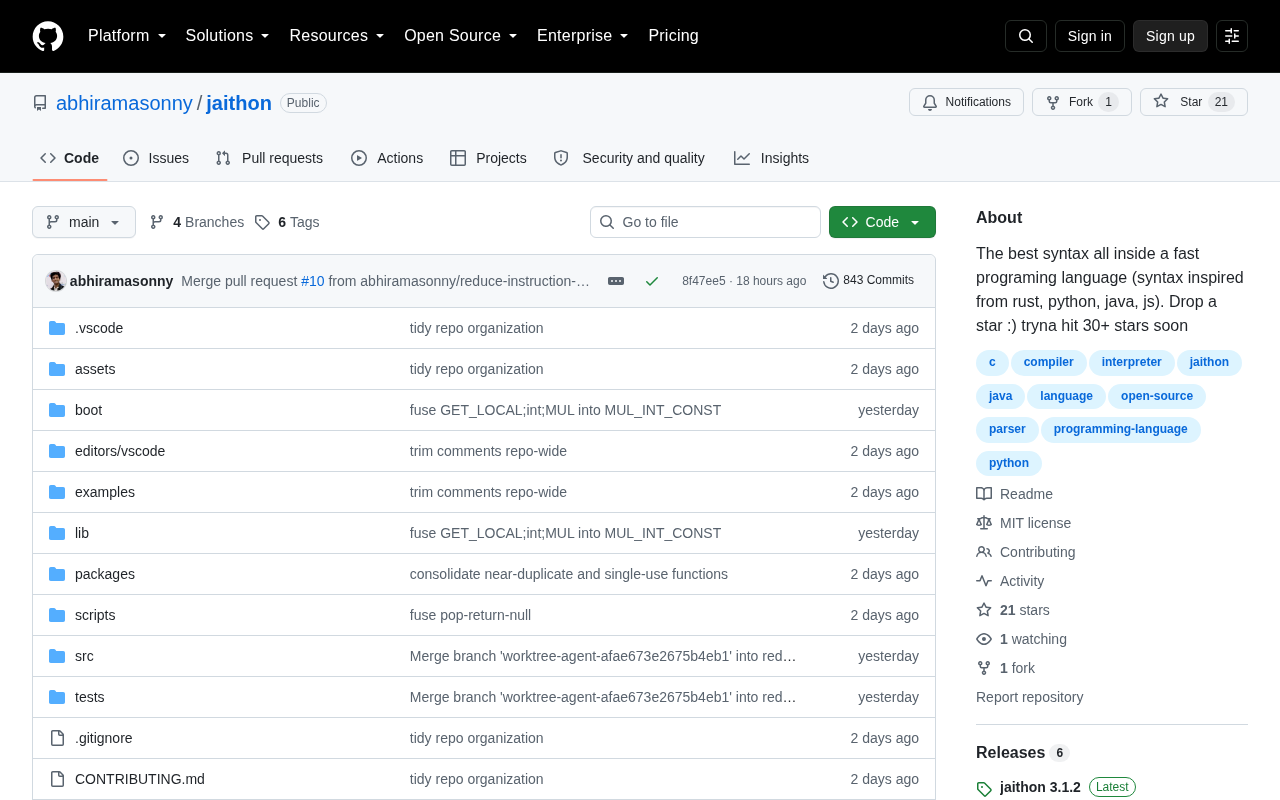
The name alone tells us a lot. "Jaithon" clearly pays homage to (or playfully riffs on) Python, with an obvious phonetic connection suggesting it may draw inspiration from Python's syntax style while attempting to improve upon or redesign it. In the history of programming languages, naming conventions that reference predecessors — whether as tribute or parody — are a common cultural phenomenon. Jython (Java + Python) is a Python implementation running on the JVM, while Cython is a tool that compiles Python code into C extensions. Even Python itself wasn't named after the snake, but rather as a tribute to the British comedy group Monty Python. Jaithon carries on this naming tradition while embodying its creator's personal vision of the "ideal programming experience." These experimental languages driven by individual developers often represent the purest expression of technological idealism.
Why Do Developers Keep Designing New Programming Languages?
For outsiders, the question is natural: with mature languages like Python, Rust, Go, and JavaScript already available, why do developers keep "reinventing the wheel" with new language designs? The answer usually lies in a few core motivations.
Syntax Design as Programming Philosophy
The notion of "perfect syntax" is inherently a highly subjective goal. Some believe Python's indentation-as-scope approach is elegant and concise; others prefer the explicit curly brace boundaries of C-family languages. This debate over how to delimit code blocks has a long history: when Guido van Rossum designed Python in 1991, he made the bold choice of enforcing indentation to represent code block hierarchy — a design inspired by the ABC language. Supporters argue that indentation syntax eliminates the visual noise of curly braces, enforces consistent code style, and perfectly aligns a code's visual structure with its logical structure. Critics counter that indentation syntax is prone to subtle errors in scenarios like copy-pasting code or mixing tabs and spaces. C-family languages use curly braces to explicitly define scope, giving programmers more formatting freedom — but this has also spawned endless style debates about brace placement (such as K&R style vs. Allman style). Some languages take a middle-ground approach: Go mandates curly braces but enforces uniform formatting through the gofmt tool, while Haskell supports both indentation syntax and curly brace syntax.
At its core, syntax design reflects the designer's philosophical stance on "how code should be read and written." The fact that Jaithon 3 dares to put "perfect syntax" in its tagline shows that the author has a clear aesthetic vision for their syntax design — and that in itself is an expression worthy of respect.
The Educational and Exploratory Value of Language Implementation
From an educational perspective, building a programming language from scratch is one of the best ways to understand core computer science concepts. It involves a series of stages: lexing, parsing, abstract syntax tree (AST) construction, and interpretation or compilation to target code.
More specifically, lexical analysis is the first step, breaking the character stream of source code into meaningful tokens. For example, let x = 42 would be split into a keyword, an identifier, an operator, and a numeric literal. Parsing then organizes these tokens into a hierarchical abstract syntax tree (AST) according to grammar rules — the AST is a tree representation of code structure, where each node represents a syntactic construct. Common parsing techniques include recursive descent parsing, LL parsing, and LR parsing. Once the AST is built, the language implementer can choose to interpret it by directly traversing the AST (as early Python did), convert it to bytecode to run on a virtual machine (as in CPython's bytecode approach), or compile it to an intermediate representation like LLVM IR to ultimately generate machine code (as in Rust's compilation pipeline). Understanding this technical pipeline is at the heart of compiler courses, which is why implementing a programming language is considered an excellent learning project.
The true value of many such projects lies not in replacing mainstream languages, but in the deep understanding developers gain through the implementation process.
The Dual Promise of "Fast" and "Perfect Syntax"
Jaithon 3's tagline emphasizes two key attributes simultaneously: fast and perfect syntax. In programming language design, these two goals often require careful trade-offs.
The Tension Between Performance and Expressiveness
Generally speaking, the more a syntax resembles natural language and the more "elegant" it is, the heavier the runtime abstraction layer behind it tends to be, potentially impacting execution efficiency. Python is a prime example — it's renowned for readability, but its native interpreted execution performance falls far short of compiled languages. For a language to achieve both "fast" and "syntax-friendly," it typically needs to employ techniques at the lower level such as JIT compilation, static type inference, or direct compilation to machine code.
JIT (Just-In-Time) compilation is a technique that dynamically compiles hot code paths into machine code at runtime. Unlike traditional AOT (Ahead-Of-Time) compilation, JIT can perform targeted optimizations based on actual runtime data characteristics, such as inline caching and speculative optimization. JavaScript's V8 engine and Java's HotSpot JVM are classic examples of JIT compilation in practice, enabling these languages to achieve near-native performance while maintaining their dynamic characteristics. Static type inference (such as the Hindley-Milner type system) allows the compiler to automatically deduce type information for expressions without requiring explicit type annotations from the programmer, thereby generating more efficient code — Rust and OCaml excel in this area. In recent years, some languages have also experimented with gradual typing strategies, allowing code to flexibly switch between dynamic and static typing. TypeScript is a successful example of this approach.
For an early-stage project like Jaithon 3, how it truly delivers on its "fast" promise will be a critical test of whether it can stand out among the many experimental languages. Elegant syntax alone, without viable performance, will struggle to attract users in real-world scenarios.
Community Response and Rational Assessment
Based on the Hacker News data, the project currently has limited traction (14 points, 9 comments). This is typical for most personal open-source language projects — they tend to exist as products of technical passion and exploration rather than industrial-grade tools targeting production environments.
The community's attitude toward such projects is typically twofold: on one hand, developers are happy to encourage innovation and the "build it yourself" spirit; on the other, comment sections often feature rational questioning about "is this necessary" and "what advantages does it have over existing languages." This kind of discourse is precisely the healthy mechanism through which open-source communities self-select and validate value.
How to Evaluate an Experimental Programming Language
If you're interested in Jaithon 3 or similar experimental languages, consider evaluating them from the following angles:
- Syntax examples: Review actual code snippets to judge whether the "perfect" claim aligns with your aesthetic preferences;
- Implementation approach: Determine whether it's interpreted or compiled, and whether the performance claims have solid technical backing;
- Documentation and ecosystem: A language's practicality largely depends on documentation quality and toolchain maturity;
- Activity level: Monitor the repository's commit frequency and issue response times to gauge the project's sustainability.
It's worth noting that a programming language's success goes far beyond the language design itself — the ecosystem is the key factor that determines its fate. Python dominates the data science field largely thanks to the thriving ecosystem of libraries like NumPy, Pandas, and scikit-learn. Rust's success is equally inseparable from the Cargo package manager and the crates.io ecosystem. For experimental languages, no matter how elegant the syntax design, the lack of a standard library, package manager, IDE plugins, debugging tools, and community documentation makes it extremely difficult to attract developers for real-world projects. This is the classic "chicken-and-egg" problem: no users means no ecosystem, and no ecosystem means no users. Historically, many well-designed languages (such as Nim and Crystal) continue to struggle to break through this barrier.
Conclusion: The Significance of Programming Language Experiments
Jaithon 3 is a microcosm of the many individually-driven programming language experiments out there. It may not become the next popular language, but the goal of "pursuing perfect syntax" itself reflects the developer community's never-ending exploration of code aesthetics and developer experience. In an era of ever-proliferating programming languages, it's precisely these seemingly niche experiments that continuously push our thinking about "what makes good code." For developers who are passionate about low-level technology and curious about language design, following or even participating in such projects is an inherently valuable learning experience.
Related articles

Bullet Enters the Stage: YC Newcomer Bets on a Faster Coding Agent
YC S26 startup Bullet launches a speed-focused coding Agent targeting developer latency pain points. Analysis of its differentiation, acceleration techniques, and market opportunity against Cursor and Claude Code.

Ballet: Codifying AI Workflows to Deliver Deterministic Results Every Time
Ballet converts natural language workflows into deterministic code execution, with audit logs, one-click rollback, simulation mode, and enterprise features to solve AI Agent reliability challenges.

AI Group Call: Six AIs Voice-Conferencing Simultaneously to Help You Strategize
AI Group Call lets six AI characters take turns speaking and debating in a voice conference, offering multi-perspective decision advice with instant interruption and automatic transcription.