Ballet: Codifying AI Workflows to Deliver Deterministic Results Every Time

Ballet codifies AI workflows into deterministic code, ensuring consistent results every execution.
Ballet tackles the core challenge of AI Agent unpredictability by converting natural language workflow descriptions into deterministic code. Rather than relying on LLM inference at runtime, it uses an "LLM-as-Compiler" approach—AI generates the logic once, then code executes reliably every time. Backed by enterprise features like full audit logs, one-click rollback, simulation mode, and granular permission controls, Ballet positions itself as the bridge between AI flexibility and enterprise reliability needs.
When Agentic Workflows Meet the "Determinism" Challenge
In recent years, AI Agents have become one of the hottest concepts in the automation space. People expect to describe tasks in natural language and have AI execute them automatically—from data processing to cross-system operations, seemingly capable of anything. However, while the vision is compelling, reality often proves frustrating: the same instructions can produce different results from AI each time. This kind of unpredictability is nearly fatal for serious business operations.
There's a key technical reason behind this: Large Language Models (LLMs) rely on a parameter called "temperature" to control output randomness during text generation. When the temperature value is high, the model samples more uniformly across multiple possible tokens, producing more diverse but unpredictable outputs. Even when temperature is set to 0, due to floating-point arithmetic precision, non-determinism in GPU parallel computing, and the effects of top-k/top-p sampling strategies, the same input can still produce subtly different outputs. This is why traditional AI Agents produce different results with each execution—they're essentially performing a fresh probabilistic inference with every call.
Ballet, a new product that recently debuted on Product Hunt, targets precisely this pain point. Its tagline is concise and strikes at the heart of the matter—"Agentic workflows that deliver the same outcome every time." With this positioning, Ballet garnered 96 upvotes after launch, reaching #15 on the daily leaderboard.
What Problem Does Ballet Actually Solve?
From "Describing in Natural Language" to "Executing as Code"
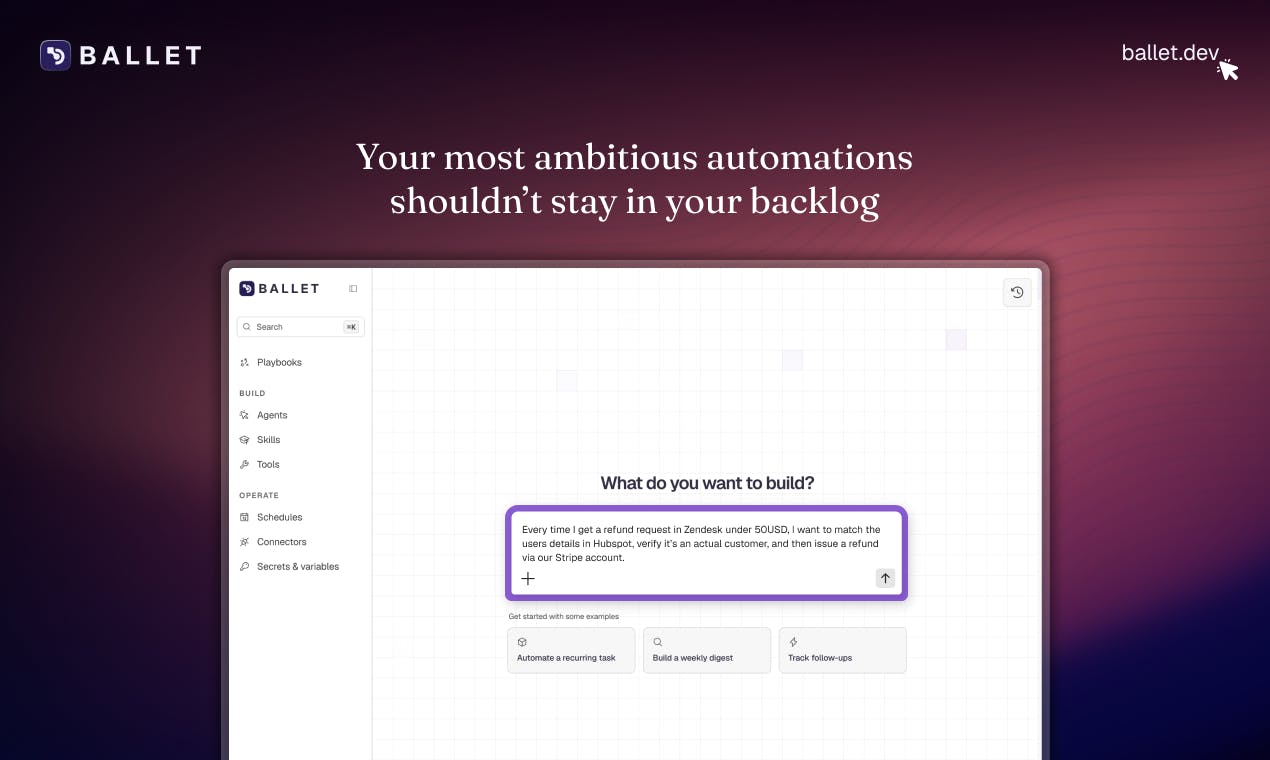
Ballet's core workflow is: operations teams describe a workflow in plain English, and Ballet converts it into code and runs it.
The brilliance of this design lies in the intermediate "codification" layer. Traditional AI Agents typically rely on real-time LLM reasoning with every execution—this is precisely the source of unstable results, as LLMs are inherently stochastic. Ballet solidifies the Agent-generated logic into auditable, reproducible code. Once confirmed, subsequent runs follow the same deterministic logic.
From a technical perspective, the "natural language → code → execution" architecture that Ballet employs is known in academia as Program Synthesis or the Code Generation paradigm. Its core idea is to transform the LLM's role from "executor" to "compiler"—AI only participates in logic generation during the initial phase. Once the code is confirmed, subsequent execution completely decouples from the LLM's probabilistic reasoning, relying instead on a deterministic code runtime for guarantees. This pattern is also called the "LLM-as-Compiler" pattern, in contrast to the "LLM-as-Runtime" pattern (where the LLM is called with every execution), the latter being the primary source of non-determinism.
This transforms "relying on AI to improvise each time" into "generate once, reuse reliably," thereby achieving the official claim of "same outcome every time."
Targeting Operations Teams, Not Developers
Interestingly, Ballet's target users are operations teams, not traditional programmers. It promises to let these teams "automate their hardest ops challenges in minutes."
This means Ballet aims to lower the barrier to automation: business personnel who don't know how to code can have the system automatically generate and run programs simply by describing their requirements. While the product is categorized under Developer Tools, its true value proposition is enabling non-technical people to enjoy the reliability of code-level automation.
Four Key Features Building "Trustworthy Automation"
Beyond the foundational codification logic, Ballet backs up its promise of "determinism" with a suite of enterprise-grade trust features:
Full Audit Log
Every workflow execution has a complete record. For scenarios in finance, compliance, supply chain, and other fields with high traceability requirements, audit logs are essential—when problems arise, you can trace them to their root cause, and they help satisfy regulatory requirements.
Full audit trails have rigid legal requirements in regulated industries. For example, the SOX Act (Sarbanes-Oxley Act) requires publicly traded companies to maintain complete records of operations on financial information systems; GDPR requires enterprises to trace every processing action on personal data. When AI Agents are introduced into these scenarios, if they cannot provide complete execution records—including input data, decision logic, output results, and timestamps—enterprises face compliance risks. Traditional RPA tools like UiPath and Automation Anywhere have long included audit logs as standard features. Ballet bringing this enterprise-grade requirement to Agentic workflows is a necessary condition for reaching production environments.
One-Click Rollback
One of the biggest risks of automation is "errors being amplified at scale." Once something goes wrong in one step, it can instantly affect massive amounts of data or operations. Ballet provides one-click rollback capability, allowing teams to quickly undo changes when errors occur, minimizing the damage.
The rollback concept originates from the ACID principles in database transaction management—specifically the Atomicity requirement: a set of operations must either all succeed or all be undone. In cross-system automation scenarios, implementing rollback is far more complex than in a single database. For example, a workflow might simultaneously involve updating customer records in a CRM system, adjusting inventory in an ERP system, and sending notifications through an email system. Achieving consistent rollback across these distributed operations requires techniques like the Saga pattern or Compensating Transactions. Ballet's one-click rollback means it needs to record the inverse operation for each action at the underlying level—a considerable engineering challenge for scenarios involving external API calls and irreversible operations.
Simulation Mode
Before actual execution, users can preview the workflow in simulation mode, observing what the AI will do and what results it will produce. This is essentially adding a "dry run" safety net to the automation process, avoiding trial-and-error directly in production environments.
The concept of simulation mode is not unfamiliar in software engineering. In the DevOps space, Shadow Deployment or Dark Launch is a mature practice—new versions receive real traffic in production without producing actual impact, allowing teams to compare output differences between old and new versions. In financial trading, Paper Trading lets traders test strategies with real market data without involving actual funds. Ballet applies this approach to the AI Agent execution layer, essentially providing a Sandbox environment for automated workflows, letting users verify whether the AI-generated logic meets expectations without bearing consequences.
Controllable Permissions (You Choose How Much It Can Do)
Ballet lets users decide how much operational authority to grant the Agent. You can limit it to read-only analysis, or gradually expand to write, execute, and higher-level permissions. This progressive authorization mechanism aligns with the industry's widespread concerns about AI Agent safety boundaries.
This mechanism embodies the "Principle of Least Privilege" from the AI safety domain. Since 2024, as AI Agent capabilities have grown rapidly, industry discussions about Agent safety boundaries have intensified. Anthropic proposed the "Constitutional AI" framework to constrain model behavior; OpenAI introduced "human-in-the-loop" mechanisms in its Agent products; Google DeepMind published research papers on Agent Alignment. The core consensus is: AI Agent permissions should be progressive and revocable, rather than granted all at once. This aligns with the Zero Trust architecture philosophy in traditional IT security—never default-trust any entity; verify authorization for every operation.
Why "Determinism" Is Key to Agent Deployment
From an industry perspective, Ballet's product philosophy reflects an important path for AI Agent commercialization.
Over the past year, the market has seen a flood of Agent products claiming to be "fully autonomous." Demo videos are often impressive, but when actually deployed in enterprise production environments, they struggle to scale due to unpredictable results, lack of auditing, and difficulty in error correction. Enterprise operations demand process stability and controllability, not AI outputs that bring surprises (or shocks) every time.
Ballet's approach—using natural language to lower barriers, using code to guarantee determinism, and using auditing, rollback, simulation, and permission controls to build trust—is essentially seeking a balance between "AI's flexibility" and "enterprise reliability requirements." This also represents a mature direction for Agentic products evolving from "showing off" to "being practical."
Notably, Ballet's emergence arrives at a critical juncture in the automation industry's evolution. The first generation of enterprise automation was represented by RPA (Robotic Process Automation), executing repetitive tasks through predefined rules and scripts, with leading vendors including UiPath (whose valuation once exceeded $35 billion), Automation Anywhere, and Blue Prism. RPA's advantage is extremely high determinism, but its weakness is poor flexibility—any process change requires manual script modification. The second generation consists of purely LLM-driven AI Agents, offering extreme flexibility but insufficient determinism. Ballet is attempting to carve out a "third way"—combining LLM's natural language understanding capabilities with code execution's determinism. It can be viewed as an evolution of Agentic RPA or Intelligent Process Automation (IPA). Gartner predicted in its 2024 report that by 2027, over 40% of existing RPA tasks will be replaced by AI-enhanced automation tools.
Determinism May Be the Next Competitive High Ground
Ballet is still in its early stages, and while 96 upvotes isn't a breakout hit, its positioning precisely targets the core anxiety of enterprise automation. As more and more teams begin introducing AI Agents into real business processes, "reliable every time" may prove more persuasive than "can do anything."
For teams following AI automation, Ballet offers a paradigm worth studying: intelligent agents that can truly be deployed in enterprises need to be not only smart, but also predictable, auditable, and controllable. This may well be the threshold that Agentic workflows must cross to achieve large-scale adoption.
Related articles

agent-usage-guard: An Open-Source Tool to Protect Claude Code Usage Windows
agent-usage-guard is an open-source Claude Code mod from Hacker News that monitors usage windows and protects agent tasks from interruption near thresholds.

Award-Winning AI Literature Sparks Debate: Where Are the Boundaries of Creation?
Hacker News discusses AI-generated literary works winning awards, exploring the boundaries of AI creation, the uniqueness of human creation, and the impact on literary award systems.

AI-Generated UI Micro-interaction Prompt Library: A New Show HN Tool
A Hacker News Show HN project, UI micro interactions prompts for AI, offers an AI-oriented collection of interface micro-interaction prompts to help developers generate hover, transition, and loading animations via prompts, filling the gap where AI writes UI for function but not experience.