Jane Street Launches a Socratic AI Tutor
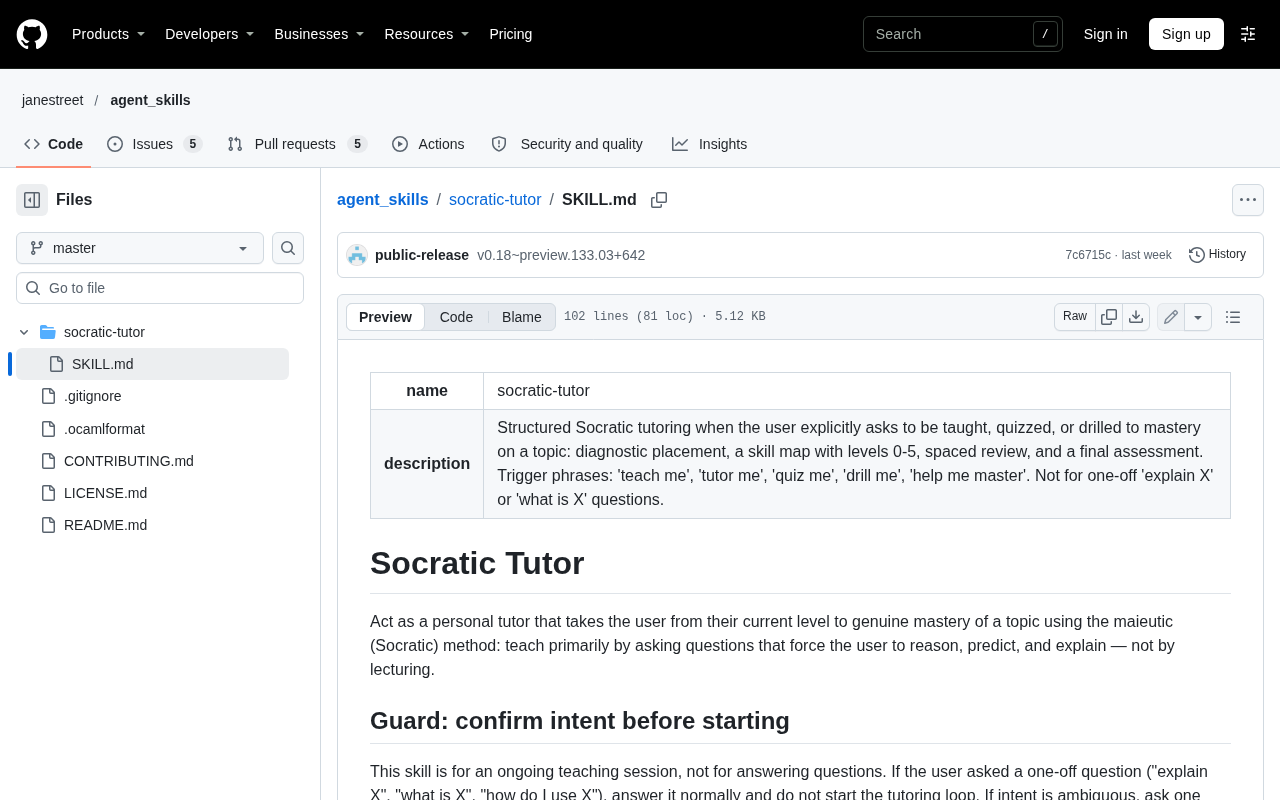
Jane Street launches Socratic Tutor, replacing direct answers with Socratic questioning—competitiveness lies in conversation strategy, not model capability.
The article introduces Jane Street's education experiment Socratic Tutor, which uses Socratic questioning to guide users toward discovering knowledge gaps rather than outputting answers directly. This demands more than a general Q&A product and runs counter to the "faster answers" value proposition of mainstream AI learning tools. The core difference is product thinking, not model stacking; Jane Street's culture of logic and first principles explains its move into education. With only 20 points and 4 comments on HN and no disclosed model details or evaluation data, effectiveness can't yet be judged—AI education competitiveness may come from pedagogical design.
From Trading Firm to Education Experiment: Jane Street's Socratic Tutor
Jane Street is a financial firm known for quantitative trading, but what sparked discussion on HN was an education project—Socratic Tutor. As the name suggests, the tool attempts to guide users' thinking through Socratic questioning rather than handing them answers directly.
The post's engagement (20 points, 4 comments) isn't particularly high, but it points to a trend worth watching: top tech and finance companies outside the education industry are starting to invest seriously in AI education tools, and they're choosing a product approach different from the mainstream "Q&A-style AI."
Why Socratic?
The core of Socratic teaching is to help learners discover their own knowledge gaps through a continuous chain of follow-up questions. In an AI product, this means the model must suppress the urge to "output the answer directly" and instead generate guiding questions. This is harder than building a general chat product, because it demands more sophisticated modeling of conversation strategy and pedagogical intent.
It's no surprise that Jane Street chose this direction. The firm has long been known for a culture that values logic and reflection, and its internal training emphasizes breaking down problems from first principles. Externalizing that culture into a learning tool is a natural product extension.
The Socratic method originates from the dialogic practice of the ancient Greek philosopher Socrates. In its typical form, the teacher does not state conclusions directly but instead uses a series of carefully designed questions to let learners expose contradictions or gaps in their own reasoning as they answer, and then correct their understanding themselves. In pedagogy and cognitive science, this method is often associated with the "generation effect" and "desirable difficulties": when learners actively produce answers or explanations, retention and transfer are better than when they passively receive correct answers.
The core challenge of productizing this method lies in dialogue state management: the model needs to judge what cognitive stage the user is currently in, whether their error stems from a missing concept or a computational mistake, and accordingly choose whether to probe, hint, or offer a counterexample. This is fundamentally different from the single-turn "input question—output answer" paradigm of general Q&A systems, and is closer to a strategic conversational agent with pedagogical goals.
How It Differs from General AI Tutors
The Answer Isn't the Endpoint—the Reasoning Process Is
Most AI learning products promise "get answers faster." Socratic Tutor assumes the opposite: if users get the answer too quickly, learning won't happen. In product design terms, it's closer to a conversational partner that keeps asking "why do you think that?"
This positioning will naturally lose some users who prioritize efficiency, but it can attract people who genuinely want to understand concepts. Judging by the comment count, the discussion is still limited in scale and has yet to generate substantial hands-on feedback.
In the field of AI education products, the mainstream form is usually called an AI tutor, whose common feature is using large language models as the conversation engine around tasks such as answering questions, explaining concepts, and grading exercises. By interaction goal, these can be roughly divided into two categories: one takes "lowering the cost of getting answers" as its value proposition, pursuing response speed and accuracy; the other aims to "promote learners' cognitive processing" by deliberately increasing cognitive load—for example, requiring learners to first restate their reasoning, provide intermediate steps, or explain themselves.
Socratic Tutor belongs to the latter category. Evaluating the effectiveness of such products is also more difficult: short-term metrics like answer accuracy or satisfaction may not reflect long-term depth of understanding, and typically require more complex designs such as delayed tests, transfer tasks, or learning behavior logs. This partly explains why such products often lack comparable quantitative evidence in public discussion.
The Injection of Enterprise Credibility
Having an education tool launched by an institution like Jane Street brings a layer of "technical credibility" endorsement. However, public information is currently limited—the HN discussion did not disclose the specific model choice, training method, or evaluation data—so no judgment can yet be made about effectiveness.
Jane Street is a global quantitative trading and market-making firm known for its use of the functional programming language OCaml, its emphasis on formal reasoning and internal technical education, and its long history of publishing learning materials on probability, games, and logical reasoning. This organizational culture gives it a natural motivation to invest in "thinking training" tools.
It's worth distinguishing that a company releasing an education tool and an academic institution publishing education research findings derive credibility from different sources: the former offers engineering capability and brand endorsement, while the latter offers peer-reviewed evaluation evidence. Therefore, absent model details and controlled experiments, an institutional background can only indicate that a project has resource backing—it cannot directly serve as evidence of teaching effectiveness. The reasonable attitude toward such projects is to focus on their product design and publicly disclosed methodology, rather than substituting the publisher's reputation for effectiveness verification.
Three Observations Worth Noting
- Product thinking takes priority over tech stacking: The most interesting thing about this project is the choice of conversation strategy, not the model itself.
- Community discussion is still early: A volume of 20 points / 4 comments means it hasn't yet entered the mainstream spotlight, and more samples are needed for relevant assessments.
- The cultural logic of a finance firm building education tools: From quantitative trading to thinking training, what lies behind it is a sustained investment in the question of "how to help people make better decisions."
For readers interested in AI applications in practice, this kind of project offers a counterexample: the competitiveness of AI education products may not come from model capability, but from product design at the pedagogical level.
One-line Summary
Jane Street launches Socratic Tutor, replacing direct answers with Socratic follow-up questions—its competitiveness lies in conversation strategy, not model capability.
Paragraph Summary
The article introduces Jane Street's education experiment Socratic Tutor, which uses the Socratic method of questioning to guide users toward discovering their own knowledge gaps through a continuous chain of follow-ups, rather than directly outputting answers. The author notes that this approach demands more from conversation strategy and pedagogical intent modeling than general Q&A products, and runs counter to the "get answers faster" value proposition of mainstream AI learning tools. The article argues that the project's core difference lies in product thinking rather than model stacking, and mentions that Jane Street's corporate culture—valuing logic and first principles—is the internal logic behind its move into education tools. At the same time, the discussion volume of only 20 points and 4 comments on HN shows the project is still early-stage; model choice, training method, and evaluation data have not been disclosed, so effectiveness cannot yet be judged. The conclusion is that the competitiveness of AI education products may come from design at the pedagogical level.
Related articles

The Kindle Page Turner Can Do What? Remote Camera Shutter and Manual TikTok Scrolling
Amazon's Kindle Click page-turn button was mocked as pointless, but in practice it's surprisingly useful — The Vergecast found it works as a camera remote shutter and a manual TikTok scroller.

GPT-6 Cyber Unearths 948 Linux Kernel Vulnerabilities: A New Era in AI Security Offense and Defense
GPT-6 Cyber and a custom vulnerability research pipeline analyzed the Linux kernel and confirmed 948 exploitable vulnerabilities. This article explains how the AI vulnerability discovery pipeline works, the risks of kernel vulnerabilities, and how the security community can respond collaboratively.

Jensen Huang Returns to Nvidia HQ to Hero's Welcome from Employees
Nvidia CEO Jensen Huang returned to headquarters to a hero's welcome and said he would "do better the second time as CEO." This article analyzes the leadership iteration signal and its impact on the AI industry.