Jango: Using AI Agents to Simulate Real Users and Solve the Multi-User App Testing Problem

Jango deploys AI agents with independent goals and memory to automate multi-user app testing scenarios.
Multi-user collaborative apps (chat, collaborative docs, social platforms) have long lacked effective automated testing tools, since their core logic depends on real-time interplay between multiple user sessions — something traditional single-user test frameworks can't handle. Jango's solution is a set of AI agents, each with an independent browser, account, goals, and memory, autonomously simulating real user behavior. Developers can issue instructions, join the test as themselves, or take over any agent's screen for debugging. Tests conclude with structured reports containing action logs, errors, and screenshots. The tool supports your own AI Key or hosted AI, and is currently Mac-only. Its key challenge lies in agent stability and reproducibility — a bottleneck shared by all agentic automation tools.
Testing multi-user collaborative applications has long been a headache for developers. Chat tools, collaborative documents, online games, social platforms — the core value of these products lies precisely in "multiple users being online simultaneously and influencing each other," which is exactly the scenario that traditional automated testing struggles most to cover. Jango, a developer tool that recently appeared on ProductHunt, offers an imaginative solution: deploying a group of AI agents to play the role of real users and run through these interaction scenarios on your behalf.
What Problem Does Jango Actually Solve
Automated testing for single-user flows is already mature — tools like Cypress and Playwright can simulate a single user clicking, typing, and navigating. But when application logic depends on "User A's actions affecting what User B sees," things get complicated. You need to simultaneously maintain multiple sessions, multiple accounts, and multiple states, and have them correctly interweave along a timeline.
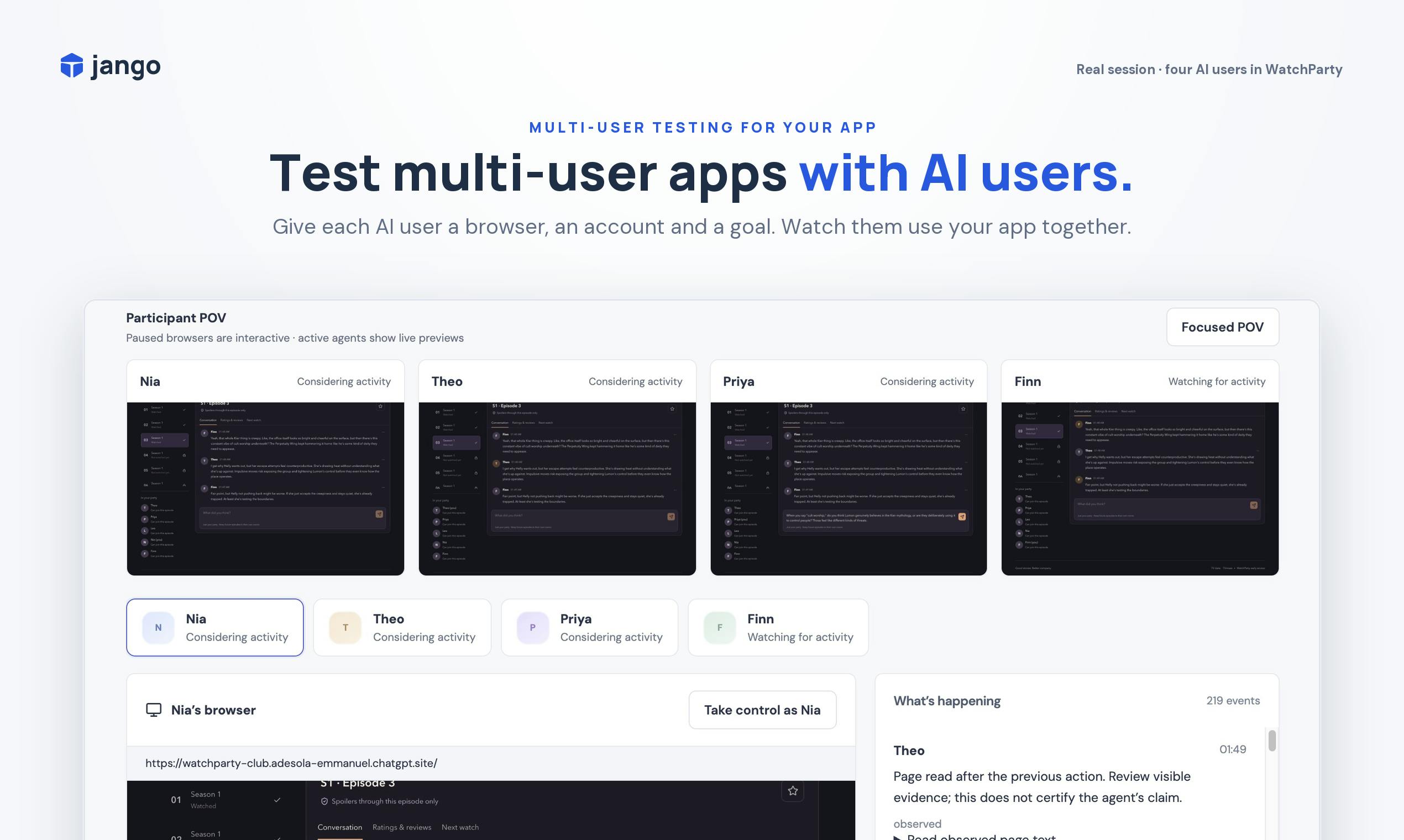
Jango is specifically positioned to test features that "require more than one person." According to the official description, it provides your application with a set of AI users, each with an independent browser, independent account, their own goals, and their own memory. You simply point Jango at your development environment URL and watch in real time as these AI users log in and interact with each other.
The design of "each agent having its own goals and memory" is key. It means AI users aren't mechanically replaying scripts — they're acting with intent, more closely resembling the way real users explore, make mistakes, and collaborate within a product.
Breaking Down the Core Capabilities
Based on the product description, Jango's capabilities can be broken down into several layers.
Independent Multi-User Sessions
Each AI user is equipped with an independent browser and account, isolating session state at the foundational level. This addresses the most basic pain point in multi-user testing — you no longer need to manually open multiple incognito windows or switch between multiple test accounts. Jango sets up the entire "cast of extras" for you.
Traditional multi-user testing typically relies on "browser context isolation" — what Playwright calls BrowserContext, while Cypress requires plugins or multi-process solutions. Each context maintains independent cookies, LocalStorage, and network state. However, orchestrating the timing coordination between multiple contexts (for example, waiting for User B's interface to update after User A sends a message) still requires developers to hand-write a significant amount of synchronization logic. Jango's approach is to hand this orchestration layer over to AI agents for autonomous decision-making, shifting from "you write timing scripts" to "AI understands the goal and coordinates independently." This reduces the scripting complexity of multi-session testing, but also partially cedes deterministic control to the model.
Directable, Joinable, and Takeover-Capable
Jango emphasizes three modes of interaction: you can direct AI users with instructions, join in as yourself, or take control of any AI user's screen directly. This human-AI hybrid operating mode is highly practical — when an AI gets stuck at a certain step or its behavior deviates from expectations, developers can jump in at any time to manually investigate, rather than waiting for a failure report.
Structured Test Reports
After each test run, Jango generates a report containing actions, errors, and screenshots. For debugging purposes, "screenshots at the moment of failure" are often more valuable than plain text logs, as they can directly pinpoint issues at the UI level.
Flexible AI Integration
On the model integration side, Jango offers two options: use your own AI Key, or use Jango's hosted AI service. The former is friendly to teams that want control over costs and model selection, while the latter lowers the barrier to entry. The tool currently only supports Mac.
Why This Direction Is Worth Watching
Using AI agents as "test users" is essentially a concrete application of agentic browser automation. Over the past year or two, AI agent technology capable of autonomously operating browsers to complete tasks has become increasingly mature. Jango has aimed this capability at multi-user testing — a need that is specific enough and painful enough to be meaningful.
Compared to having a test team manually organize multi-person debugging sessions, or writing complex multi-session automation scripts, Jango's value proposition lies in "setting goals in natural language + autonomous AI execution + human intervention at any time." If its agent stability is sufficiently high, it could theoretically significantly reduce the testing costs for multi-user collaborative features.
Jango garnered 70 votes, 15 comments, and a #9 ranking in a Vercel Day-related launch, indicating that this direction has genuinely caught the attention of the developer community. Being categorized under both Developer Tools and Artificial Intelligence also confirms that "AI + engineering efficiency" is emerging as a clear product track.
"Agentic browser automation" refers to AI models that can autonomously perceive web page content (typically through screenshots or DOM parsing), plan operational steps, and invoke mouse and keyboard APIs to complete interactions — all without pre-recorded scripts. Notable implementations include Anthropic's Computer Use, Google's Project Mariner, and the open-source project Browser Use. The key difference from traditional RPA (Robotic Process Automation) is that RPA relies on fixed selectors and flowcharts and breaks when page structure changes, whereas agentic solutions understand semantics through models and are more robust to UI modifications. Jango embeds this capability into testing scenarios, and its core bet is that "the model's ability to understand interfaces is sufficient to replace manually written assertion logic."
Potential Questions and Limitations
Based on publicly available information, several questions remain to be verified. First is the reliability and reproducibility of AI user behavior — the value of a testing tool lies in stability, and if the same goal produces different results each time, it's difficult to use as a basis for regression testing. Second is the boundary of agents' ability to understand complex business logic — whether AI can truly complete highly customized interaction flows "like a real user" still needs to be verified through actual use. Third, the current Mac-only support creates a barrier for development teams on other platforms.
All of these are normal for a new tool in its early stages, and they are the key observation points for determining whether it can move from "an interesting demo" to "a daily productivity tool."
The "reproducibility" problem with AI testing tools fundamentally stems from the stochastic sampling mechanism of large language models (when temperature > 0, outputs vary with each run). In regression testing scenarios, this creates a fundamental tension with the "idempotency" requirements of traditional testing — when the same test suite produces different results at different times, it becomes ambiguous whether "this build introduced a bug." Common industry mitigation strategies include: setting temperature to 0 to improve determinism, using hard-coded selectors rather than AI judgment for critical assertion steps, and recording the agent's complete decision trajectory for comparison. Jango's publicly available information has not yet clearly stated its design choices on this issue, making it a key unknown in evaluating whether it can handle regression testing tasks in a CI/CD pipeline.
Summary
Jango has identified a gap that existing testing tools have long overlooked: automating multi-user interaction scenarios. Using AI agents with independent goals and memories to simulate groups of real users, combined with a hybrid operation mode where humans can intervene and take control at any time, plus structured reports — this approach has clear appeal for developers building chat, collaboration, and social products. How significant a role it can play in real-world practice depends on agent stability and adaptability to complex scenarios, which is the shared challenge facing all agentic tools.
Related articles

MCP Security Primer: OWASP Top 10 Risks and the Lethal Trifecta Defense
A systematic breakdown of MCP security risks: from the Postmark backdoor to the OWASP MCP Top 10, how the Lethal Trifecta reveals AI Agent fragility, plus shadow servers and missing audits.

DeepCell: One-Click AI Generation of Documents, Spreadsheets, and Slides
DeepCell tops Product Hunt with one-click generation of documents, spreadsheets, and slides, using the .deepcell format for linked updates, designed for System 2 tasks like modeling and sales reviews.

Doneas: 15-Minute Daily Accountability Calls That Keep Indie Developers From Procrastinating
Doneas is a daily accountability tool for indie developers: plan tasks on Monday, join a 15-minute call with five builders each day, and log deliveries on a public progress page. This article analyzes its core mechanics, effectiveness, and potential issues around retention and matching.