Japan's AI Dilemma: Why Does It Depend on China's DeepSeek?
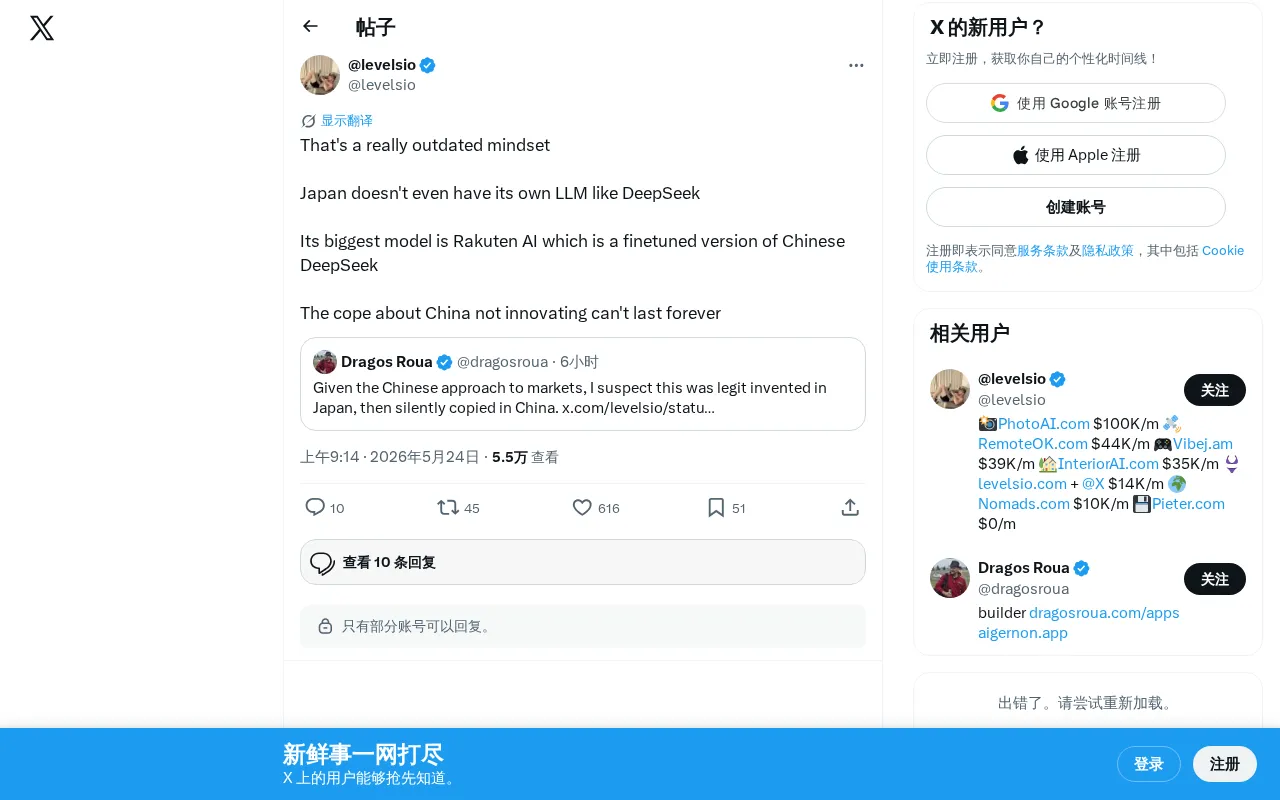
Japan's largest AI model relies on China's DeepSeek as global AI shifts to a China-US duopoly.
Japan's Rakuten Group built its largest AI model by fine-tuning China's DeepSeek, exposing Japan's lack of indigenous foundation model capabilities. DeepSeek achieved top-tier performance at minimal cost through innovations like Mixture of Experts architecture, and expanded its global influence via open source—marking China's transition from AI follower to peer competitor or even leader, shattering the "China doesn't innovate" narrative.
A Thought-Provoking Observation
Recently, a viral social media post raised a pointed question: Japan—once a global tech powerhouse—has no original large language model (LLM) of its own in the current AI race. Its largest AI model, Rakuten AI, is actually fine-tuned from China's DeepSeekAd.
While brief, this observation touches on a long-overlooked reality in the global AI competition: the narrative that "China doesn't innovate" is being shattered by facts on the ground.
What is a Large Language Model (LLM)? A Large Language Model is a deep learning model built on the Transformer architecture, trained on massive text datasets. Its core capabilities lie in understanding and generating natural language, with broad applications in conversation, translation, code generation, content creation, and more. Training a top-tier LLM requires thousands or even tens of thousands of high-end GPUs (such as NVIDIA A100/H100) running continuously for months, with costs easily reaching hundreds of millions of dollars. This is why only a handful of organizations worldwide can independently train frontier foundation models, creating extremely high technical and capital barriers—and why "having an indigenous foundation model" has become a core metric for measuring a nation's AI strength.
The Rise of DeepSeek and Its Global Impact
From Follower to Foundation
DeepSeek, a domestically developed Chinese large language model, has risen rapidly in the global AI landscape in recent years. Its open-source strategy and impressive performance have made it not only widely adopted within China but also a foundational infrastructure for AI capabilities across multiple countries and enterprises abroad.
DeepSeek was founded in 2023 by High-Flyer, a Chinese quantitative hedge fund. Its DeepSeek-V2, V3, and R1 series models have repeatedly set new records on international benchmarks. DeepSeek's most notable innovations lie in its combination of Mixture of Experts (MoE) architecture and Multi-head Latent Attention (MLA) mechanism, which dramatically reduce memory usage and computational costs during inference. According to public reports, DeepSeek-V3's training cost was approximately $6 million—only a fraction of what comparable American models cost. This engineering efficiency breakthrough is widely regarded in the industry as genuine technical innovation, not mere resource accumulation.
The fact that Japan's Rakuten Group chose to fine-tune its AI model based on DeepSeek speaks volumes about DeepSeek's world-class technical capabilities.
The Relationship Between Fine-tuning and Foundation Models Fine-tuning refers to the process of performing secondary training on an existing pre-trained foundation model using domain-specific data, adapting the model to specific languages, industries, or task requirements. Fine-tuning costs far less than training from scratch—typically requiring only dozens of GPUs running for a few days. However, a fine-tuned model's core capabilities are highly dependent on the quality of the foundation model—the foundation model's reasoning ability, knowledge breadth, and language comprehension form the ceiling for any fine-tuned derivative. Therefore, choosing which foundation model to fine-tune is essentially a public endorsement of that model's technical strength. When a leading tech company from a developed nation chooses to rely on another country's foundation model, the balance of technical power has clearly shifted.
Japan's Structural Challenges in AI Development
Japan dominated the global semiconductor and consumer electronics industries in the 1980s and launched the ambitious "Fifth Generation Computer" project in 1982, aiming to lead the AI era. However, that project ultimately failed, and Japan's transition through the software and internet eras was relatively sluggish. In the deep learning era, while Japan boasts tech giants like Toyota, Sony, and Fujitsu, it faces significant gaps compared to China and the US in cloud computing infrastructure, data scale, and top-tier AI talent reserves. Although the Japanese government released an AI strategy in 2023 with increased investment, catching up at the foundation model level remains an enormous challenge.
This historical context, combined with the following structural factors, collectively explains Japan's lag in foundation models:
- Insufficient computing investment: Training top-tier LLMs requires massive GPU cluster investments, and Japanese companies' spending in this area falls far short of China and the US
- Severe brain drain: Top AI research talent continues flowing to Silicon Valley and Chinese tech companies
- Language data limitations: Japanese, as a relatively niche language, has limited high-quality training data at scale
- Conservative corporate culture: Decision-making mechanisms in large Japanese corporations struggle to keep pace with AI's rapid iteration cycles
The Collapse of the "China Doesn't Innovate" Narrative
From Imitation to Leadership
For a long time, a deeply entrenched perception has existed in the West and parts of Asia: China can only copy, not innovate. This view may have had some basis a decade ago, but in the AI landscape of 2024-2025, reality has completely changed.
DeepSeek not only competes with OpenAI's GPT series in model performance but also demonstrates a unique innovation path in training efficiency and open-source ecosystem development. Achieving near-top-tier performance at relatively low cost is itself a major engineering innovation.
A Reshuffling of the Global AI Landscape
The current global AI foundation model competition is shifting from "US dominance" to a "China-US duopoly." Traditional tech powers like Europe, Japan, and South Korea have clearly fallen behind in this round and must choose between or balance the two major technology ecosystems.
Notably, DeepSeek's open-source strategy plays a crucial role in this reshaping. Open-source models allow developers, enterprises, and research institutions worldwide to fine-tune, deploy, and build upon them, creating powerful network effects—the more users, the more vibrant the ecosystem, which in turn reinforces the foundation model's influence and standard-setting power. This closely mirrors Linux's rise in the operating system space: trading openness for ecosystem dominance, ultimately gaining authority over technical standards. Meta's LLaMA series rapidly built a massive developer community through open source; DeepSeek is following a similar but potentially more globally influential path.
Implications for the Industry
This phenomenon offers several important takeaways:
- Foundation model capability is the core competitive advantage of the AI era—nations without indigenous foundation models will be constrained at the application layer
- Open-source strategy is an effective means of expanding technological influence—DeepSeek has achieved ecosystem influence far exceeding that of proprietary models through open source
- Judgments about innovation capability must evolve with the times—clinging to outdated biases leads only to strategic miscalculation
The global AI competitive landscape continues to evolve rapidly, but one thing is becoming increasingly clear: on the foundation model track, China has gone from following to running alongside, and in certain dimensions, has taken the lead.
Key Takeaways
- Japan's largest AI model, Rakuten AI, is actually fine-tuned from China's DeepSeek, lacking an indigenous original foundation model
- DeepSeek's rise signals that China has reached world-class levels in AI foundation models
- The traditional "China doesn't innovate" narrative is being shattered by realities in the AI field
- The global AI competitive landscape is shifting from US dominance to a China-US duopoly
- Indigenous foundation model capability has become a critical indicator of national core competitiveness in the AI era
Related articles
Meta Muse Hits 900K Downloads in Six D…
Meta Muse Hits 900K Downloads in Six Days: The AI Agent Era Has Officially Arrived
Meta's AI agent Muse hit 902K downloads in 6 days, topping US App Store and Google Play charts above ChatGPT and Claude. A deep dive into Muse's capabilities and the AI Agent race.
 Industry Insights
IRS Fully Embraces Claude AI, Accelerating Federal Government's AI Adoption
The IRS is recruiting staff with 24/7 Claude AI access, marking Anthropic's breakthrough into the federal government. Explore the strategic implications and tax use cases.
 Industry Insights
The IRS Mobile App Debate: A Trust Crisis in Government Digital Transformation
The IRS's proposed mobile app has sparked heated debate. This article analyzes the core arguments, exploring data security, privacy, and the trust crisis in government digital transformation.