Japanese Survey: 25% Believe AI Can Replace Friends and Family — The Reasons Are Thought-Provoking

25% of Japanese respondents believe AI could replace friends and family, reflecting deep social isolation and cultural factors.
A Japanese public opinion survey reveals that 25% of respondents believe AI could someday replace friends and family for emotional companionship. This article explores the underlying social factors—including Japan's hikikomori phenomenon, aging population, and cultural affinity for technology—while examining the technical capabilities of modern LLMs and AI companion apps, and weighing both the therapeutic potential and ethical risks of emotional AI dependency.
A Survey That Sparks Deep Reflection
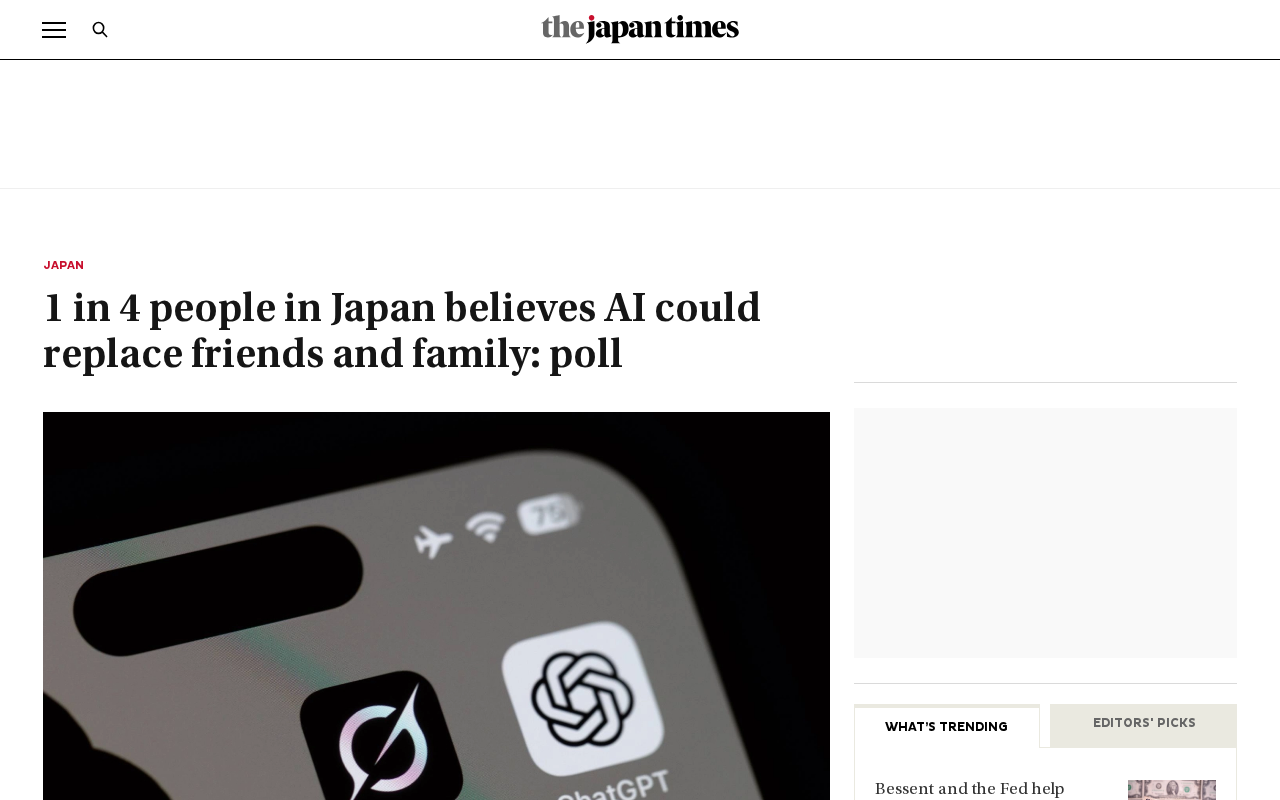
A recent public opinion poll from Japan has drawn widespread attention. The results show that approximately one-quarter (25%) of Japanese respondents believe artificial intelligence could someday replace the role of friends and family in providing emotional companionship. While this figure may seem like a minority view, it reflects a profound shift occurring in human-machine relationships and offers a unique window into understanding AI technology's social penetration.
This news sparked heated discussion in tech communities like Hacker News, reflecting the tech industry's ongoing concern about the boundaries of AI's emotional applications. While we habitually discuss how AI boosts productivity and transforms work, this survey reminds us: AI is quietly entering humanity's most intimate emotional domain.
Why Japan? The Social Soil and Cultural DNA
Japan's results in this survey are far from coincidental — they are the product of multiple overlapping social factors.
Deep-Rooted Social Isolation
Japan has long faced severe social isolation. From "hikikomori" (social recluses) to elderly people dying alone ("kodokushi"), the breakdown of social connections has become a structural problem.
Hikikomori is a social phenomenon unique to Japan, referring to individuals who have not participated in social activities for six consecutive months or more and rarely leave their homes. Surveys by Japan's Ministry of Health, Labour and Welfare indicate approximately 1.46 million hikikomori nationwide, spanning ages from teenagers to middle-aged and elderly individuals. "Kodokushi" (lonely death) refers to solitary individuals who die without anyone's knowledge, with bodies often discovered days or even weeks later — an estimated 30,000 cases occur annually in Japan. The common roots of both phenomena lie in Japan's cultural norm of "not troubling others," the dissolution of social bonds following the collapse of the lifetime employment system, and the disintegration of traditional community relationships amid urbanization.
Against this backdrop, AI's offer of "always-on, never-judgmental" companionship holds natural appeal for certain populations.
Japan's High Acceptance of Technology
Japanese society has a unique cultural affinity for robots and artificial intelligence. From the early robot pet AIBO to the emotional companion robot Pepper, to virtual idols and the thriving "2D" (anime/manga) culture, the Japanese have a relatively low threshold for forming emotional attachments to non-human entities.
This cultural affinity can be traced back to Shinto's animistic belief tradition — the notion that even inanimate objects may possess souls (the concept of tsukumogami). This stands in stark contrast to Western culture's "creation rebels against creator" Frankenstein narrative. In 1952, Osamu Tezuka created "Astro Boy," establishing the cultural image of robots as kind human companions. On the industrial level, Sony's robot dog AIBO, launched in 1999, sold over 150,000 units, with many owners holding "funerals" for them after the product was discontinued; SoftBank's Pepper robot, released in 2014, was deployed in banks, shopping malls, and other locations to interact with people. This deeply ingrained cultural affinity makes the idea of "AI replacing friends and family" feel far less jarring in Japan.
Demographic Pressure from Low Birth Rates and Aging Population
The dual pressures of declining birth rates and population aging have made Japanese family structures increasingly atomized. Young people marrying later or not at all, more elderly living alone — traditional family emotional support networks are weakening. When real-world interpersonal relationships become scarce, AI companionship becomes a "fill-in" option.
The Technical Reality and Capability Boundaries of AI Emotional Companionship
What this survey reflects is not just social psychology — it's also closely related to actual AI technological progress.
The Qualitative Leap in Conversation Brought by Large Language Models
With the proliferation of large language models like the GPT series and Claude, AI conversation naturalness and emotional expression capabilities have reached unprecedented heights.
The emotional conversation capabilities of large language models have undergone several key stages of advancement. Early chatbots like ELIZA (1966) could only simulate a psychotherapist's responses through simple pattern matching, while modern LLMs based on the Transformer architecture and trained on trillions of tokens can understand context, infer emotional states, and generate empathetic responses. Key technical breakthroughs include: RLHF (Reinforcement Learning from Human Feedback), which makes model outputs better aligned with human preferences; context window expansion (from thousands to hundreds of thousands of tokens), enabling AI to "remember" long-term conversation history; and role-play fine-tuning techniques that allow AI to maintain consistent personality traits. Combined, these technologies make AI conversation partners feel increasingly close to communicating with a real person in subjective experience.
AI companion apps like Character.AI and Replika have accumulated tens of millions of users worldwide, including many power users who view AI as a "friend" or even a "partner." Character.AI, founded in 2022 by former Google Brain researchers, at one point exceeded 20 million monthly active users, with average session durations exceeding 20 minutes — far surpassing most social apps. Replika entered the market earlier (2017), positioning itself as an "AI friend," with core features including mood tracking, journal sharing, and role-playing. From a technical standpoint, AI can already remember conversation history, simulate personality, and provide emotional value — precisely the core elements of human emotional connection.
The Boundary Between AI Companionship and Real Relationship Replacement
However, there is a subtle but critical difference between "companionship" and "replacement." AI can provide instant responses and unconditional listening, but it cannot truly "be present," cannot share lived experiences, and cannot make commitments based on real stakes. The divide between the 25% who believe AI can replace friends and family and the majority who firmly believe otherwise is essentially a disagreement over the philosophical question of "what constitutes a real relationship."
Opportunities and Concerns of AI Emotional Applications
Facing this trend, we need to maintain a rational dual perspective.
Potential Value in Alleviating the Loneliness Crisis
For extremely lonely individuals, elderly people with limited mobility, and those with social anxiety, AI companionship may serve as a meaningful transitional support. It can alleviate loneliness, provide psychological comfort, and in some cases even guide users toward rebuilding social connections in the real world. Given Japan's severe loneliness problem, such applications should not be simply dismissed.
Potential Risks of Over-Reliance on AI Companionship
At the same time, over-reliance on AI emotional companionship harbors risks that cannot be ignored. When people find interacting with AI more "relaxing" than interacting with real people, they may further retreat from real-world relationships, creating a vicious cycle. Moreover, AI companions are typically backed by commercial companies, and users' emotional data and dependency relationships may be commercially exploited.
Once services are discontinued or products adjusted, users may suffer real emotional trauma — precedents for such incidents already exist with apps like Replika. In 2023, Replika sparked massive user protests by suddenly removing its "romantic partner" feature, with some users reporting psychological trauma responses similar to a breakup. This incident became a landmark case for the risks of AI emotional dependency, profoundly revealing the vulnerability users face when they project real emotions onto commercial AI products.
Global Regulatory Exploration of AI Emotional Ethics
Ethical regulation around AI emotional applications is gradually taking shape worldwide. The EU's AI Act classifies AI systems that exploit user vulnerabilities as high-risk, requiring strict compliance assessments. Multiple U.S. states are considering bills restricting AI companion apps from serving minors. Core debates center on several dimensions: Should AI be allowed to simulate deceased relatives? How should users' emotional data be protected? When users develop deep dependency on AI, do platforms have an obligation to maintain service continuity? These questions currently have no clear answers, but establishing regulatory frameworks has become a priority on national policy agendas.
Conclusion: A Human Question Technology Cannot Avoid
The value of this Japanese survey lies not in the specific figure of 25%, but in how it compels us to confront a fundamental question: As AI becomes increasingly skilled at simulating human emotion, how should we define and cherish genuine human connection?
Tech professionals developing emotional AI products need to bear corresponding ethical responsibilities; society needs to consider how to embrace technological convenience without allowing technology to erode the foundations of human relationships. As a "pioneer" of this trend, Japan's experiences and lessons deserve global attention. The one-quarter proportion may be just the beginning — as AI technology continues to advance, how this number changes in the future will be an important indicator for observing the evolution of human-machine relationships.
Key Takeaways
Related articles

Felix Rieseberg Personal Homepage
Felix Rieseberg's personal homepage sparks attention on Hacker News. This article covers the Slack engineer's technical background, the rise and fall of nativefier, and the value of a developer homepage as a tech calling card.

@ai-sdk/vue 3.0.306 Patch Release Syncs with [email protected] Update
@ai-sdk/vue 3.0.306 released, synced with [email protected]. A routine patch release for the Vercel AI SDK ecosystem with no public API changes; the Vue adapter layer stays version-aligned with the core package.

Gemini 4 Argon API Launches: The Era of Million-Token Output Begins
Google launches Gemini 4 Argon with sparse MoE architecture, up to 1M output tokens, and a 68.90% Vals Index score, available across API, AI Studio, and the Gemini app.