jasna: An Open-Source Video Restoration Tool That Gives Old Videos New Life

Open-source Python video restoration tool jasna has 2,193 stars, 115 new stars per day, lightweight and customizable.
jasna is an open-source video restoration tool written in Python. Its GitHub repository is Kruk2/jasna, and it has currently earned 2,193 stars and 171 forks, with 115 new stars in a single day, showing high popularity. Positioned as video restoration, it may cover denoising, deblurring, super-resolution, and color correction, aiming to provide developers and content creators with a lightweight, customizable alternative to expensive professional software or complex filter chains. Python lowers the barrier to entry and facilitates integration into existing video processing pipelines or secondary development. Potential applications include restoring old videos, improving the quality of low-resolution online videos, film and television post-production preprocessing, and serving as an experimental platform for video enhancement algorithms. However, the project documentation is currently brief, and newcomers need to read the source code or examples to get started.
In today's world of exploding short-form video and streaming content, the demand for restoring low-quality video is growing. The open-source project jasna on GitHub (repository Kruk2/jasna) is a tool focused on video restoration. With its clean design and powerful features, it has already earned 2,193 stars and 171 forks, with 115 new stars in a single day—a clear sign of its popularity.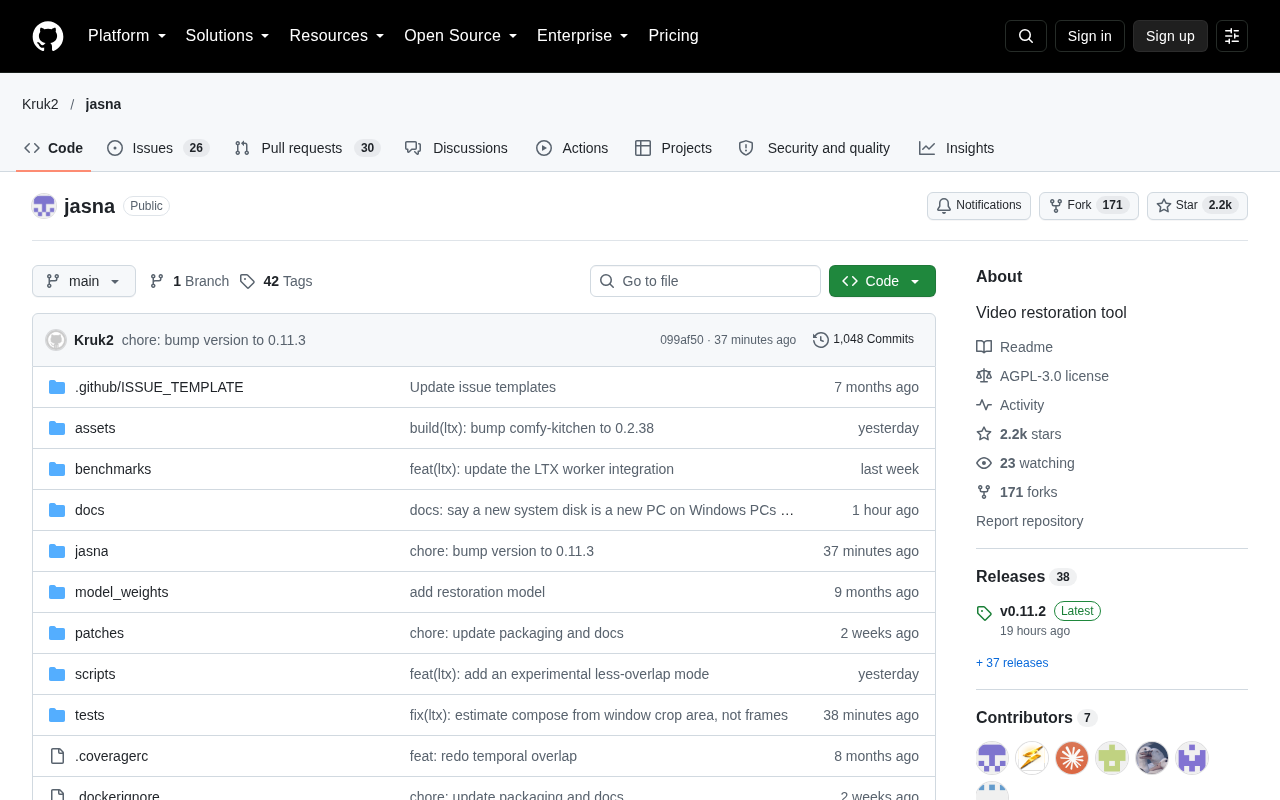
Why Do We Need Video Restoration?
Video restoration is not a new topic, but traditional solutions often rely on expensive professional software or complex filter chains. jasna offers developers and content creators a lightweight, customizable alternative. It is written in Python, which means you can easily integrate it into existing video processing pipelines or build on the source code for secondary development.
Judging from the project description "Video restoration tool," jasna's core goal is to repair damaged, blurry, or low-quality video. Although the README does not provide much detail, based on community discussion and experience with similar tools, such tools typically cover denoising, deblurring, super-resolution, color correction, and other functions.
Project Status and Community Response
jasna is active on GitHub: 2,193 stars and 171 forks indicate that it has already attracted a group of early adopters. The growth rate of 115 new stars per day suggests that the project may have been recently recommended or updated. The choice of Python lowers the barrier to entry, making it especially suitable for developers in data science and AI to get started quickly.
However, the project documentation is currently relatively brief, and newcomers may need to read the source code or refer to examples to understand specific usage. This is also a common state for many early-stage open-source projects, and community contributions will determine their future development.
Tech Stack and Potential Applications
Video restoration tools based on Python usually combine libraries such as OpenCV and FFmpeg for frame-level processing. jasna may adopt a similar architecture, but the specific implementation requires further exploration. Its open-source nature means you can adjust algorithm parameters according to your needs, or even replace the restoration model.
Potential application scenarios include:
- Restoring old family videos and historical footage
- Improving the quality of low-resolution online videos
- Providing preprocessing tools for film and television post-production
- Serving as an experimental platform for research on video enhancement algorithms
Super-Resolution in video restoration refers to the technology of reconstructing a high-resolution version from low-resolution video. Traditional methods are based on interpolation (such as bicubic interpolation), but they lose high-frequency details; modern approaches mostly use deep learning models (such as ESRGAN and BasicVSR), learning the mapping from low definition to high definition through convolutional networks or Transformers. Video super-resolution also needs to consider temporal consistency between frames to avoid flickering after frame-by-frame processing. If jasna involves this feature, it likely encapsulates pre-trained models, and users can replace model weights to adapt to different scenarios.
Denoising aims to remove random noise in video (such as sensor noise and compression artifacts). Video denoising is more complex than image denoising because it needs to use temporal information—noise in adjacent frames is usually uncorrelated, while content is correlated, so multi-frame fusion can be performed through motion estimation and frame alignment. Common algorithms include block-matching-based VBM3D and learning-based FastDVDNet. jasna's Python implementation may call OpenCV's denoising functions or integrate PyTorch models, and developers can adjust parameters according to the noise type.
FFmpeg is a cornerstone tool in the field of video processing, providing complete functions such as decoding, encoding, filtering, and muxing. In Python projects, FFmpeg command-line tools are usually called through subprocess, or wrapper libraries such as ffmpeg-python are used. jasna very likely relies on FFmpeg to complete video reading, writing, and format conversion, while applying restoration algorithms to the decoded frame sequence. The advantage of this architecture is strong compatibility (supporting almost all video formats), while the disadvantage is that frame synchronization and memory management need to be handled. Understanding basic FFmpeg commands (such as -i input.mp4 -vf filter) helps customize the restoration pipeline.
OpenCV is the most commonly used open-source library in the field of computer vision, providing basic operations such as image/video reading and writing, color space conversion, filtering, and geometric transformation. In video restoration, OpenCV is often used for frame extraction, preprocessing (such as denoising and sharpening), and post-processing (such as color correction). Its VideoCapture and VideoWriter classes can simplify video I/O. If jasna is based on OpenCV, developers can conveniently replace or combine different filters, but they need to note that OpenCV's default BGR color order is inconsistent with the RGB input of many deep learning models.
How to Get Started with jasna?
Since the project documentation is limited, it is recommended to try the following steps:
- Clone the repository:
git clone https://github.com/Kruk2/jasna - Install dependencies: check
requirements.txtorsetup.py - Run the example script: projects usually provide
demo.pyor a similar entry point - Read the comments and function definitions in the source code to understand the restoration workflow
If you encounter problems, you can check GitHub Issues or submit a new issue. Mutual assistance in the open-source community is key to the project's growth.
Summary and Outlook
jasna is an open-source video restoration tool worth watching, especially suitable for developers and creators who want to solve video quality problems with low cost and high flexibility. Although the documentation is not yet complete, its code structure and affinity with the Python ecosystem lay the foundation for future development. As the demand for video content continues to grow, the value of such tools will become increasingly prominent. If you are interested in video processing, you might as well give the project a star or participate in contributions.
Related articles

Testing the 350K-Star REA in an Isolated Environment: 4-Second Install, but Watch Out for Two Pitfalls
Isolated lab test of the 350K-star open-source reverse-engineering tool REA: 4-second install, 15 seconds to list a screenshot tool's outbound addresses, 565 communication channels mapped, while exposing two pitfalls—user-level settings writes and 31 high-risk tool permissions—plus three safety rules.
Reverse Engineering + AI Agents: The T…
Reverse Engineering + AI Agents: The Technical Truth Behind Cloning Adobe Apps in Weeks
A developer used AI Coding Agents for reverse engineering to build 7 open-source Adobe alternatives in weeks. We explore how it works, the MCP Server that hit 100K stars in 6 days, and the real technical and legal limits.
MCP Protocol Explained: How AI Agents Connect to External Tools
What is MCP (Model Context Protocol)? From APIs and Function Calling to MCP's three-layer architecture, this article explains how AI Agents connect to external tools like calendars and email, and reveals two major security risks—prompt injection and tool poisoning—along with four protection principles.