Java 27 Released: OpenJDK Official Announcement and Community Buzz
Java 27 Released: OpenJDK Official Ann…
Java 27 is out, continuing the six-month release cadence with language, GC, and ecosystem updates.
OpenJDK has officially announced Java 27, continuing the six-month release cadence established since Java 9. The article focuses on release context and community highlights rather than a full feature list, as the source material lacks detailed specifics. With 262 points and 200+ comments on Hacker News, Java remains a major force in enterprise development. Community discussion centers on preview feature graduation (e.g., pattern matching, virtual threads), JVM garbage collector improvements, and framework/toolchain compatibility. Developers are advised to consult the official JEP list and verify dependency compatibility in test environments before upgrading production systems.
Java 27 Arrives
OpenJDK's official mailing list has published the formal announcement for Java 27. As yet another milestone in the Java platform's continuous evolution, Java 27 follows the six-month release cadence established since Java 9, delivering a range of language features, performance improvements, and API updates. The announcement quickly gained traction on Hacker News, accumulating 262 points and over 200 comments — a testament to the developer community's sustained enthusiasm for Java's evolution.
It's worth noting that the original source material only provides links to the OpenJDK announcement and the Hacker News discussion, without a detailed feature list for Java 27. This article therefore focuses on the release context and community discussion highlights, serving as a reference point before readers dive into the official Release Notes.
Java's Fixed Release Cadence
Since Java 9, Oracle and the OpenJDK community shifted Java's release cycle to one version every six months. This change broke away from the historical pattern of waiting years between major releases, enabling new features to be delivered in smaller increments and in a more predictable manner.
Under this model, only select versions are designated as Long-Term Support (LTS) releases, giving enterprise users a clear roadmap for planning upgrades. The faster iteration cycle also means experimental language features (preview features) can receive community feedback earlier and stabilize incrementally, rather than waiting for a lengthy release window. Java 27 is the latest milestone born out of this system.
What the Community Is Talking About
The high engagement on Hacker News reflects Java's continued central role in enterprise development. When a new version drops, the developer community typically gravitates toward a few key areas:
Language Feature Maturity
In recent years, Java has progressively introduced pattern matching, Records, Sealed Classes, virtual threads, and more across multiple versions. Developers want to know whether these features have graduated from preview to standard in the new release, whether there are any syntax changes, and whether they can be safely used in production.
Preview Features are a mechanism introduced in JEP 12 that allows language features — fully specified but not yet finalized — to ship in a "preview" state. Developers must explicitly opt in at compile and runtime via
--enable-preview. A feature typically goes through one or more preview rounds, with syntax or semantics adjusted based on community feedback, before being finalized as a standard feature in a later version. Virtual Threads, the flagship output of Project Loom, were officially released in Java 21 (LTS), enabling massive concurrency with minimal overhead and simplifying traditional async programming models. Records and Sealed Classes were finalized in Java 16 and Java 17 respectively — the former offers a concise way to declare immutable data carriers, while the latter enhances type safety by restricting inheritance hierarchies. Together, they form the foundation of modern Java's algebraic data type system.
Performance and GC Improvements
The JVM's garbage collectors — G1, ZGC, Shenandoah — may receive optimizations with each release. For large-scale services, even marginal improvements in pause times, throughput, and memory usage have real-world value, making this a key factor in upgrade decisions.
ZGC (Z Garbage Collector) and Shenandoah are both low-pause garbage collectors designed to keep GC pause times in the single-digit milliseconds or even sub-millisecond range, making them well-suited for latency-sensitive online services. G1 GC is the current default JVM garbage collector, striking a balance between throughput and pause time for most general-purpose workloads. Each Java release may fine-tune these collectors' concurrent marking, region management, or memory reclamation strategies. Even when not prominently highlighted in release notes, measurable improvements can show up in benchmarks. For services running large heaps (tens of gigabytes or more), simply upgrading the JVM version can sometimes yield significant performance gains — well worth validating in a load-testing environment.
Upgrade Cost and Ecosystem Compatibility
Enterprise users in these discussions frequently weigh the benefits of upgrading against migration costs. The pace at which frameworks (like Spring), build tools, and third-party libraries add support for a new version often determines when teams actually adopt it. The LTS vs. non-LTS tradeoff is also a perennial topic.
Recommendations for Developers
For developers who want to stay current with Java's evolution, the best approach is to go directly to the official OpenJDK announcement and the corresponding JEP (JDK Enhancement Proposal) list for accurate feature descriptions. When evaluating an upgrade, start by validating compatibility of critical dependencies in a test environment before rolling out to production.
If your team prioritizes stability, you can continue running the latest LTS release while keeping tabs on non-LTS updates to understand where things are headed. If you're after the latest features and performance improvements, consider trying Java 27 on a suitable project to build experience ahead of future upgrades.
JEP (JDK Enhancement Proposal) is OpenJDK's formal proposal documentation system. Each JEP describes a specific feature, change, or research topic, covering motivation, goals, non-goals, design description, and risk assessment. Every Java release's notes list the JEP numbers included in that version, and developers can look up the full content of any proposal at openjdk.org/jeps. Compared to blog posts or news coverage, JEP documents are the most authoritative primary source for understanding the design tradeoffs and usage boundaries of a new feature — they should be your first stop when evaluating whether to adopt something new.
Conclusion
The release of Java 27 once again demonstrates the Java platform's steady and continuous capacity for evolution. Under the fixed release cadence, Java introduces new features and optimizations in a predictable way, balancing innovation with enterprise-grade stability requirements. For specific feature details, the official OpenJDK release notes remain the definitive reference.
Related articles
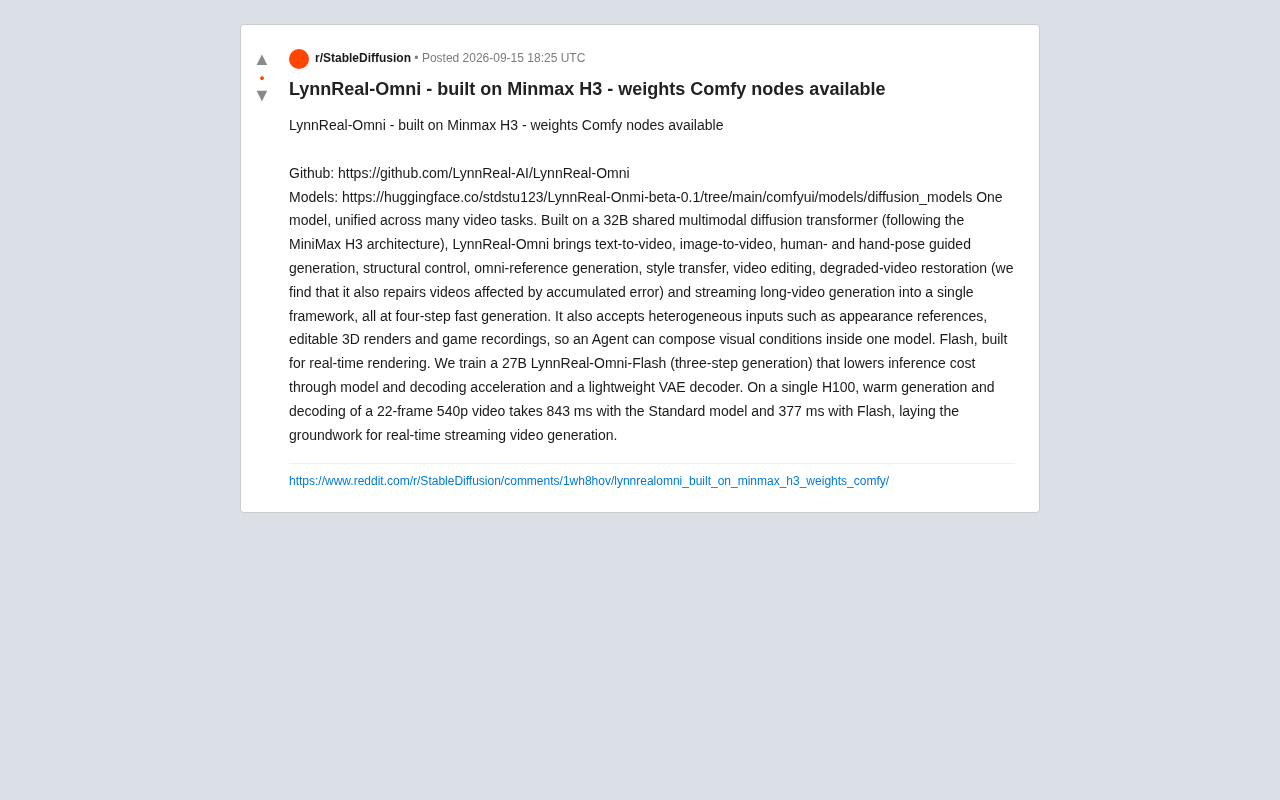
LynnReal-Omni: 32B Unified Video Diffusion Model Goes Open Source with Multi-Task Coverage in Four Steps
LynnReal-Omni is a 32B unified video diffusion model on MiniMax H3, covering text-to-video, pose guidance, style transfer, restoration in 4 steps. Flash version generates 540p video in 377ms on one H100.

Anthropic Co-Founder: AI 'Kill Switch' May Need to Be Mandatory by Law
Anthropic's co-founder tells the BBC that AI 'kill switches' may need to be legally mandated. We analyze the industry logic, technical challenges, and the tension between regulation and innovation.

The AI Data Center Boom Is Colliding With Cities Scarred by Heavy Industry
The AI data center boom is clashing with post-industrial communities. Philadelphia's case reveals structural conflicts between AI growth, energy use, water, and environmental justice.