Java Developer's Path to AI Full-Stack: From Traditional Tech Stack to LLM Development in Practice

LLM development skills are becoming a baseline requirement for Java roles—transitioning is now mandatory.
The article covers a Bilibili AI course for Java developers, noting that the Java job market is undergoing structural change: where Spring Cloud, microservices, and containerization once sufficed, job postings now list LLM platform familiarity and LLM application experience as preferred qualifications, with RAG, MCP, and multimodality entering routine backend interviews. The article argues that the barrier for Java programmers entering AI is low—no need to learn deep learning from scratch. Focus is on application-layer engineering: API calls, streaming output, memory caching, prompt engineering, vector databases, RAG, and Tool Calling, achievable in one to two months. Resume strategy: layer Spring AI or LangChain4j integration onto existing Java projects, upgrading to \"Java + LLM Development Engineer.\" Conclusion: transition is a required course driven by both competition and business demand.
Why Java Developers Should Pivot Toward AI and Large Language Models
A recent public course on Bilibili has sparked considerable discussion among Java developers, addressing an increasingly urgent question: How can traditional Java programmers build their first AI application? Rather than diving straight into API calls, this tutorial opens with a reality check—the job market for Java programmers is changing.
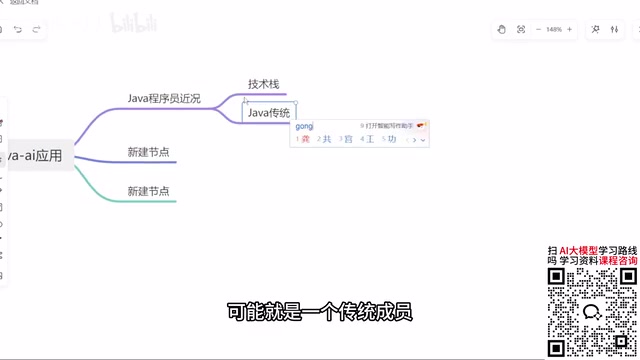
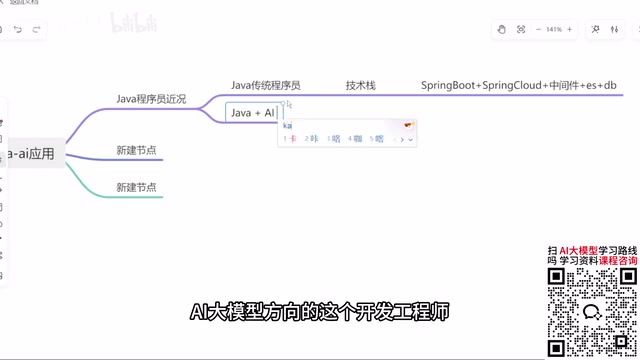
The instructor raises a pointed question right from the start: What tech stack do you actually need to land a Java development job today? In past years, mastering the full microservices suite—Spring Cloud, Nacos, gateways, distributed tracing, Redis, Elasticsearch, message middleware—plus Docker and Kubernetes containerization was enough to secure a solid position. This set of skills was defined as the technical foundation of a "traditional Java programmer."
The problem is that enterprise hiring requirements are now layering new demands on top of this baseline.
The Job Market Is Forcing Java Developers to Catch Up on AI
The course presents straightforward evidence: searching for Java positions on platforms like Boss Zhipin, the "preferred qualifications" section frequently includes descriptions like "familiar with mainstream industry LLM development platforms" and "experience in LLM application development." Interviewers are starting to ask about concepts like multimodality, RAG, and MCP—even requiring candidates to demonstrate on the spot how to use RAG to connect a knowledge base.
Two years ago, these terms might have only been relevant to algorithm teams. But now they are permeating routine questions in Java backend interviews.
The instructor shares a real case: a graduate student from Beijing University of Posts and Telecommunications (BUPT) with a combined bachelor's and master's degree went to interview for a Java position. During the group interview, he discovered that among all the competitors, he was the only one who hadn't prepared any LLM-related projects. This detail is worth pondering—when two or three out of ten candidates show up to a Java interview with LLM project experience, it becomes a signal of a "new standard." Interviewers naturally gravitate toward candidates who can cover more business possibilities.
RAG (Retrieval-Augmented Generation) is an engineering paradigm that enables large language models to "answer questions with reference materials." Its basic workflow: First, split enterprise knowledge bases (documents, FAQs, product manuals, etc.) into chunks, convert them into vectors using an Embedding model, and store them in a vector database. When a user asks a question, the question is also converted into a vector, the most relevant chunks are retrieved from the vector database, and these chunks are assembled as context into the prompt, which is then sent to the LLM to generate an answer. The value of this approach is that the model no longer answers solely from its training memory, but based on the real-time, private materials you provide—reducing hallucinations and allowing knowledge updates without retraining the model. You simply update the vector database. For Java developers, RAG is essentially an engineering combination of "retrieval + prompt assembly + API calls," highly similar in architectural thinking to traditional search engine integration and cache queries.
MCP (Model Context Protocol) is an open protocol that standardizes how LLMs interact with external tools and data sources. It aims to solve the fragmentation problem where "every model and every tool requires its own custom integration code": as long as tools expose their capabilities via MCP and the model side discovers and invokes them via MCP, both sides can be plug-and-play. You can think of it as the USB interface or JDBC of the AI world—the latter unified how Java programs access different databases, while MCP unifies how LLMs access different tools and data sources. For Java engineers, understanding MCP doesn't require diving into model internals; the key is grasping how tools are registered, how parameters are described, and how invocation results are returned—still classic interface integration work.
The Barrier to Java + AI Is Lower Than You Think
A pragmatic assessment from the course: For developers whose primary language is Java, the learning curve for expanding into AI-related capabilities is relatively gentle. The instructor estimates that with one to two months of focused effort, you can catch up on the core skills of LLM development.
The premise is that you don't need to start from scratch learning deep learning or model training. The path for Java programmers into AI is concentrated at the application layer—calling LLM APIs, implementing streaming output, managing memory caches, designing prompts, integrating vector databases, and implementing RAG and Tool Calling. These capabilities are fundamentally still engineering integration; the only difference is that the objects being integrated shift from databases and middleware to LLMs and vector stores.
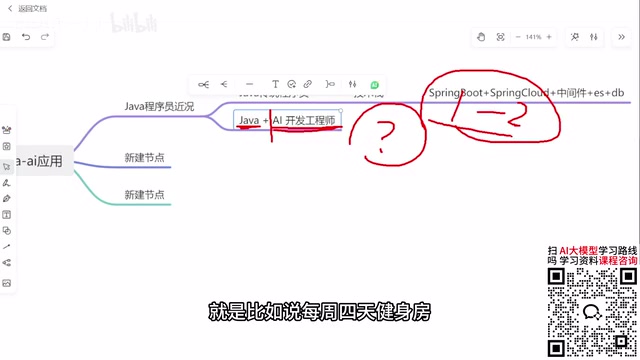
The instructor even offers a very concrete suggestion: Redirect the four days a week you spend at the gym to learning LLMs, and you'll add a very solid highlight to your resume.
Tool Calling refers to an LLM autonomously deciding, based on user intent during a conversation, to invoke an external function or API and incorporate the returned result into its final answer. For example, if a user asks "Help me check the shipping status of order 12345," the model won't fabricate an answer—it outputs a structured invocation request, your Java code executes the real order query API, and the result is fed back to the model to generate a natural language response. Its engineering essentials include: defining the tool's input/output parameter schema, parsing the model's returned invocation instructions, handling exceptions and timeouts properly, and limiting the number of multi-turn invocations. For Java developers, this is equivalent to treating the model as a dispatch center that "issues commands," while the actual business logic is still executed by the Service layer you're already familiar with.
Prompt Engineering is not mysticism—it's a reusable set of input design methods. Core techniques include: clearly defining roles and task boundaries, providing few-shot examples, specifying output formats (such as JSON), and breaking down complex tasks into multiple steps. In Java projects, prompts typically exist as templates in configuration centers or code constants, dynamically rendered with parameter placeholders. It shares the same thinking as "interface contract design" in traditional development—you define the input clearly, and only then can the model produce stable output.
How to Write "Java + LLM" on Your Resume
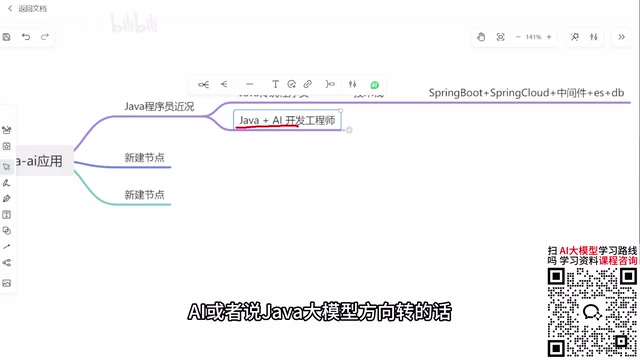
The course offers a practical resume optimization approach. By layering LLM capabilities on top of existing Java business project experience, you can upgrade your positioning from "Java backend" to "Java + LLM Development Engineer."
What specifically can you write? The instructor lists several directions:
Model Deployment and Invocation: Experience deploying LLMs on platforms like Ollama, capable of invoking LLMs through Spring AI or LangChain4j and completing configuration.
Engineering Capabilities: Familiar with key areas including streaming output, memory caching, prompt engineering, vector database integration, RAG retrieval-augmented generation, MCP protocol, and Tool Calling.
Project Practice: The course mentions they currently have nearly 20 hands-on projects. Pick any two, combine LLM features with existing business logic, and you can assemble a compelling AI application development resume.
The core logic here is: Don't abandon your existing Java engineering skills—build something new on top of them. For enterprises, a developer who understands both microservices architecture and LLM application integration is closer to real-world business implementation than someone with a pure algorithm background.
Spring AI and LangChain4j are two mainstream LLM application development frameworks in the current Java ecosystem. Spring AI is driven by the official Spring team, with its greatest advantage being seamless integration with Spring Boot: through ChatClient and EmbeddingClient abstractions similar to JdbcTemplate, you can switch between different model providers through configuration, naturally fitting into existing dependency injection, configuration management, and observability systems—ideal for teams already on the Spring Cloud stack to get started quickly. LangChain4j is closer to the design philosophy of Python's LangChain, offering finer-grained component abstractions like Chain, Memory, Retriever, and Tool, with stronger expressiveness in RAG orchestration, multi-turn conversation memory, and Agent workflows. The two are not mutually exclusive—a common practice in real projects is to use Spring AI for basic model invocation and configuration management, and LangChain4j for complex retrieval and tool orchestration pipelines. For Java developers preparing their resumes, being able to articulate "why you chose this framework and what specific integration problem it solves" is more convincing than simply listing framework names.
This Is Not a Multiple-Choice Question—It's a Required Course
The course concludes with a clear judgment: For Java programmers transitioning toward AI and LLMs, it's no longer a question of "whether to do it" but "when to do it."
There are two layers of logic behind this judgment. The first is competitive pressure—when LLM project experience shifts from a bonus to a baseline requirement, resumes without it may be filtered out at the initial screening stage. The second is business demand—once enterprises begin integrating LLM capabilities, they need people with engineering backgrounds to drive implementation, and developers with purely Java backgrounds who don't upskill will miss this wave of demand.
From the course content, the positioning is quite clear: aimed at traditional Java developers with zero AI background, starting from development frameworks and gradually transitioning to hands-on projects. The title's phrasing of "step-by-step" and "from development frameworks to hands-on projects" indicates it attempts to cover the complete path from mindset shift to practical implementation.
For Java programmers who are still hesitating about whether to learn AI, this course offers a pragmatic entry point—it doesn't require you to become an algorithm expert, but it does require you to become an engineer who can use LLMs to solve business problems.
One-line Summary
LLM development skills are shifting from a bonus to a baseline requirement for Java positions—transitioning is now mandatory.
Paragraph Summary
This article discusses a Bilibili public course aimed at Java developers, highlighting a structural shift in the Java job market: where mastering Spring Cloud, the microservices suite, and containerization once sufficed, job postings now frequently list "familiarity with mainstream LLM platforms" and "LLM application development experience" as preferred qualifications. Concepts like RAG, MCP, and multimodality have entered routine Java backend interview questions. The article argues that the barrier for Java programmers entering AI is not high—no need to learn deep learning from scratch. The focus is on application-layer engineering integration: API calls, streaming output, memory caching, prompt engineering, vector databases, RAG, and Tool Calling—core skills that can be acquired in one to two months. The resume strategy is to layer Spring AI or LangChain4j LLM integration experience on top of existing Java business projects, upgrading positioning to "Java + LLM Development Engineer." The conclusion: transition is not a multiple-choice question but a required course, driven by both competitive pressure and business demand.
Related articles

Chain of Thought Isn't Just for AI: How Humans Can Use CoT to Improve Thinking Quality
Chain of Thought isn't just a prompt trick for large models. Starting from a Hacker News discussion, this article analyzes why CoT works for human thinking too, breaks down actionable ways to transfer it, and highlights the key differences between human CoT and machine CoT.
Cloudflare Teams Up with OpenAI: Closi…
Cloudflare Teams Up with OpenAI: Closing the Loop from Vulnerability Discovery to Defense with AI
Cloudflare uses OpenAI Daybreak to investigate security vulnerabilities and generate reviewable remediation plans, while developers use Codex to boost coding efficiency and quality.

Orca Multi-Agent Orchestration in Practice: A Guide to Parallel Collaboration with Claude and Codex
Orca is Stable AI's free open-source agent workbench supporting 34 agents like Claude Code and Codex in parallel. Learn its Git worktree isolation, multi-model orchestration, and mobile management.