JavaScript Clean Code in Practice: Core Principles from clean-code-javascript

Core clean code principles for JavaScript developers, based on the 94k-star clean-code-javascript project.
The clean-code-javascript project adapts Robert C. Martin's Clean Code philosophy to JavaScript, offering practical guidance on variable naming, function design, DRY, SOLID principles, functional programming, and error handling. With nearly 100,000 GitHub Stars, it serves as both a personal code quality mirror and a team-wide review standard.
Article
In software development, making a program run is merely the baseline. Writing code that makes teamwork enjoyable and maintenance manageable is what separates good engineers from great ones. The clean-code-javascript project on GitHub was built around exactly this idea. It systematically adapts the clean code philosophy from Robert C. Martin's book Clean Code to the JavaScript ecosystem.
Background: Robert C. Martin and the Origins of Clean Code Robert C. Martin (known as "Uncle Bob") is one of the most influential thinkers in software engineering and a signatory of the Agile Manifesto. His 2008 book Clean Code: A Handbook of Agile Software Craftsmanship distilled decades of engineering practice into actionable coding standards, laying the theoretical foundation for the modern software craftsmanship movement. The book emerged during the early 2000s, when software systems were growing rapidly — maintenance costs began to exceed development costs, and "technical debt" started entering mainstream discourse. Martin argued that code is written first for humans to read, and only secondarily for machines to execute.
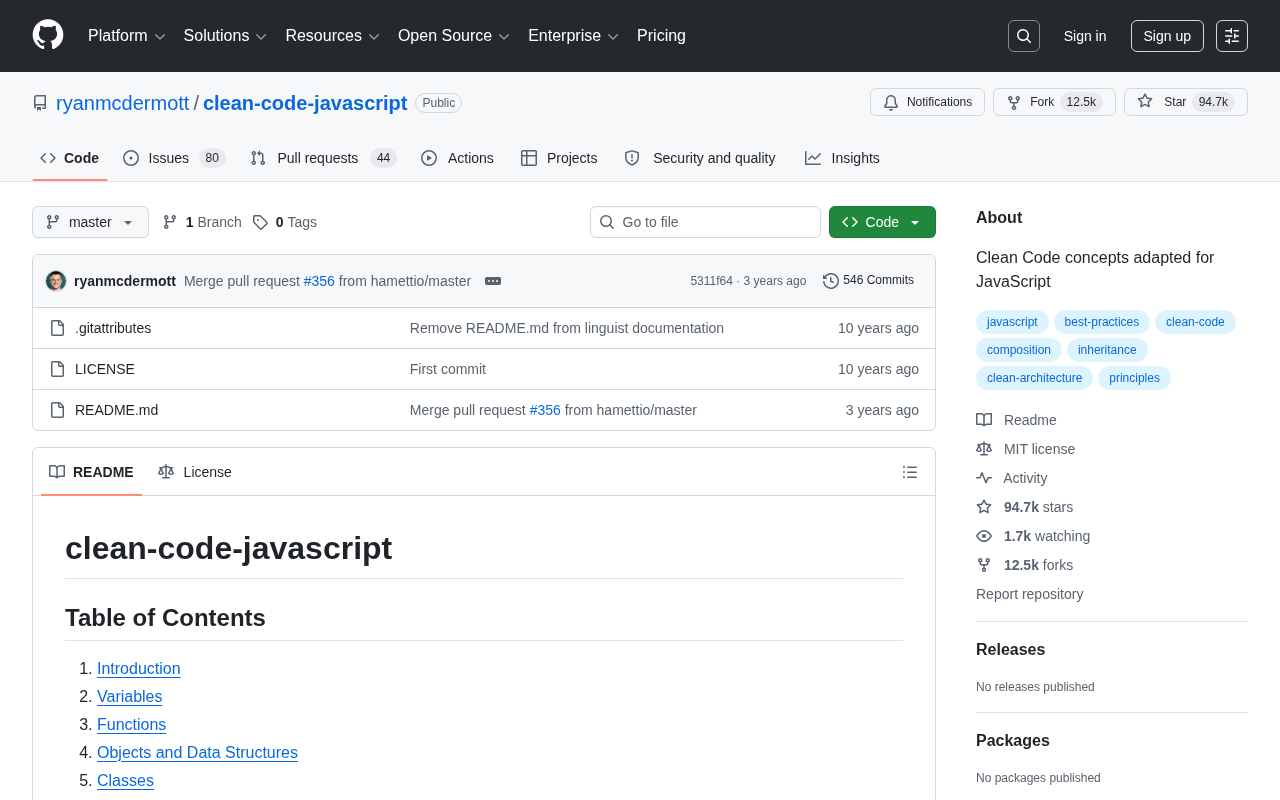
The repository has earned over 94,587 Stars and 12,474 Forks, and continues to hold lasting influence in the developer community.
Why Clean Code Is Essential for Every Engineer
Most of the cost in software engineering lies not in writing code, but in reading and maintaining it. Research consistently shows that engineers spend far more time reading code than writing it — IEEE studies and multiple academic sources confirm that roughly 80% of a software system's lifecycle costs occur during the maintenance phase, and more than 50% of that maintenance time is spent simply trying to understand existing code.
The concept of "technical debt" was coined by software engineer Ward Cunningham in 1992 as a financial metaphor for the "debt" incurred when short-term delivery is prioritized over code quality. When code is filled with magic numbers, ambiguous variable names, and deeply nested logic, technical debt compounds — and every change risks introducing new bugs. Martin Fowler lists "code that is hard to read" as one of the most serious "code smells" in Refactoring, precisely because of this reality.
The value of clean-code-javascript lies in the fact that it doesn't deal in abstract theory. Instead, it uses a large number of "bad example vs. good example" code comparisons to show developers concretely what good code looks like and what doesn't. This hands-on approach helps beginners quickly develop a sense of code quality, while giving experienced developers a shared standard they can promote across their teams.
One notable detail: the project's author explicitly reminds readers that these principles are guidelines, not ironclad rules. They represent decades of collective experience, but not every team or every situation demands strict adherence. The goal of clean code is to improve readability and maintainability — not to follow rules for their own sake.
Core Principles of Clean JavaScript Code
The project breaks down clean code practices into multiple dimensions, covering nearly every aspect of day-to-day JavaScript development.
Variable Naming: Make Names Speak for Themselves
The project emphasizes using meaningful, readable, and pronounceable variable names. For example, don't use d to represent a date — use currentDate or daysSinceModification instead. Avoid "mental mapping" — readers shouldn't need to mentally translate a variable's name into its actual meaning while reading. You should also avoid unnecessary contextual redundancy: inside a Car object, there's no need to write car.carColor; car.color is cleaner and clearer.
Function Design: Single Responsibility, Small and Focused
Functions should do one thing and do it well. The project recommends keeping function parameters to two or fewer, and when more are needed, consider wrapping them in an object. It also advocates avoiding side effects and avoiding flag arguments — a function that takes a boolean to decide between two different execution paths has, by definition, already violated the Single Responsibility Principle.
The DRY Principle: Avoid Duplication
Don't Repeat Yourself is one of the cornerstones of software engineering, formally introduced by Andy Hunt and Dave Thomas in their 1999 book The Pragmatic Programmer, where it's defined as: "Every piece of knowledge must have a single, unambiguous, authoritative representation within a system."
It's worth noting that DRY targets the duplication of knowledge, not literal code repetition — two code snippets that look identical but represent different business concepts should not be forcibly merged, as doing so creates unnecessary coupling. Duplicated code means that when logic needs to change, you must update it in multiple places, making omissions and bugs far more likely. At the same time, over-abstraction leads to the opposite extreme — the trap of premature abstraction that the AHA (Avoid Hasty Abstractions) principle warns against. The project uses practical examples to show how to abstract repeated logic into reusable functions, improving maintainability at the source while preserving necessary flexibility.
Balancing Object-Oriented and Functional Programming
JavaScript was born in 1995, originally designed as a browser scripting language. But its prototype-based inheritance and first-class function support made it naturally suited to multiple programming paradigms. clean-code-javascript offers practical guidance on both object-oriented and functional programming approaches.
On the object-oriented side, the project covers the practical application of the five SOLID design principles in JavaScript. SOLID is an acronym coined by Robert C. Martin for five key OOP design principles:
- Single Responsibility Principle (SRP): A class should have only one reason to change
- Open/Closed Principle (OCP): Open for extension, closed for modification — adapt to change through abstraction rather than rewriting existing code
- Liskov Substitution Principle (LSP): Subtypes must be substitutable for their base types without breaking program correctness
- Interface Segregation Principle (ISP): Don't force clients to depend on interfaces they don't use
- Dependency Inversion Principle (DIP): High-level modules should not depend on low-level modules; both should depend on abstractions
In dynamically typed languages like JavaScript, these principles manifest differently than in Java or C++ — they're more often reflected in how module boundaries are drawn and how function contracts are designed. The project also recommends favoring method chaining for more fluent code, and endorses the modern design consensus of "composition over inheritance."
On the functional programming side, the JavaScript community's interest in functional programming has been largely driven by languages like Haskell and ML, as well as the React ecosystem. The project encourages developers to make good use of higher-order functions like map, filter, and reduce, replacing imperative loops with declarative expressions that make code intent clearer. Immutability and pure functions are the two pillars of functional programming — the former prevents unexpected state mutations, while the latter guarantees that the same input always produces the same output, making code easier to test and reason about while reducing side effects from mutable state.
Error Handling and Code Formatting
Many developers habitually ignore caught errors, or simply log a single line to the console and move on. The project makes clear that catching an error without any meaningful response is equivalent to planting a time bomb. The right approach is to log it, notify the appropriate channel, or take remedial action — ensuring that exceptions don't get silently swallowed.
On the formatting side, the project recommends maintaining consistent casing and placing callers and callees close to each other in physical file location. It also emphasizes that formatting should, wherever possible, be delegated to automated tooling — freeing developers to focus their energy on actual business logic.
Tooling Background: The Complementary Roles of ESLint and Prettier ESLint was created by Nicholas C. Zakas in 2013. It performs static analysis on JavaScript code using a configurable set of rules, catching potential logic errors and non-standard patterns, with support for auto-fixing. Prettier was released by James Long in 2017, positioning itself as an "opinionated code formatter" that eliminates team formatting debates by parsing code into an AST (Abstract Syntax Tree) and reprinting it from scratch. The two tools are complementary: ESLint handles code quality rules, Prettier handles style consistency. With proper configuration, teams can redirect code review energy away from formatting debates and toward meaningful discussions about business logic.
Real Value for Individuals and Teams
For individual developers, this guide serves as a mirror — one that reveals code smells in your own work. For teams, it can serve as a starting point for coding standards and Code Review criteria, helping establish a shared evaluation framework and meaningfully reducing communication overhead.
Also worth highlighting: clean-code-javascript is available in multiple community-translated versions, including Chinese, Japanese, and Spanish, making it accessible to developers worldwide. The nearly 100,000 Stars behind it represent a shared pursuit by countless developers of a simple but profound goal: writing better code.
Closing: Code Quality Is a State of Mind
Clean code isn't a technique you master overnight — it's a way of thinking that requires long-term, deliberate practice. The significance of clean-code-javascript isn't in providing a set of doctrines to follow rigidly, but in awakening developers' sensitivity to code quality. Treat these principles as guidance rather than gospel, apply them flexibly to real-world contexts, and you'll be on your way to writing software that not only runs reliably but stands the test of time.
Key Takeaways
Related articles

The Truth Behind Codex 'Build a Website in 5 Minutes': AI Isn't Creating Sites—It's Helping You Copy Them
Exposing the truth behind viral Codex 5-minute website videos: creators aren't building original sites with AI—they're copying shared prompts or scraping others' work. Learn AI coding tools' real limits.

Getting Started with AI Agent Development: A Complete Guide from Concept to Practice
A comprehensive guide to AI Agent architecture and development, covering automated marketing, intelligent customer service, and investment analysis scenarios with single and multi-agent collaboration.

The Truth Behind Codex 'Build a Website in 5 Minutes': AI Isn't Creating Sites — It's Helping You Copy Them
Exposing the truth behind viral Codex 5-minute website videos: creators aren't building original sites with AI — they're copying shared prompts or scraping others' work.