WorkBuddy in Action: How Tencent's AI Agent Gets LLMs to Actually Do the Work
AI Agents can directly operate computers to complete tasks, bridging the gap from "thinking" to "doing", and WorkBuddy is a low-barrier office tool among them.
By contrasting traditional chat models with AI Agents, the article explains that the core value of Agents lies in forming an execution loop and directly operating computers to deliver results. Using Tencent's WorkBuddy as an example, it demonstrates a zero-code task of converting DOCX to PDF and archiving, taking about three minutes and consuming a small number of credits. It also notes capability gaps between WorkBuddy and CodeX, with CodeX faster on certain tasks but more costly. The article categorizes Agents into general office, programming development, and chat types, emphasizing that competing products will eventually converge, with current differences stemming from product focus and ecosystem maturity. It concludes that Agents suit highly repetitive, clearly defined tasks and can deliver order-of-magnitude efficiency gains.
From "Thinking" to "Doing": The Core Value of AI Agents
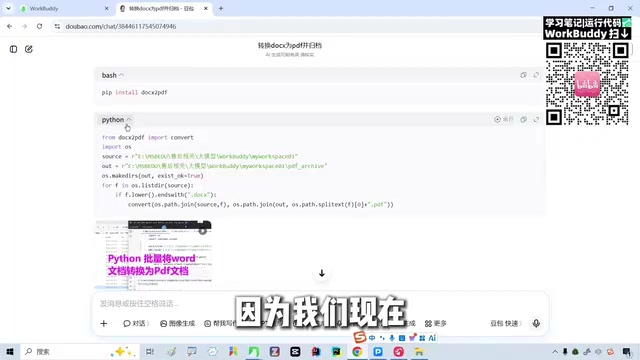
Many people first encounter large models through chat tools like Doubao, DeepSeek, and Kimi. These tools can understand requirements and propose solutions, but they share a fundamental limitation: they can think but cannot act. For instance, if you ask Doubao to convert all DOCX files in a folder to PDF and archive them, it can tell you which dependencies to install, provide Python code, list caveats, and even offer alternative approaches—but in the end, you still have to perform the operations yourself.
As demonstrated by a Bilibili creator in a WorkBuddyAd hands-on course, this disconnect is very evident: ordinary chat models can analyze problems but cannot directly operate a computer. AI Agent tools emerged precisely to fill this "last mile" gap.
An Agent is essentially a "digital employee that can get work done"—it not only understands your natural language requests but, after authorization, can read local files, invoke software, execute system commands, and ultimately deliver results to you. This marks a shift in AI from "answering questions" to "executing tasks," and from "giving advice" to "delivering outcomes."
AI Agent refers to a software system capable of perceiving its environment, making autonomous decisions, and taking actions to achieve goals. Unlike traditional chat models, Agents typically possess tool invocation (e.g., reading/writing files, executing commands), task planning, and memory capabilities, enabling them to complete multi-step tasks without human intervention. Their core architecture generally includes: a perception module (receiving user input and environmental information), a planning module (decomposing tasks and formulating steps), an execution module (invoking tools or APIs), and a memory module (storing context and historical experience). It is the synergy of these components that enables Agents to shift from passive response to proactive execution, becoming users' "digital employees."
WorkBuddy Hands-On: A Real File Conversion Task
WorkBuddy is an AI Agent tool for office scenarios launched by Tencent. In the demo, the user sent the same request—"convert all DOCX files in a specified directory on my computer to PDF and archive them into one folder"—directly to WorkBuddy, without writing any code or installing dependencies.
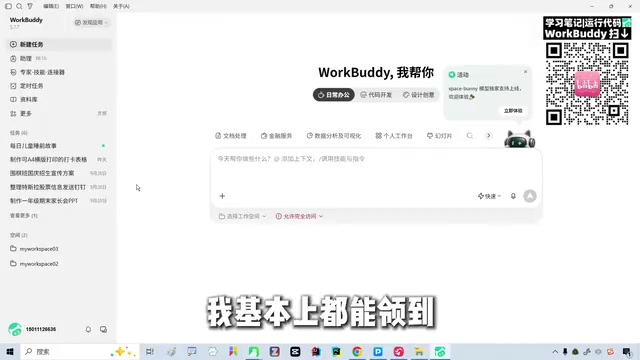
After receiving user authorization (full access permission), WorkBuddy began processing automatically: it read the target folder, batch-converted the files, and created an archive directory. The entire process took about three minutes and consumed roughly 1.55 credits. As seen in the demo screenshots, the converted formatting was well preserved, and a preview was provided after task completion.

This case intuitively demonstrates the key difference between Agents and traditional chat models: ordinary models help you break down tasks, while Agents help you complete them. For non-programmers, this "zero-code, natural-language-driven" experience significantly lowers the barrier to automated office work.
Credit Mechanism and Usage Cost
WorkBuddy gives 100 credits daily, and new users can receive 2,000 credits upon registration. After using it for about half a month, the demonstrator still had 3,900 credits in their account, even without claiming daily credits every day. For learning and small tasks, the free quota is generally sufficient. However, if tasks are complex or time-consuming, credit consumption will increase accordingly.
Capability Gaps Between Agents: WorkBuddy vs. CodeX
According to comparative testing from the same source, WorkBuddy does not always have the advantage in every scenario. The demonstrator once used an image of an Excel spreadsheet from Xiaohongshu and asked both WorkBuddy and CodeX to generate an Excel file in the corresponding format. WorkBuddy took 23 minutes and the result was unsatisfactory, while CodeX met the requirement in just two and a half to three and a half minutes.
This reflects that different Agent products still differ in capability, especially when tools like CodeX are backed by stronger models and engineering optimization. But the demonstrator also noted that CodeX has higher usage costs—about 200 yuan per month (membership fee plus VPN costs)—whereas WorkBuddy relies on daily free credits, making it suitable for users with limited budgets or light usage.
The deeper judgment is: competing products will eventually converge in functionality. Whether domestic or overseas, understanding, reasoning, and acting capabilities will gradually level out—it just takes time. The current differences are more about product focus and ecosystem maturity.
CodeX was originally a code generation model developed by OpenAI, and later also refers to programming assistant tools based on that model. It focuses on understanding natural language and generating, completing, or explaining code, and performs outstandingly in software development scenarios. CodeX typically needs to integrate with a development environment (such as an IDE) or be invoked via API, which requires some technical background from users. Its strength lies in deep understanding of programming languages and frameworks, enabling efficient completion of code-related tasks, but it is not designed for general office scenarios.
Three Types of AI Agents and Their Use Cases
From a product positioning perspective, current AI Agents can be roughly divided into several categories:
- General-purpose office Agents: Represented by WorkBuddy and OpenClawAd, aimed at ordinary users' work scenarios, emphasizing ease of use and low barriers, and capable of handling files, spreadsheets, documents, and other tasks.
- Programming and development Agents: Represented by CodeX, Claude Code, and Trae, focused on code generation and software engineering, suitable for developers.
- Chat-based large models: Doubao, DeepSeek, Kimi, etc., essentially intelligent advisors that provide suggestions and solutions but do not directly operate the user's computer.
It should be noted that these boundaries are not absolute. WorkBuddy also includes modules for code development and design creativity, and CodeX could theoretically perform file conversion—the difference lies in product focus. As the demonstrator put it, WorkBuddy's advantage is being "handy and friendly," with no barriers to installation or use and no VPN needed, making it suitable for office workers without a technical background.
OpenClaw is an open-source AI Agent framework designed to let developers build agents that can operate computers. It provides foundational capabilities such as tool invocation, task planning, and execution monitoring, and users can instruct it in natural language to complete tasks like file management and web operations. OpenClaw emphasizes flexibility and extensibility, suitable for users with some technical background to customize, but installation and configuration are relatively complex and not as plug-and-play as commercial products.
Execution Loop: The Divide Between Agents and Traditional Large Models
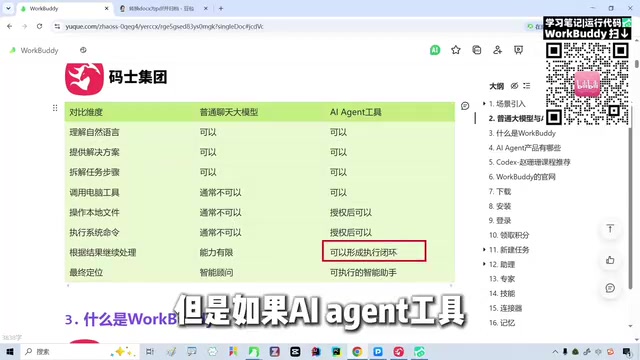
When traditional chat models execute tasks, every step requires a human to relay results—it gives a plan, you execute it, and if you encounter problems, you come back to ask it. Agent tools, by contrast, can form an execution loop: during task execution, if a step fails, they try alternatives, self-debug, and ultimately deliver the result.
This capability difference determines their positioning: tools like Doubao are "intelligent advisors," while Agents like WorkBuddy are "intelligent assistants." Advisors tell you what to do; assistants do it for you. For daily office tasks that are highly repetitive and clearly defined (such as format conversion, file archiving, and spreadsheet generation), the efficiency gains brought by Agents are orders of magnitude greater.
Of course, Agents are not omnipotent. Complex tasks require multiple rounds of dialogue tuning, credit consumption correlates with task complexity, and human intervention is still needed when capability boundaries are reached. But the leap from "thinking" to "doing" is already enough to make WorkBuddy a productivity tool worth trying in office scenarios.
Related articles

WebMCP Security Guide: Three Hints That Make AI Agents Safer
The Chrome team demonstrates three security hints for WebMCP tools: readOnlyHint eliminates invalid confirmation dialogs, consequentialHint forces human confirmation for high-risk operations, and untrustedContentHint defends against indirect prompt injection—improving AI agent security with one or two lines of code.

Why Turbulence Is the Hardest Problem in Fluid Mechanics — and How AI Could Crack It
Why is turbulence the hardest problem in fluid mechanics? This article, based on a Lex Fridman podcast conversation, explores turbulence's multi-scale nature, comparisons with classical thermodynamics, and how AI might simplify turbulence description by discovering coordinate transformations — examining the intersection of vortex formation with mathematics and physics.

R.L. Stine Google Talk: How the Master of Horror Ignites Kids' Passion for Reading
At a Google talk, R.L. Stine shares his accidental pivot from comedy to horror, his principles for children's horror, how phones impact storytelling, and how Goosebumps motivates kids to read.