JECT: Addressing the Context Shortcut in Chest CT Predictive Learning

JECT solves the context shortcut problem in chest CT self-supervised pretraining by having the encoder predict radiology report text.
This article introduces JECT, a method for addressing the "context shortcut" problem in Joint-Embedding Predictive Architecture (JEPA) pretraining for chest CT: key findings (such as small nodules) cannot be predicted from surrounding anatomy, causing models to ignore lesions. JECT makes radiology reports serve both as a predictor condition and as the encoder's prediction target, using masked text prediction to force the encoder to learn clinically relevant content, and employs a hierarchical 3D encoder to preserve information at multiple scales. Trained on 173k volumes, JECT reaches CT foundation model level on classification, retrieval, and nodule malignancy prediction, and after fine-tuning matches task-specific models on lung cancer risk prediction. Ablation experiments show that the text target significantly improves encoder performance, while conditioning brings limited gain to the encoder, but the predictor can be reused to localize image regions corresponding to report sentences, providing interpretability.
Introduction
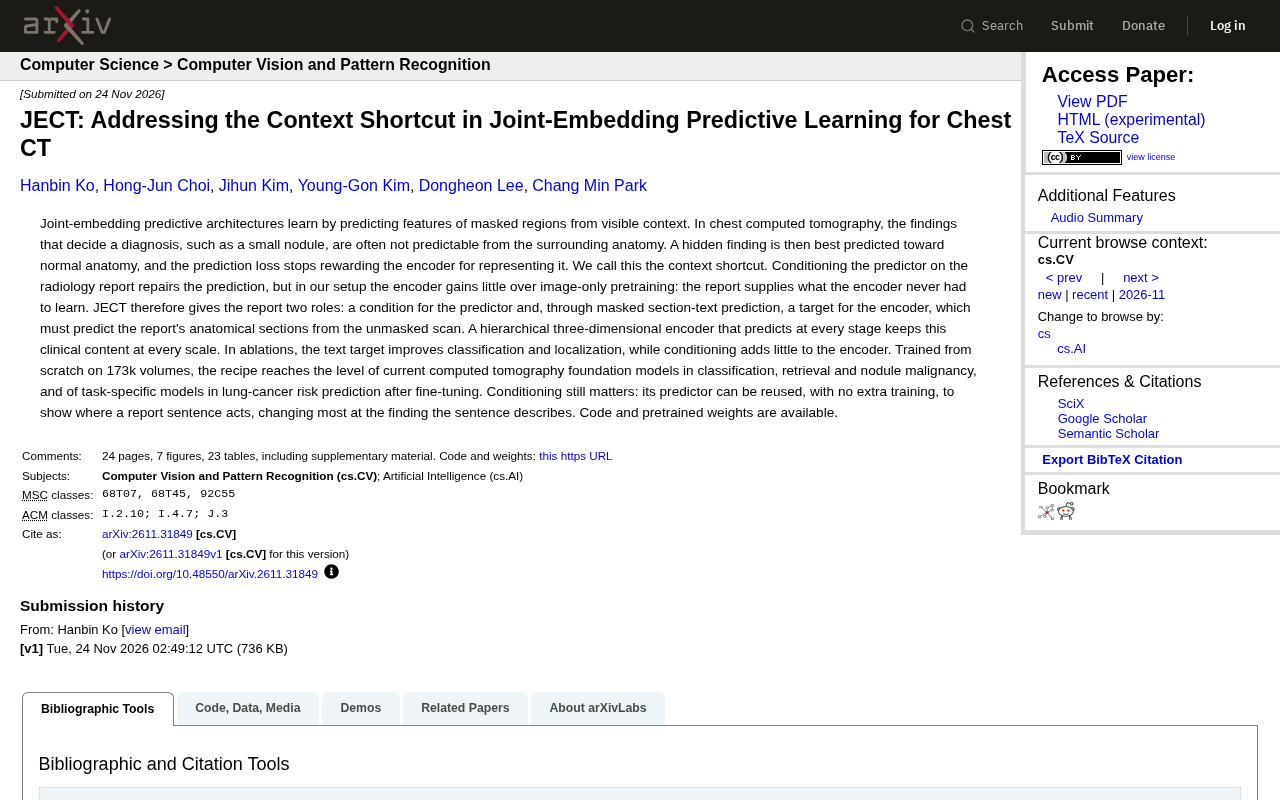
In medical image analysis, Joint-Embedding Predictive Architectures (JEPA) learn representations by predicting features of masked regions from visible context. However, in chest CT, the findings that determine a diagnosis (such as small nodules) often cannot be predicted from the surrounding anatomical structures. This "context shortcut" causes models to ignore key lesions. A paper titled "JECT: Addressing the Context Shortcut in Joint-Embedding Predictive Learning for Chest CT" proposes a new method to fix this problem by conditioning the predictor on radiology reports and using masked text prediction as the encoder's target.
The Context Shortcut: The Problem
The core idea of joint-embedding predictive architectures is to predict the features of masked regions from visible areas. But in chest CT, many key findings (such as small nodules) are not correlated with surrounding anatomical structures and cannot be inferred from context. The model therefore tends to predict hidden findings as normal anatomy, so the prediction loss no longer incentivizes the encoder to represent those findings. The authors call this phenomenon the "context shortcut."
This shortcut makes the features learned during pretraining insensitive to lesions, thereby affecting performance on downstream tasks. Conventional methods fix the prediction by conditioning the predictor (e.g., using radiology reports), but the authors found that in their experimental setup, the encoder benefits very little from this conditioning: the reports provide information the encoder never needed to learn.
The Joint-Embedding Predictive Architecture (JEPA) was proposed by Yann LeCun and others. Its core idea is to make predictions in latent space rather than pixel space: given the encoded features of a visible region, predict the encoded features of a masked region. Unlike masked autoencoders (MAE), which reconstruct raw pixels, JEPA's prediction target is itself a representation generated by the encoder (or a target encoder), so it avoids the model focusing excessively on low-level texture details. In medical imaging, JEPA is often used for self-supervised pretraining, with the goal of learning general representations from large numbers of unlabeled scans. However, JEPA's effectiveness depends heavily on one assumption: that the content of a masked region can be reasonably inferred from visible context. When this assumption does not hold (as with isolated small nodules in chest CT that lack strong correlation with surrounding tissue), the prediction loss cannot effectively drive the encoder to represent these key abnormalities.
JECT's Solution: A Dual Role
JECT gives reports two roles: first, as a condition for the predictor; second, as the encoder's target through masked section text prediction. The encoder must predict the report's anatomical sections from the unmasked scan, which forces the encoder to learn clinically relevant content. In addition, a hierarchical 3D encoder makes predictions at each stage, thereby preserving clinical content at multiple scales.
In ablation experiments, the text target improved classification and localization performance, while conditioning brought little gain to the encoder. This shows that having the encoder directly predict report content is more effective than merely using reports as a condition.
Masked text prediction draws on masked language modeling in natural language processing (such as BERT), in which some tokens in the text are randomly masked and the model predicts the masked content from context. In JECT, the encoder does not process the report text directly; instead, it must start from image features and predict the masked tokens of the report's anatomical sections. This is essentially a cross-modal prediction target: the image encoder must compress the visual information in the scan into a representation sufficient to recover the report's semantics. Compared with merely using the report as a predictor condition, this target directly imposes a constraint on the encoder to learn clinically relevant features, because the anatomical descriptions in the report provide an explicit supervisory signal that forces the encoder to focus on structures relevant to diagnosis rather than merely fitting the routine anatomical patterns in the context.
Experiments and Results
The authors trained JECT from scratch on 173k volumes, reaching the level of current CT foundation models on classification, retrieval, and nodule malignancy prediction tasks, and, after fine-tuning, also reaching the level of task-specific models on lung cancer risk prediction. You might not have noticed that conditioning still matters: its predictor can be reused without additional training to show where in the image a report sentence applies, with the greatest change at the finding described by the sentence.
This result shows that JECT not only improves the encoder's representational ability but also provides an interpretability tool that can localize the image regions corresponding to report sentences.
Foundation models generally refer to models pretrained in a self-supervised manner on large-scale, diverse data, with strong generalization ability that can be adapted to many downstream tasks through fine-tuning. In medical imaging, CT foundation models aim to learn general representations from massive chest CT data to reduce each downstream task's dependence on labeled data. When evaluating such models, two protocols are often used: linear probing (freezing the encoder and training only a classification head) or full-parameter fine-tuning, with comparisons against task-specific models on tasks such as classification, retrieval, and lesion detection. JECT was trained from scratch on 173k volumes, and its performance reaches the level of CT foundation models, showing that the design of the self-supervised objective can achieve competitive representation quality without relying on massive external data.
Conclusion and Outlook
By having the encoder predict report text, JECT solves the context shortcut problem and achieves performance comparable to existing foundation models on multiple tasks. Its method is simple and effective, and its code and pretrained weights have been made public. In the future, this idea may extend to other medical imaging modalities, further advancing the development of pretrained models for medical imaging.
For AI researchers, JECT reminds us that designing an appropriate prediction target is crucial in pretraining, especially when key information cannot be inferred from context.
Related articles

Prospero: A Lightweight Native AI Coding Tool Built with ImGui
Prospero is a bloat-free native AI coding tool built with ImGui, emphasizing lightweight design, high performance, and low dependencies. This article analyzes its design philosophy, technical choices, and the divergence between platformization and toolization in AI coding tools.

WebRTC Abused: New Variant of Credit Card Skimming Scripts on Shopping Sites
Security researchers found skimming scripts on popular shopping sites using WebRTC data channels to exfiltrate credit card data. This article analyzes the technical原理, differences from traditional Magecart attacks, and defense strategies for e-commerce platforms in third-party script governance and CSP policies.

Single GB10 Card Hits 101 tok/s: Inkling 2 Mini Performance Tested on vLLM
A developer shared on Hacker News running Inkling 2 Mini with vLLM on a single GB10 at 101 tok/s. This article analyzes the technical context, the significance of vLLM with small models on single cards, and caveats for interpreting tok/s metrics.