Jeff Geerling Organizes HomelabFest: An In-Person Gathering for Self-Hosters and Homelab Enthusiasts

Jeff Geerling announces HomelabFest, the first dedicated in-person homelab gathering, coming to St. Louis in 2027.
HomelabFest is an in-person event organized by tech blogger Jeff Geerling, scheduled for September 12–14, 2027 in St. Louis, Missouri. It targets self-hosting and homelab enthusiasts of all experience levels, covering home networking, hardware DIY, digital privacy, and rack building. Leveraging Geerling's broad influence in open-source, Raspberry Pi, and Ansible communities, the event aims to bring together a community that has long thrived online — on Reddit, forums, and YouTube — into a shared physical space for more effective knowledge exchange.
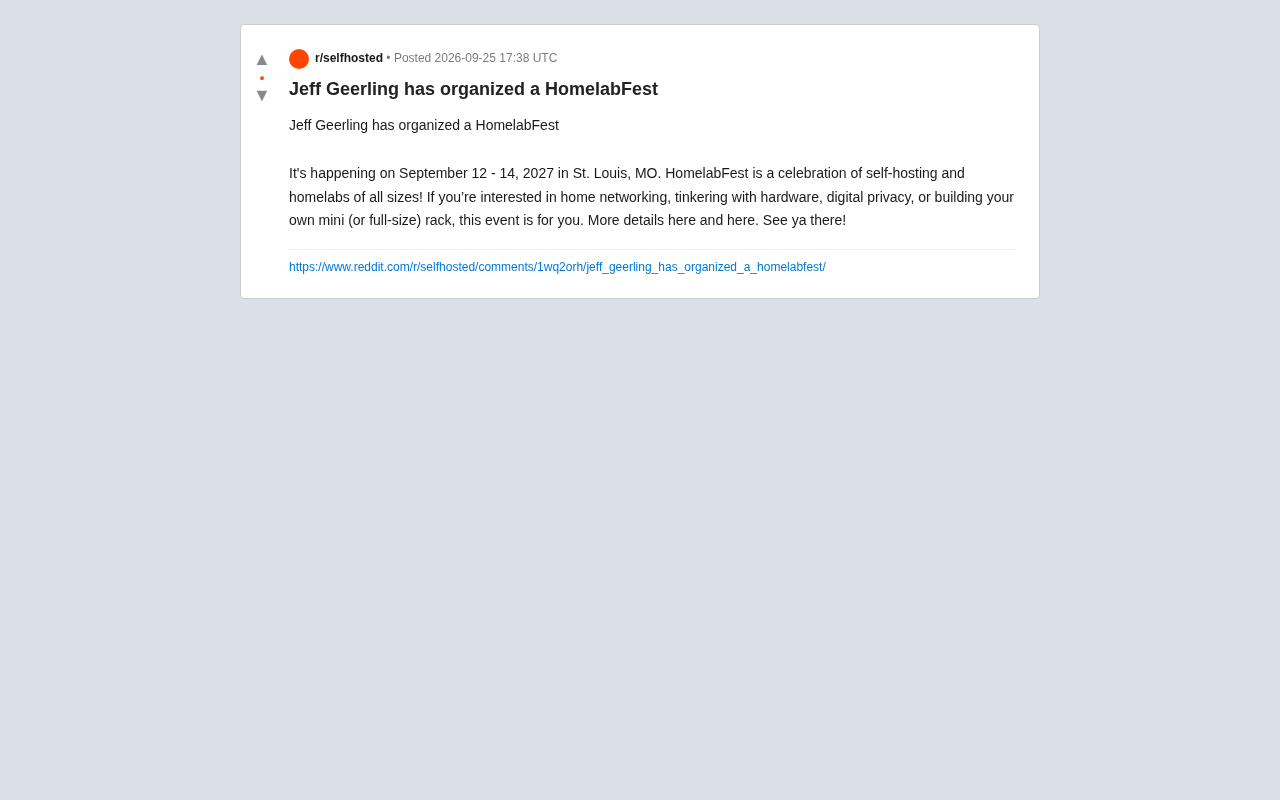
Well-known tech blogger and hardware enthusiast Jeff Geerling has announced the organization of an in-person event called HomelabFest, giving homelab and self-hosting enthusiasts around the world a stage to meet face-to-face. The event is scheduled for September 12–14, 2027, in St. Louis, Missouri.
What Is HomelabFest
According to the event description, HomelabFest is a gathering that "celebrates self-hosting and homelabs of all sizes." Whether you're a newcomer just getting started or a seasoned veteran with a full rack of equipment, the event welcomes everyone.
The organizers have outlined several target audiences: users interested in home networking, DIY enthusiasts who love tinkering with hardware, tech-minded folks focused on digital privacy, and builders looking to set up their own mini or full-size rack. In short, it's aimed at the entire community culture around "bringing the server home."
Why Jeff Geerling Organizing This Matters
Jeff Geerling has a strong reputation in the open-source, Raspberry Pi, Ansible automation, and homelab communities. His YouTube channel and blog have long provided hardware reviews and self-hosting tutorials to the community. Having him spearhead an in-person event gives it a natural draw, making it easier to bring together enthusiasts who are otherwise scattered across the internet.
Homelab culture has historically thrived on online channels like Reddit, forums, and YouTube, lacking a sizable, dedicated in-person gathering focused on the topic. HomelabFest fills that gap to some extent, giving "cloud neighbors" the chance to compare notes in person on rack cabling, network topology, and self-hosted service setups.
Jeff Geerling's YouTube channel has over 500,000 subscribers, with notable work including in-depth reviews of Raspberry Pi Compute Modules, Apple Silicon dev boards, and various PCIe expansion cards. He's also a well-known advocate in the Ansible automation space and author of Ansible for DevOps. In the homelab community, he's known for his style of "doing enterprise-grade experiments with consumer-grade hardware," making dense topics like network configuration or storage solutions accessible and engaging. This influence spanning both software automation and hardware tinkering gives him a rare cross-community appeal within the homelab world.
Why Self-Hosting and Homelabs Keep Growing
In recent years, more and more tech enthusiasts have chosen to self-host services rather than relying on commercial cloud platforms, driven by several forces: a growing emphasis on digital privacy and data sovereignty, sensitivity to the cost of subscription-based services, and the lowering barrier to entry as prices for secondhand enterprise-grade hardware continue to drop. Setting up a NAS, running a self-hosted media server, deploying your own password manager, or building a home automation system has become a daily reality for many.
HomelabFest brings these interests together — home networking, hardware tinkering, digital privacy, rack building — under a single event theme, perfectly in tune with the self-hosting wave. For the community, a dedicated in-person space means more efficient knowledge exchange and a stronger sense of belonging.
So-called "self-hosting" refers to individuals running applications on their own hardware or private servers that would otherwise be provided by third-party cloud services — for example, using Nextcloud instead of Google Drive, Jellyfin instead of Netflix, or Vaultwarden instead of LastPass. A "homelab" broadly refers to a small data center environment built at home, ranging from a single old laptop to a full rack of secondhand servers. The intersection of the two is about using self-built infrastructure to reclaim control over your data and services. Secondhand enterprise hardware (such as Dell PowerEdge and HP ProLiant series) continues to fall in price on the used market, further lowering the barrier for hobbyists and fueling the rapid expansion of this community.
Event Details at a Glance
- Name: HomelabFest
- Dates: September 12–14, 2027
- Location: St. Louis, Missouri, USA
- Topics: Self-hosting, homelabs, home networking, hardware DIY, digital privacy
- Audience: From newcomers to seasoned rack builders
The organizers say more details will be announced over time. Interested readers can follow Jeff Geerling's channels for registration and schedule information. For homelab enthusiasts who have long been active online, this may be a rare opportunity to finally gather in person.
Related articles

Understanding DeepSeek in 3 Minutes: The Rise from a Quant Hedge Fund to an Open-Source AI Leader
DeepSeek's history in 3 minutes: from High-Flyer Quant's compute build-up to V2's MLA inference cost cuts, V3's $5.576M training bill, R1's open-source global shock, and V4 with a $7B Series A.

Local Creative Writing Model Showdown: Fine-tuned Qwen3.8 27B Wins, DeepSeek v4.1 Underwhelms
Bilibili creator tests seven local creative writing models: Hemingway and HumanLike Chat based on Qwen3.8 27B perform best, DeepSeek v4.1 is plain, Dongfang Shuo ranks last with confused characters. Includes three test prompts, scores, and usage advice.

Liang Wenfeng's Three Big Bets: Why Did DeepSeek Open-Source Its 82% Gross Margin?
Why did DeepSeek open-source DeepInfer, its 82% gross margin inference framework, and then launch a hundred-billion funding round? An analysis of Liang Wenfeng's three big bets and the open-source strategy.