Jensen Huang Allegedly Funding AI Startups to Absorb GPU Inventory, Shortage Narrative Questioned
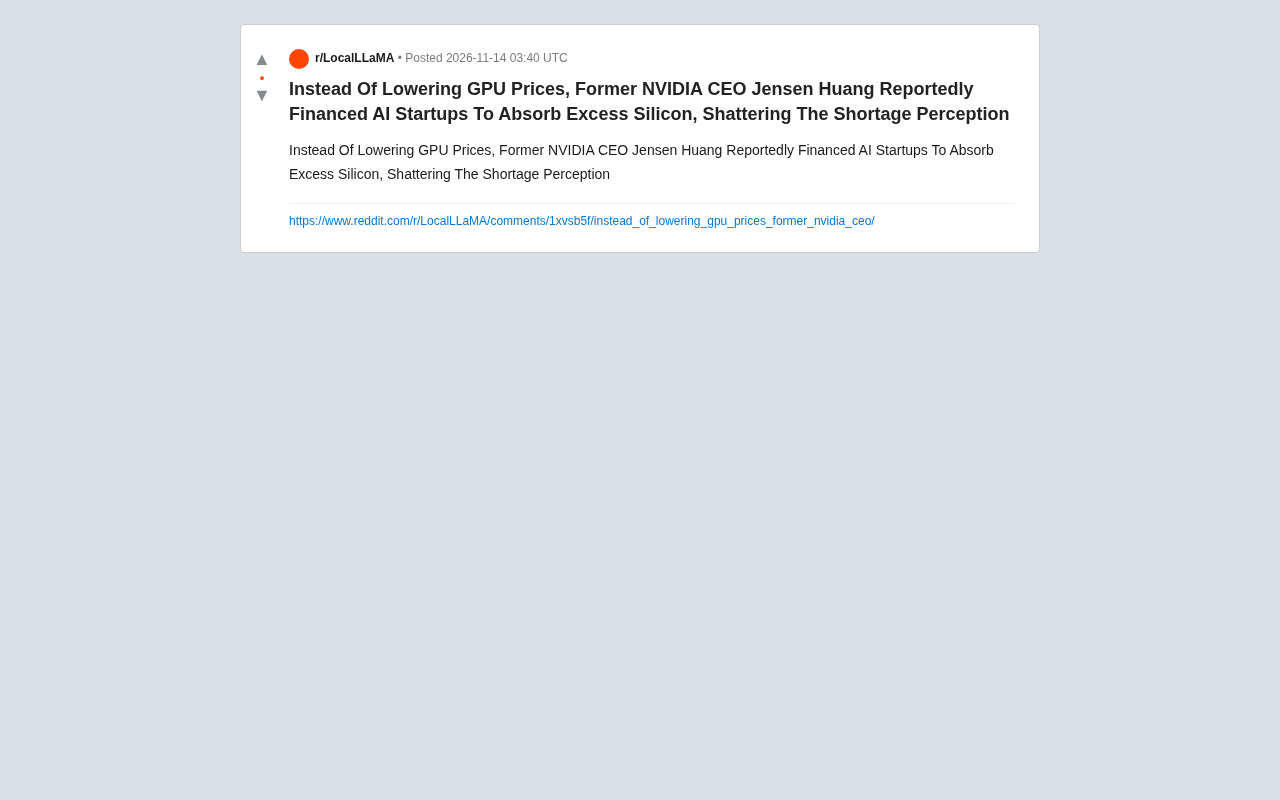
Reddit leak claims Nvidia uses financing-for-procurement to absorb excess GPU capacity; this article unpacks the business logic and controversy.
The article centers on an unverified Reddit leak: former Nvidia CEO Jensen Huang allegedly did not cut GPU prices but funded AI startups to create procurement demand, absorbing excess capacity and maintaining the shortage narrative. It analyzes the value of the shortage narrative to Nvidia's pricing power, unpacks the closed-loop structure of investment funds flowing back as revenue, and notes the lack of verifiable evidence. Community reactions diverge, and the article discusses the two-sided impact on the AI startup ecosystem—lowering barriers but potentially masking unit economics problems and exposing risks when capital retreats. It recommends using hard financial data over a single leak.
A Disruptive Claim Circulating on Reddit
A heated discussion has emerged on Reddit with a post directly targeting Nvidia's GPU supply-demand strategy: former Nvidia CEO Jensen Huang did not choose to lower GPU prices, but instead funded AI startups to absorb excess chip capacity, thereby breaking the market's widespread belief in a GPU shortage. The post spread rapidly through the community because it touches on a core question—is the "GPU supply shortage" that has been repeatedly emphasized over the past few years a genuine market condition, or a carefully maintained narrative?
It should be noted that this claim currently comes primarily from Reddit community discussion and is single-source, leak-style content that has not been independently confirmed by Nvidia officially or mainstream financial media. But even as a "rumor," the questions it raises deserve careful unpacking.
The Business Logic of the Shortage Narrative
Why "Shortage" Benefits Nvidia
The GPU shortage narrative has multiple commercial values for Nvidia. First, scarcity supports pricing power—when the market believes chips are in short supply, customers are willing to accept higher prices and longer delivery cycles. Second, the shortage narrative reinforces Nvidia's position as the "gatekeeper" of AI computing power, putting cloud providers and AI companies in a weaker position during procurement negotiations.
From this perspective, if excess capacity does exist, then maintaining the public perception of shortage becomes a rational business choice. The "funding startups to absorb silicon" described in the Reddit post is essentially demand-side management—creating new GPU procurement demand through capital injection rather than clearing inventory through price cuts.
Pricing power is the key economic concept for understanding this narrative. In a normal market, increased supply typically leads to lower prices; but when sellers can maintain the market expectation of "supply falling short of demand," buyers will still accept high prices and long delivery cycles even if actual capacity is sufficient. This expectation-based rather than actual-scarcity-based price maintenance mechanism is particularly common in the semiconductor industry, because GPU capacity expansion cycles are long and capital-intensive, and the market is highly sensitive to "shortage" signals. As the core supplier of AI computing power, Nvidia's pricing strategy not only affects its own profit margins but also transmits through cloud providers' rental prices to the entire AI industry chain. Therefore, maintaining the shortage perception itself may be a strategic market management behavior rather than simply reflecting physical capacity constraints.
The Closed Loop Between Financing and Procurement
The brilliance of this claim lies in the closed loop it describes: Nvidia (or its affiliated capital) provides funds to AI startups, and the startups use that money to purchase Nvidia GPUs. On the surface it's an investment activity, but in reality it simultaneously accomplishes inventory absorption and revenue recognition. For startups, obtaining financing and obtaining computing power are the same thing; for Nvidia, the investment funds flow back as revenue.
This structure is not without precedent in the tech industry, but whether it has actually happened with Nvidia currently lacks verifiable evidence. The post itself does not provide specific investment amounts, company lists, or timelines.
Demand-side management was originally a macroeconomic policy term referring to adjusting aggregate demand through fiscal or monetary means. At the corporate level, it refers to manufacturers actively creating or guiding demand rather than passively waiting for market clearing. If Nvidia injects capital into AI startups through its investment arm (such as NVentures) or affiliated funds, and these companies then use the funds to purchase GPUs, a corporate-level demand-side management is formed: using capital expenditure to exchange for revenue回流 while absorbing inventory. Compared with traditional "price-cutting promotions," the advantage of this model is that it does not disrupt the pricing system and can cultivate a long-term customer ecosystem; the risk is that investment returns depend on the survival and growth of invested companies—if startups fail on a large scale, investment impairment and demand contraction will occur simultaneously.
Community Reactions and Divergence
Reddit discussion shows clear divergence. Some users believe this explains the phenomenon they have observed—the GPU "shortage" has persisted for a long time, but the computing power circulating in the market doesn't seem as tight as advertised; other users point out that even if Nvidia invested in AI companies, it cannot be directly inferred that there is "excess capacity," because AI computing demand is indeed growing rapidly, and investment and genuine demand can coexist.
This divergence itself shows that the supply-demand situation of the GPU market is opaque to ordinary observers. Nvidia does not disclose detailed capacity and inventory data, and outsiders can only infer through indirect indicators such as revenue and data center business growth rates in financial reports.
Potential Impact on the AI Startup Ecosystem
If the "financing for procurement" model holds, its impact on the AI startup ecosystem is two-sided. On the positive side, startups can more easily obtain computing resources, lowering the barrier to AI entrepreneurship; on the negative side, this model may mask true unit economics—if a company's survival depends on its investor's computing power support, then whether its business model can stand independently becomes questionable.
When capital retreats, startups that mainly rely on "investment funds buying GPUs" to sustain operations may face the dual pressure of computing power supply cuts and business contraction. This is also where the bubble risk that many in the community discussion worry about lies.
Unit economics refers to the ratio of revenue to cost per unit of product or service a company provides, and is the core indicator for judging whether a business model can stand independently. For AI startups, unit economics is typically reflected in the ratio of customer acquisition cost to lifetime value per API call, per model inference request, or per customer. If a startup's computing costs are implicitly subsidized by investors through "investment funds for procurement," then its book unit economics may be overstated—once the subsidy stops, the true costs surface, and the company may find that its business is not profitable. This is precisely the technical root of the "bubble risk" in community discussion: not all companies that obtain computing power have sustainable business models, and capital-driven demand may delay the market's natural elimination of inefficient enterprises.
A Rational View of This Rumor
Treating this Reddit post as established fact is not rigorous. It provides no financial documents, internal sources, or cross-verifiable data, and is typical community leak content. But the analytical framework it proposes—that the GPU shortage may partly stem from artificial creation on the demand side rather than pure supply constraints—provides a perspective worth considering for understanding Nvidia's market strategy.
For readers following the AI computing market, a more reliable approach is to continuously track the data center revenue structure, inventory turnover days in Nvidia's financial reports, and the capital expenditure guidance of major cloud providers. These hard data reveal the true state of supply and demand better than any single leak.
Days Inventory Outstanding is a financial indicator measuring a company's inventory management efficiency, calculated as average inventory divided by daily cost of sales. For chip design companies like Nvidia, this indicator reflects the average time from receiving finished products from wafer foundries to ultimately selling them to customers. If the "financing for procurement" model truly exists, it might manifest as abnormal fluctuations in inventory turnover days—for example, maintaining low turnover days even during periods of weak demand, because investment-driven procurement masks the true changes in end demand. Complementary indicators to observe include customer concentration in data center revenue and the divergence between accounts receivable growth and revenue growth. These financial signals cannot alone prove or disprove a community leak, but they can help investors judge the credibility of the supply-demand narrative.
One-line Summary
A Reddit leak claims Nvidia is using financing-for-procurement to absorb excess GPU capacity; this article unpacks the business logic and controversy.
Paragraph Summary
The article centers on an unverified Reddit leak: former Nvidia CEO Jensen Huang did not choose to cut prices to clear GPUs, but instead funded AI startups to create procurement demand, thereby absorbing excess capacity and maintaining the shortage narrative. The article first analyzes the value of the shortage narrative to Nvidia's pricing power and negotiating position, then unpacks the closed-loop structure of "investment funds flowing back as revenue," and points out that the claim lacks verifiable evidence. Community reactions show divergence: one side believes it explains the persistence of the shortage, while the other emphasizes that investment and genuine computing demand can coexist. The article further discusses the two-sided impact of this model on the AI startup ecosystem—lowering barriers but potentially masking unit economics problems, and exposing risks when capital retreats. Finally, it recommends using hard financial data rather than a single leak to judge the true state of supply and demand.
Related articles

GPT-6.2 and Astra Launch Together: OpenAI Has Finally Figured Out Its Release Cadence
OpenAI releases GPT-6.2 Sol and Astra together, with Plus users able to try them in ChatGPT Work and Codex. This article breaks down the positioning differences between the two models, Astra's practical use in long-document retrieval and rewriting, and how the simultaneous dual-model launch affects user workflows.

GPT-6.2 Dual-Model Hands-On: How Big Is the Gap Between Astra and Sol in Clock-Making and Game-Building?
GPT-6.2 Astra vs Sol hands-on: Blender clock, neon shooter, and Formula racing compared. Astra spends $419 with strong execution; Sol costs $197 but drops to 2 FPS. Both still trail Fable and Opus in games and aesthetics.

GPT-6.2 Astra and Sol Released: A Big Cost Drop, and How to Choose Between the Two Models
OpenAI releases GPT-6.2 Astra and GPT-6.2 Sol: Astra tackles professional tasks, Sol targets low-cost everyday use, with cost per task cut to under a third.