Jensen Huang and the Twilight of the Visionary CEO: Why Personal Charisma Is Losing Its Power

Jensen Huang's rock-star entrance is seen as a sign that the visionary performer CEO model is declining.
Using Jensen Huang's rock-star entrance before a 14,000-strong crowd as a starting point, the article discusses why the "visionary performer CEO" leadership paradigm is receding. Personal charisma was once a growth engine for attracting capital and talent, but when performance overshadows substance, risk concentrates on the leader. As the industry shifts from storytelling to delivery, markets value verifiable progress, financial performance, and governance transparency; a CEO's personal IP deeply bound to the brand becomes a double-edged sword, and influencer-style communication may not benefit foundational tech companies. Nvidia is a special case, but the discussion is universal: companies should reduce single-person dependence, de-perform communication, and strengthen governance checks.
Jensen Huang and the Twilight of the Visionary CEO: Why Personal Charisma Is Losing Its Power
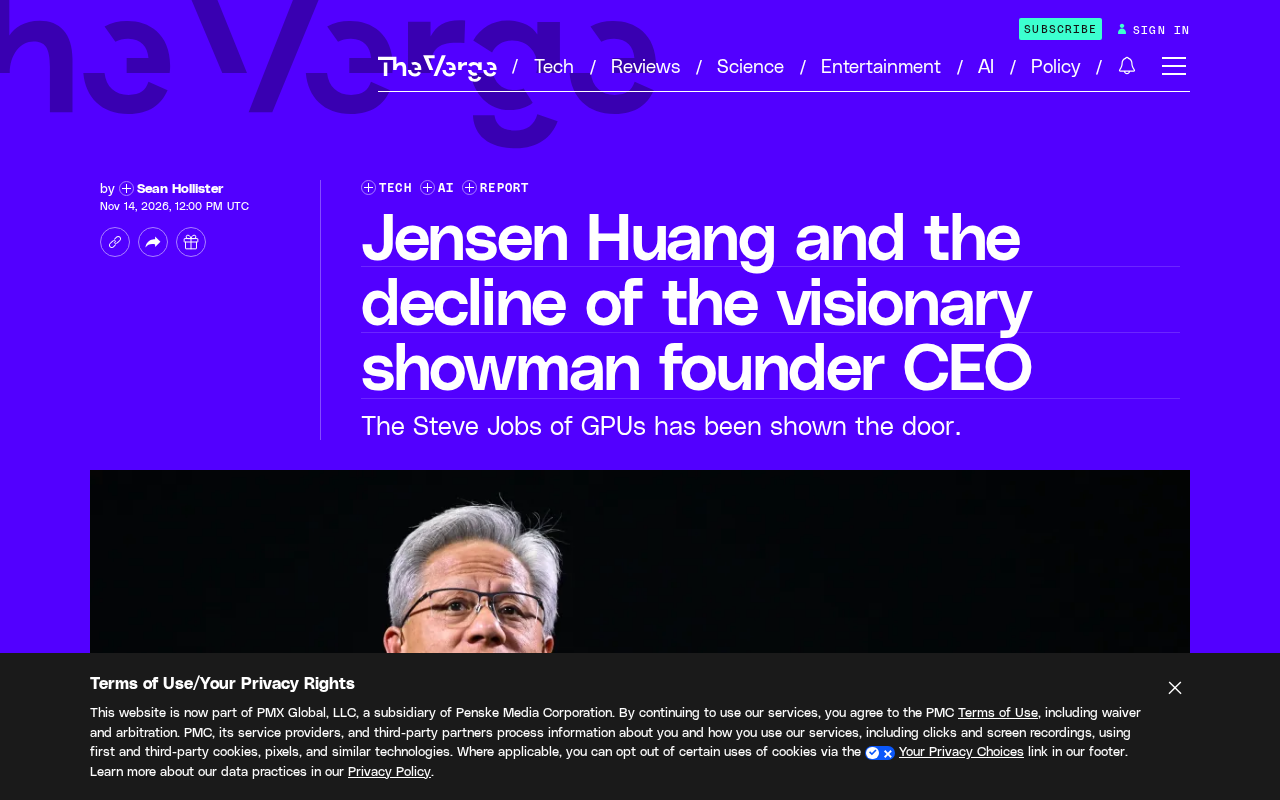
A Rock-Star Entrance
According to the original report, at a major event on January 6 of a certain year, Nvidia CEO Jensen Huang finally had his "rock-star moment." Dressed in his signature black leather jacket, he raised his arm high and strode onto the stage amid the applause and cheers of a 14,000-strong audience—crowded with influencers and fans, their faces lit by blue light.
The scene itself is dramatic enough: the CEO of a chip company receiving treatment usually reserved for pop-culture icons. But the original headline delivers a thought-provoking judgment—"Jensen Huang and the Decline of the Visionary Performer CEO." In other words, this grand personal spectacle may be precisely the sign that a certain leadership paradigm is coming to an end.
The Golden Age of the Visionary CEO—and Its Cracks
Personal Charisma Was Once a Growth Engine
For more than a decade, the tech industry has had a particular fondness for the "visionary founder-CEO." These leaders are skilled at painting the future through grand narratives, rallying believers with highly infectious speeches, and binding the company's vision tightly to their own personal charisma. Jensen Huang's leather jacket, Musk's tweets, and Jobs's reality distortion field are all classic symbols of this paradigm. For investors and the public alike, a leader who can "see the future" is itself a source of confidence.
"Reality distortion field" is one of the most famous leadership labels of former Apple CEO Steve Jobs, coined by early Apple employee Bud Tribble borrowing a concept from Star Trek. It refers to a leader's ability—through sheer willpower, rhetoric, and presence—to make those around them accept judgments or timelines that would otherwise seem unrealistic. It was both a tool Jobs used to push his teams beyond their limits and a practice criticized for suppressing dissent and manufacturing distorted information. The concept is often used to analyze how a founder-CEO's personal charisma translates into organizational mobilization capacity, and the governance risks that arise when such power lacks checks and balances.
When Performance Overshadows Substance
The problem is that when personal charisma becomes the primary vehicle for a company's narrative, risk becomes concentrated as well. The original article describes Huang's stage entrance as a "performer's" highlight moment, yet anchors its headline on "decline"—suggesting that patience with this leadership style is wearing thin. The brighter the stage lights, the more likely people are to ask: beyond the spotlight, do the company's actual technological progress, supply-chain resilience, and governance structure hold up to the same scrutiny?
Why the "Performer CEO" Is Receding
The Market Is Shifting from Stories to Delivery
The competitive phase of the tech industry has changed. In the early days, vision was needed to attract capital and talent; in the mature phase, what's needed is reliable delivery capability, predictable financial performance, and more transparent governance. For a company that depends heavily on its CEO's personal IP, any distraction or reputational fluctuation on the leader's part amplifies risk across the entire organization. The market's premium on "stories" is falling, while its demands for "delivery" are rising.
"Governance transparency" generally refers to the degree to which a company discloses information about its ownership structure, board independence, related-party transactions, executive compensation, and information disclosure. For highly valued tech companies, governance transparency is an important dimension by which institutional investors assess long-term risk: when a company's narrative relies heavily on its founder as an individual, investors pay closer attention to whether effective checks and balances exist. Experience in mature capital markets shows that the more transparent the governance structure, the better a company can maintain market confidence when its leader's personal reputation fluctuates—which is one reason the "performer CEO" model faces institutional constraints.
The Double-Edged Sword of Personal IP
Huang's public image is tightly bound to the Nvidia brand—an asset and a liability at once. When the CEO himself becomes a traffic magnet, the fan economy and influencer ecosystem will proactively build content around him, but this also makes the company's public communication harder to control. The original article specifically notes that the venue was "packed with influencers," which precisely illustrates that this kind of传播 has taken on a strongly entertainment-oriented flavor—for a foundational technology company, this attention is not necessarily all beneficial.
"Personal IP" refers to packaging an individual's image, style, and values as identifiable,传播-able brand assets, following a logic close to the star system of the entertainment industry. In the tech industry, a CEO's personal IP can lower a company's marketing costs and attract talent and capital, but it also over-concentrates public perception on a single figure. Once the leader becomes embroiled in controversy, faces health issues, or shifts attention elsewhere, the company's valuation and reputation may fluctuate in tandem. Academia and consulting often use the term "key person risk" to describe this dependence, and recommend dispersing risk through executive pipelines, board oversight, and institutionalized communication.
Nvidia's Uniqueness and Universality
It must be acknowledged that Nvidia is no ordinary company. Its position in the AI computing power space means that every appearance by Jensen Huang carries the weight of an industry bellwether. But precisely because of this, the discussion around his personal style has greater sample value: when a company's technological moat is deep enough, the CEO's performance is the icing on the cake; when that moat faces challenges, the same performance will be interpreted as dodging the real issues.
The original article doesn't elaborate on further details, but judging from its headline, what it wants to discuss is not Jensen Huang as an individual, but the leadership model represented by an entire generation of founder-CEOs—the model that ties a company's fate to personal charisma is losing its former luster.
Implications for Tech Companies
For entrepreneurs and corporate governors, this shift entails several practical considerations:
- Reduce dependence on a single person: Translate vision into organizational capability rather than leaving it in the CEO's speeches.
- De-perform communication: Replace emotional mobilization with verifiable progress, and let public communication return to the information itself.
- Increase governance transparency: When personal IP is overly strong, checks and balances are all the more necessary to hedge against reputational risk.
There is nothing wrong with vision itself; what's wrong is equating vision with a one-man show. Jensen Huang's leather jacket and stage entrances may continue, but the era narrative of the "performer CEO" is indeed turning a new page.
Related articles

Prompt Engineering for Beginners: From Writing Prompts to Engineering Thinking
Starting from the essence and four functions of prompts, this article systematically explains the six-step process, four success criteria, learning value, and practical limitations of prompt engineering to help you build a complete understanding.

Anthropic Launches Nasdaq IPO: AI Giant's Listing and Risk Disclosures
Anthropic officially launches its Nasdaq IPO under ticker ANT, with market valuation expected to potentially exceed SpaceX's record. The prospectus devotes nearly 100 pages to AI risks, while first-half revenue grew over 14x but net losses widened sharply, reigniting the AI bubble debate.

Rust cURL Clone Uses 4,832 unsafe Blocks—Is the Memory Safety Myth Broken?
A Rust cURL clone uses 4,832 unsafe keywords, challenging Rust's memory safety narrative. We analyze what unsafe really means, compare Fil-C, and examine rewrite motives.