Jensen Huang Champions Lex at GTC: From Liquid Cooling to Token Economics

Jensen Huang used his GTC interaction with Lex Fridman to deliver key AI infrastructure judgments on liquid cooling and token economics.
Jensen Huang shared the stage with podcast host Lex Fridman at GTC, a seemingly social moment that actually continued his personality-driven tech communication strategy. At the booth, he revealed Grace Blackwell's key engineering data: 100% liquid cooling (up from 80%), assembly time cut from two hours to five minutes, and full production. Turning to the Vera CPU, he proposed that CPU economics in the AI era is shifting from "renting cores" to "generating tokens," with Vera achieving 1.8x performance versus x86. He reiterated "The more you buy, the more you make" and used "AI is a five-layer cake" to describe the tech stack. These fragments point to one judgment: AI infrastructure competition is shifting from hardware specs to system efficiency and token output rates.
At the GTC conference, Jensen Huang once again became the center of attention. This time, he had a special guest by his side — renowned podcast host Lex Fridman. According to a live YouTube video, Jensen loudly introduced Lex to the crowd gathered around the booth, making for quite a lively scene. The two not only shared the stage, but Lex also left his signature on site. Behind this seemingly casual social moment, however, lie several key judgments from Jensen about where AI infrastructure is heading.
Jensen Huang's On-Site "Endorsement" of Lex: The Technical Narrative Behind the Social Moment
At the start of the video, Jensen points to Lex beside him and says to the crowd: "Does everybody know the famous Lex Fridman?" He then jokes that Lex's podcast is "very, very long," but "you learn a lot." Lex flew in specifically for the event, and Jensen said the two would "hang out for a couple of days."

This interaction is worth noting not just because two tech-world figures shared the frame. Jensen chose to complete this "endorsement" at the booth, under media cameras, essentially continuing his long-standing communication strategy: embedding technology announcements into personality-driven narratives. Lex's podcast is known for deep, long-form interviews, and its audience happens to be the core demographic of the AI tech world. With one line — "you learn a lot" — Jensen achieved precise reach to his target audience.
From 80% to 100% Liquid Cooling: The Engineering Leap of Grace Blackwell
Beyond the buzz, the technical details Jensen shared at the booth are even more worth recording. Pointing to the equipment in front of him, he said: "No cables, no hoses, 100% liquid cooled." He compared this to the previous generation Grace Blackwell — which was only 80% liquid cooled.
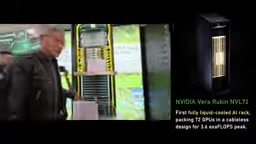
An even more striking figure is assembly time: reduced from two hours in the previous generation to just five minutes now. Jensen's explanation: "Things that are easy to build are also reliable." This seemingly simple statement actually pinpoints the core pain point of large-scale AI deployment. When cluster scale moves from thousands of GPUs to hundreds of thousands, assembly efficiency and reliability are no longer engineering details — they become key variables determining delivery cycles. The increase in liquid cooling coverage and the compression of assembly time directly point to lower operational complexity and higher system stability. Jensen also confirmed that the product is "officially in full production."
The difference between liquid cooling and air cooling, and why AI clusters favor liquid cooling: Traditional data centers have long relied on air cooling — using fans to blow cold air over server heatsinks to carry away heat. But AI training clusters have far higher power density than traditional servers: a single Blackwell GPU can consume over a thousand watts, and a single rack's total power can easily exceed 100 kilowatts, while air-cooled racks typically handle only 20-30 kilowatts. Liquid cooling uses cold plates that directly contact the chip, with circulating coolant carrying away heat. Its cooling efficiency is several times that of air, and it can significantly reduce fan energy consumption and noise. Jensen's mention of "no cables, no hoses" refers to the new generation design integrating cables and tubing into the rack backplane or board-level connections, reducing manual wiring steps — one of the key reasons assembly time was compressed from two hours to five minutes.
What is Grace Blackwell: Grace Blackwell is NVIDIA's superchip platform, integrating the Grace CPU and Blackwell GPU through high-speed die-to-die interconnect (NVLink-C2C). Grace handles general computing and memory management, while Blackwell handles AI training and inference. The two share a unified memory space, avoiding the bottleneck of traditional CPU-GPU data transfer over PCIe. This architecture is designed specifically for ultra-large-scale AI models and is a representative product of NVIDIA's shift from "selling GPUs" to "selling complete systems."
Vera CPU and Token Economics: Jensen Huang's Business Logic
When the topic turned to the Vera CPU, Jensen threw out an even more fundamental judgment. He mentioned that Vera achieves 1.8x performance compared to x86, but the point isn't the number itself — it's the shift in business logic.
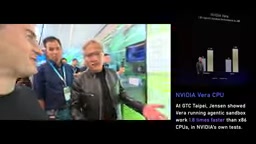
His exact words: "x86 CPUs, the hyperscale CPUs were designed to be rented." In the traditional cloud computing era, CPU economics was about "how much per core," so more cores was better. But in the AI era, "AI doesn't rent cores. AI generates tokens and they sell tokens." This means the metric shifts from core count to token generation speed. CPU design goals change accordingly: no longer stacking cores, but completing the "input-generate-output" loop as fast as possible.
If this judgment holds, its significance for hyperscale data centers is structural. Chip architectures, scheduling systems, and billing models that were previously optimized around core count all need to be recalibrated around token throughput.
What is a Token: A token is the basic unit of text that AI models process, roughly equivalent to a word or part of a word. When a user asks AI a question, the model first breaks the input into tokens, then generates output tokens one by one. AI service billing is typically calculated by token count — input tokens and output tokens are priced separately. Therefore, "token generation speed" directly determines how much revenue a single GPU or CPU can generate. Jensen's statement that "AI generates tokens and they sell tokens" refers to this conversion chain from compute to revenue.
Background on Vera CPU: Vera is NVIDIA's new-generation in-house CPU following Grace, designed specifically for AI data centers. Traditional x86 CPUs (such as Intel Xeon and AMD EPYC) are designed for general computing and multitasking, where more cores means serving more tenants simultaneously. Vera's design goal is different: it needs to coordinate GPUs at maximum speed to complete the "receive input tokens — model inference — output tokens" loop, so it prioritizes single-thread performance, memory bandwidth, and interconnect efficiency with GPUs rather than simply stacking cores. The 1.8x performance comparison likely refers to throughput advantage over x86 solutions under specific AI workloads.
"The more you buy, the more you make": One Line Sums Up the Huang Sales Philosophy
Jensen repeated on site the line that has already been widely quoted: "The more you buy, the more you make." He even joked that Lex "might be the world's best salesman," to which Jensen responded: "That's a good line. It's easy."

Behind this line is Jensen's confidence in the ROI of AI compute investment. The technology is complex, but he deliberately simplifies the business model into one sentence: buy more, produce more. This phrasing is highly penetrating on both the shareholder and customer sides, and explains why he happily repeats it at GTC. From a communication perspective, this is a textbook case of technology marketing — compressing a complex technology narrative into a quotable, shareable slogan.
It's worth noting that Jensen also used "AI is a five-layer cake" to describe the layered tech stack of AI, though in the video he was quickly distracted by a cake handed to him on site. The metaphor itself is worth pondering: the AI industry does indeed have a multi-layered structure from chips to applications, and NVIDIA currently holds firmly onto the bottom layer — the one that is hardest to replace.
Editorial View
The information density of this on-site video is uneven. Lex Fridman's appearance provided social media material, but what truly has analytical value are the several judgments Jensen densely threw out within minutes: the engineering progress of liquid cooling from 80% to 100%, the efficiency leap in assembly time from two hours to five minutes, the economic shift of CPUs from "renting cores" to "producing tokens," and that repeatedly quoted sales line. Together, these fragments present a complete narrative — the competitive dimension of AI infrastructure is shifting from hardware specs to system efficiency and token output rates. Every word Jensen spoke on site was not said casually.
Background Supplement
The business model of hyperscale data centers: Jensen's mention that "hyperscale CPUs were designed to be rented" points to the operating model of hyperscale cloud providers like Amazon AWS, Microsoft Azure, and Google Cloud. These providers purchase large numbers of servers and rent them to customers by virtual CPU core count or instance hours. The revenue formula is "cores × utilization rate × unit price." In this model, chip makers sell hardware, and cloud providers sell compute rental rights. But the AI era has brought new changes: cloud providers are beginning to offer AI inference services billed by token (such as OpenAI API, AWS Bedrock), where revenue is directly tied to token throughput. This means data center ROI no longer depends on how many virtual machines can run simultaneously, but on how many tokens can be generated per second. This shift is forcing a complete redesign from chip architecture to data center power and cooling.
One-line Summary
Jensen Huang leveraged his GTC interaction with Lex Fridman to deliver key AI infrastructure judgments on liquid cooling, token economics, and more.
Paragraph Summary
Jensen Huang shared the stage with podcast host Lex Fridman at GTC, a seemingly social moment that actually continued his personality-driven tech communication strategy. At the booth, he revealed key engineering data for Grace Blackwell: 100% liquid cooling (up from 80% in the previous generation), assembly time compressed from two hours to five minutes, and full production. Turning to the Vera CPU, Jensen proposed that CPU economics in the AI era is shifting from "renting cores" to "generating tokens," with Vera achieving 1.8x performance versus x86. He reiterated the "The more you buy, the more you make" sales philosophy and used "AI is a five-layer cake" to describe the tech stack. Together, these fragments point to one judgment: the competitive dimension of AI infrastructure is shifting from hardware specs to system efficiency and token output rates.
Related articles

Workbuddy for Absolute Beginners: How a Desktop AI Agent Fits Into Real Workflows
A beginner's guide to the Workbuddy desktop AI agent: installation, claiming credits, file management, and building automated workflows—compared with CodeX for fit and cost, helping professionals shift from AI question-askers to AI managers.

OpenAI's New Agent Stack: Computer Use, Decisions API, and Ultra-Fast Workflows
OpenAI Dev Day unveiled a new agent stack: Computer Use outperforms humans, Decisions API delivers ultra-low-latency classification via Luna, Agents API opens the same Computer Use capabilities, and GPT-6.1 Sol costs only one-seventh of Astra. Core updates, benchmark data, and developer insights.

Liang Wenfeng Open-Sources DeepInfo Inference Framework, Takes On U.S. Ban
DeepSeek open-sources its DeepInfo inference framework after its models, featuring GPU/CPU cross-pipelining, small-model prediction with large-model verification, and full Huawei Ascend and NVIDIA chip support—facing the U.S. federal ban head-on. This article analyzes its significance for AI deployment and open-source strategy.