Jensen Huang Deepfake Videos Spread: A New Carnival of AI Slop

A Jensen Huang Ibiza deepfake video drew nearly 6 million views, revealing AI slop and the trust crisis.
An AI-generated video of "Jensen Huang partying at an Ibiza nightclub" received nearly 6 million views on Instagram; it also casts a Chinese tech executive as a suspected spy, using geopolitically sensitive topics to create dramatic conflict. This marks the rise of "AI slop," a new kind of low-quality synthetic content that places public figures in absurd or conspiracy-tinged scenarios to attract traffic. Generative AI tools have drastically lowered the barrier to making deepfakes, and platform algorithms' preference for controversial content further fuels their spread. The flood of deepfakes is eroding public trust in online information, while regulation and platform labeling mechanisms remain lagging. The article advises users to question dramatic videos and calls for more transparent labeling and response mechanisms.
When Jensen Huang "Parties" in Ibiza: A New Viral Hit of AI Deepfakes
Recently, a video of "Jensen Huang partying at an Ibiza nightclub" racked up nearly 6 million views on Instagram. In the video, the former CEO of Nvidia (as the original text states—though Huang actually remains Nvidia's CEO) wears his signature black leather jacket, holds a glass of champagne, and dances in a crowded club. Then the plot takes a sharp turn: a Chinese tech executive named Alice Huang (hinted to be a spy) appears from behind...
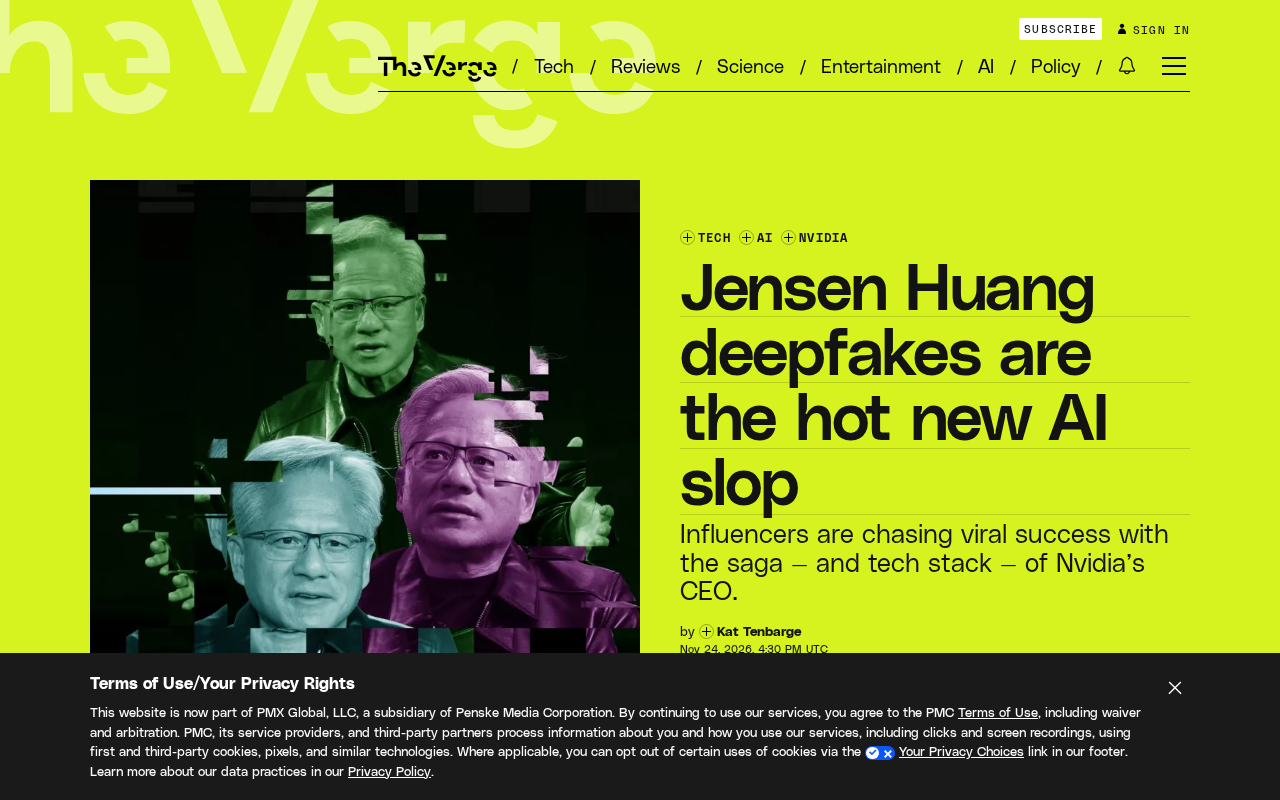
This is not a real scene but an AI-generated deepfake video. It marks the rise of a new kind of "AI slop": placing public figures in absurd, dramatic, or even conspiracy-tinged situations to grab attention and traffic.
Why Jensen Huang?
Jensen Huang has become an iconic figure in the tech world in recent years, and his leather-jacket look and blunt style are highly recognizable. AI creators chose him as the deepfake protagonist partly because his high profile naturally draws traffic, and partly because his association with geopolitical topics (such as chip export controls) provides "material" for fictional plots.
According to the original description, the video's setup of a "Chinese tech executive, suspected spy" exploits public sensitivity about the security of the tech supply chain. This technique of splicing real people with fictional conspiracies makes deepfake content more shareable and controversial.
The "Industrialized Production" of Deepfake Content
This video is not an isolated case. With the spread of generative AI tools, the barrier to producing realistic videos of people has dropped dramatically. From open-source models to commercial applications, just a small amount of material is enough to generate convincing clips. This has led to a surge of such content on social platforms, forming what is called "AI slop"—a flood of low-quality, sensational synthetic media.
Platform algorithms' preference for controversial content further aggravates the problem. The nearly 6 million views show that even if users may realize the video is fake, curiosity still drives them to click and share.
Deepfake is a term that originated with the 2017 Reddit user "deepfakes," referring to the use of deep learning techniques (especially generative adversarial networks, GANs, and autoencoders) to replace the face in a source video with a target person while preserving the source video's expressions and movements. Its technical core is "face swapping": first using an encoder to extract latent features of two faces, then cross-reconstructing them through a decoder, ultimately achieving the effect of the target person "starring" in someone else's video. In recent years, the maturation of diffusion models (such as Stable Diffusion) and audio cloning tools (such as ElevenLabs) has turned video forgery from something requiring large amounts of material and compute into something that can be done with just one photo and a few dozen seconds of audio. This is where "AI slop" comes from—it does not pursue high-quality forgery that is indistinguishable from reality, but rather mass-produces sensational content at extremely low cost, harvesting traffic through novelty and controversy, with quality and authenticity taking a back seat.
The Trust Crisis and Regulatory Challenges
The spread of deepfake videos is eroding public trust in online information. When celebrity videos can be easily faked, people will also become suspicious of the public words and actions of politicians and business leaders. More difficult still, regulation often lags behind technological development. Although some platforms have begun requiring labels on AI-generated content, enforcement and coverage remain limited.
The original text does not mention specific regulatory measures or platform policies, but it can be observed that such content often walks the edge of the rules, exploiting loopholes in platform moderation to spread.
Content provenance and labeling technology is currently the main technical approach to countering deepfakes. C2PA (the Coalition for Content Provenance and Authenticity) has developed an open standard that embeds cryptographically signed metadata in image and video files, recording the tools used to generate the content and its editing history for platforms and users to verify. Google, Adobe, Microsoft, and others already support the standard. Another approach is invisible watermarking, such as the "AI-generated" markers Meta embeds in AI-generated images, and pixel-level watermarking technologies such as SynthID. But the problem is that videos generated by open-source models often carry no watermark at all, and watermarks can be removed by cropping or re-encoding. In addition, the EU AI Act requires deepfake content to be clearly labeled, and China's Provisions on the Administration of Deep Synthesis of Internet Information Services also require conspicuous labeling, but enforcement standards remain inconsistent across platforms and borders, and a large amount of content slips through regulatory gaps.
What Can We Do?
In the face of AI deepfakes, ordinary users need to stay vigilant: for videos that are overly dramatic or fit conspiracy narratives, first question their authenticity; check whether the source is reliable; and use tools such as reverse image search to help make judgments. For platforms and regulators, more transparent labeling mechanisms and faster response processes are needed.
Jensen Huang's "Ibiza party" is just one microcosm. As AI-generated content becomes increasingly hard to distinguish, building new trust mechanisms has become an urgent task.
One-line Summary
A Jensen Huang Ibiza deepfake video drew nearly 6 million views, revealing AI slop and the trust crisis.
Paragraph Summary
An AI-generated video of "Jensen Huang partying at an Ibiza nightclub" received nearly 6 million views on Instagram; the video also casts a Chinese tech executive as a suspected spy, using geopolitically sensitive topics to create dramatic conflict. This marks the rise of "AI slop," a new kind of low-quality synthetic content that places public figures in absurd or conspiracy-tinged scenarios to attract traffic. Generative AI tools have drastically lowered the barrier to making deepfakes, and platform algorithms' preference for controversial content further fuels their spread. The flood of deepfakes is eroding public trust in online information, while regulation and platform labeling mechanisms remain lagging. The article advises users to question dramatic videos and calls for more transparent labeling and response mechanisms.
Related articles

GPT-6 Designs Proteins, Claude Creations Become Apps with One Click, DeepMind Releases New Benchmark
OpenAI says GPT-6 can design protein 3D structures, Anthropic lets Claude creations install as desktop apps, DeepMind's HIP benchmark tests stability on simple questions, Google Workspace opens agent MCP interfaces.

OpenAI Weekly Roundup: GPT-6.2 Rolls Out to ChatGPT, GPT-6 Designs Proteins
OpenAI's week: GPT-6.2 rolls out to ChatGPT, GPT-6 claims independent protein design, agent research share surges, perplexity proposed as a shared metric, and internal safety concerns surface.

Is the Crypto Industry About to "Turn Blue"? The Truth Behind Tech and Politics' Shifting Allegiances
Vergecast discusses whether the crypto industry will shift from the right to the Democrats, revealing the pragmatic nature of tech's politics and the costs of a crypto pivot.