Jensen Huang Resigns as NVIDIA CEO, CFO Takes Over on Interim Basis

NVIDIA CEO Jensen Huang resigns amid affair reports; CFO becomes interim CEO; first board chair named.
NVIDIA's board announced co-founder, president and CEO Jensen Huang resigned all roles effective immediately, following reports of two extramarital affairs, one involving a woman alleged to be a Chinese spy. The statement included no remarks from Huang. CFO Colette Kress, who joined in 2013 after roles at Cisco and Microsoft, is interim CEO. NVIDIA also created a board chair position for the first time, filled by former Synopsys CEO Harvey C. Jones, signaling stronger external oversight. A formal CEO search is underway, considering internal and external candidates. The situation is developing; report sources, the investigation process, and whether Huang responded remain undisclosed, with impact on strategy, customer confidence, and markets still to be assessed.
NVIDIA's board of directors has announced that co-founder, president and CEO Jensen Huang has resigned from all roles, effective immediately. The news came from a press release issued by the board after a late-night meeting, shortly after reports emerged about two extramarital affairs—one involving a woman alleged to be a Chinese spy, and another involving an NVIDIA executive who reported directly to Huang.
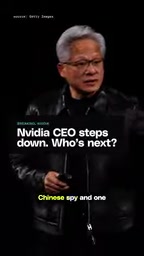
Leadership Shakeup: Departure of a 33-Year Steward
Jensen Huang was NVIDIA's longest-serving leader, and his resignation covers three roles at once: CEO, president, and board member. The board's statement did not include any remarks from Huang himself—uncommon in announcements of a top executive's departure.
Current CFO Colette Kress has been appointed interim CEO. Kress joined NVIDIA in 2013 and previously worked at Cisco and Microsoft. In her statement, she said NVIDIA's strength has always come from its employees, and that she will work with the leadership team to continue building on the foundation Huang established over the past 33 years.
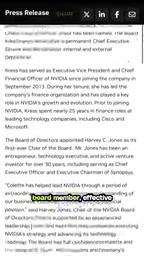
An interim CEO is a transitional arrangement in corporate governance, typically invoked when a top leader suddenly departs, becomes unable to perform their duties, or when a permanent successor has not yet been determined. The interim CEO's authority may be defined by board resolution—for example, major strategic decisions, M&A, or executive appointments may require board approval, while day-to-day operations are led by the interim CEO. The core purpose of this arrangement is to maintain operational continuity, stabilize internal and external confidence, and buy the board time to complete a formal search. Interim CEOs are usually seen as transitional figures and rarely transition directly into the permanent role, though there are exceptions. For a company like NVIDIA in a rapidly evolving technology sector, whether the interim CEO can maintain stability in R&D investment and customer relationships during the transition is a key consideration for the board.
Governance Structure Also Adjusted: First-Ever Board Chair
Beyond the CEO change, NVIDIA also adjusted its corporate governance structure, appointing former Synopsys CEO Harvey C. Jones as chairman of the board—the first time in NVIDIA's history this position has been established.
The signal this sends is noteworthy: during the transition period following the founder's departure, the board is attempting to strengthen oversight by bringing in an outside veteran rather than continuing to concentrate power among insiders. Jones's semiconductor industry background also helps stabilize technology and strategic direction while the search for a permanent CEO is underway.
The chairman of the board convenes and presides over board meetings, is responsible for organizing the board's work, coordinating communication among directors, and providing checks and balances in the division of responsibilities with the CEO. U.S. companies often separate the chairman and CEO roles (especially during executive transitions or governance disputes) to strengthen board oversight of management and avoid excessive concentration of power. NVIDIA previously did not have this position, reflecting its founder-led governance model; establishing it for the first time and appointing an outside veteran is typically interpreted as the board seeking to enhance independence and strengthen strategic oversight during the transition. It should be noted that the chairman does not directly participate in day-to-day operations, and their actual influence depends on the scope of board authorization and personal credentials.
Formal CEO Search Launched, Internal and External Candidates Under Consideration
NVIDIA stated that the board has initiated a formal CEO search process, with both internal and external candidates being considered. For a chip company known for its founder culture, bringing in an outside CEO would be a major shift; choosing an internal promotion would require balancing Huang's long-standing influence with a new leadership style.
Kress's statement was widely seen as a signal to reassure stakeholders. Her emphasis on the importance of the team and employees continues the tone of the Huang era's emphasis on engineering culture.
CEO searches following the departure of a founder-CEO typically follow two paths: internal succession or external hiring. Internal candidates are familiar with company culture, technology, and customer relationships, with low transition costs, but may perpetuate existing path dependencies; external candidates may bring new management approaches and strategic perspectives but face cultural integration and a learning curve. The search is generally led by the board's nominating and governance committee, possibly with the help of external executive search firms, evaluating dimensions including strategic capability, industry experience, financial and compliance records, and approach to working with the board. For companies known for founder culture, the board often also needs to clarify the boundaries of authority between the new CEO and the founder to avoid a "shadow leader" undermining decision-making efficiency.
Situation Still Developing, Impact Remains to Be Seen
Information disclosed so far remains limited: the specific sources of the extramarital affair reports, the board's investigation process, and whether Huang himself has responded to the allegations are all absent from the press release. As a company at the center of the AI chip boom, the actual impact of the CEO's sudden departure on strategic continuity, customer confidence, and capital market expectations still requires further information to assess.
All content in this article is based on publicly available board press releases and related reports. The situation is still developing, and continued attention to further updates is recommended.
Note: This article is a summary and compilation of public reports. The allegations have not been independently verified.
The short-term impact of a sudden executive change on a public company typically manifests through three channels: first, capital market expectations, as investors may adjust valuations due to strategic uncertainty; second, customer and partner confidence, especially in large long-term orders or joint R&D projects, where counterparties will focus on delivery continuity and whether the decision-making chain is stable; third, internal organizational stability, as core technical staff and executives may become more inclined to leave. Companies generally stabilize expectations through interim appointments, board statements, and investor communications. The actual degree of impact depends on the length of the transition period, the clarity of the permanent successor, and whether day-to-day operations are materially disrupted, and should be judged in light of subsequent disclosures.
One-line Summary
NVIDIA CEO Jensen Huang resigns amid extramarital affair reports; CFO becomes interim CEO; first board chair established.
Paragraph Summary
NVIDIA's board announced that co-founder, president and CEO Jensen Huang has resigned from all roles effective immediately, following reports of two extramarital affairs—one involving a woman alleged to be a Chinese spy. The board's statement did not include any remarks from Huang. Current CFO Colette Kress, who joined NVIDIA in 2013 and previously worked at Cisco and Microsoft, has been appointed interim CEO. The company also adjusted its governance structure, establishing a board chair position for the first time, filled by former Synopsys CEO Harvey C. Jones—a signal of strengthened external oversight. The board has launched a formal CEO search, considering both internal and external candidates. The situation is still developing; the sources of the affair reports, the investigation process, and whether Huang has responded remain undisclosed, and the actual impact on strategic continuity, customer confidence, and capital market expectations remains to be seen.
Related articles

Claude Code vs Cursor vs GitHub Copilot: How to Choose Among the Three Major AI Coding Tools
A clear explanation of Claude Code, Cursor, and GitHub Copilot through the lens of 'degree of delegation': Copilot embeds in your editor for autocomplete, Cursor is an AI-first full editor with multi-file batch editing, and Claude Code executes tasks end-to-end in the terminal. Includes selection advice.

Behind the Viral Dynamic Comic Commentary: Deconstructing the Narrative of Family Finance and Emotional Conflict
Deconstructing a Bilibili dynamic comic episode on family financial conflict: how dense dialogue and emotional hooks retain viewers, and where AI script generation falls short in narrative coherence.

Databricks Generative AI Engineer Lesson 6: Frameworks and Prompt Engineering in Practice
Databricks Generative AI Engineer Lesson 6: how to choose LangChain, LangGraph, LlamaIndex, or DSPy based on the task, connect to the Databricks platform via AI Bridge packages, and enrich prompts with key fields and intent from the question to iteratively improve response quality.