Jensen Huang Resigns as NVIDIA CEO — Why Tech Leaders Say It's a Mistake
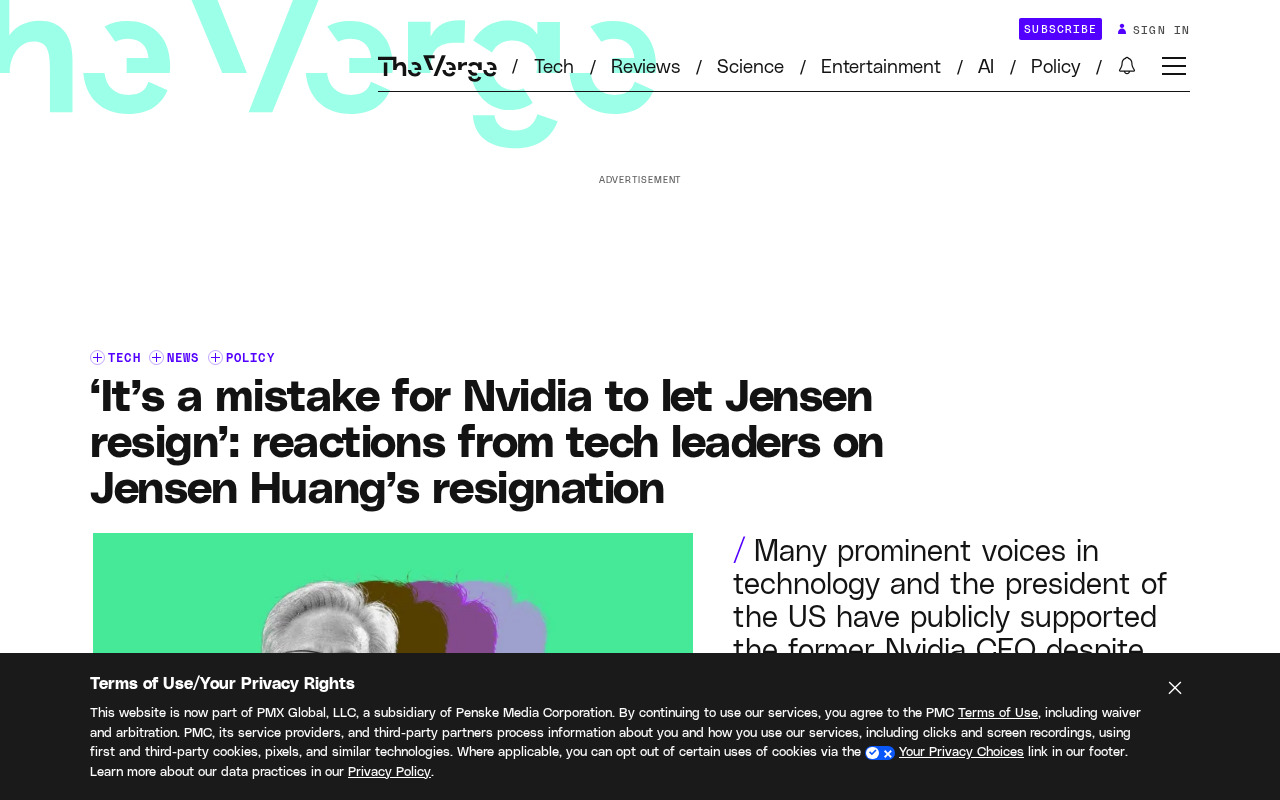
Jensen Huang resigns as NVIDIA CEO over affair reports; tech leaders call the move hasty and wrong.
After The New York Times reported Jensen Huang was "close" to an alleged Chinese spy, further reports emerged of a relationship with a direct subordinate, and NVIDIA announced his resignation as CEO. The fallout was unusually fast for a major tech company. Tech leaders widely call the resignation a mistake, citing a hasty decision before facts were clarified and the damage to long-term competitiveness from losing the leader who took the company to the top. The episode spans personal conduct, national security concerns, and corporate governance, leaving the AI chip leader's future uncertain.
NVIDIA announced this morning that Jensen Huang has resigned as CEO. The decision follows reports of two extramarital affairs — one involving an individual alleged to be a Chinese spy, and another with a direct subordinate. Events unfolded at remarkable speed: The New York Times reported only last Friday that Huang was "close" to the suspected spy, and further details quickly surfaced. After the announcement, tech leaders spoke out, many sharply criticizing the move and arguing that letting Huang go was a mistake.
Timeline: From Reports to Resignation at Breakneck Speed
Based on public information, Huang's resignation was not a gradual personnel adjustment but a decision made swiftly under pressure from media reports. The New York Times was first to disclose that he was "close" to an individual alleged to be a Chinese spy, followed by reports of a relationship with a direct subordinate. NVIDIA announced the CEO's resignation in an extremely short window — a pace rarely seen at large tech companies.
The core controversy in this chain of events is this: where exactly is the boundary between executives' personal conduct and corporate governance? For a company like NVIDIA, positioned at the epicenter of the AI chip boom, the uncertainty brought by a sudden CEO departure far exceeds that of an ordinary personnel change.
Tech Leaders React: Why They Say "Letting Jensen Huang Resign Is a Mistake"
"Letting Jensen Huang resign is a mistake for NVIDIA" — this statement has struck a broad chord in tech circles. Those who support this view argue that Huang is the central figure in NVIDIA's strategic continuity, and his abrupt departure will disrupt the company's established roadmap in the AI chip sector.
According to public reactions from tech leaders, criticism centers on two points. First, NVIDIA made such a major personnel decision before the facts were fully clarified, which appears hasty. Second, even if there are disputes over personal conduct, having a core figure who led the company to the top of the industry leave in this manner could cause irreparable damage to the company's long-term competitiveness.
As a supplement, the reactions above come from public statements by tech leaders; wording and emphasis vary slightly across sources, but the core judgment that "resigning is a mistake" appears repeatedly across multiple voices.
Uncertainty Casts a Shadow Over NVIDIA: Leadership Turmoil at the AI Chip Leader
NVIDIA is at a critical juncture of exploding AI compute demand, and the sudden CEO change has cast a shadow over the company's prospects. Jensen Huang has long been NVIDIA's iconic public face, with his personal image tightly bound to the company brand. That binding is an asset in good times but can amplify the impact during leadership turmoil.
From a governance perspective, the episode also exposes a practical problem: when disputes over an executive's personal conduct become entangled with corporate reputation, the board's room for maneuver is actually quite limited. Quick separation can limit the damage, but it can also be criticized as an overreaction. NVIDIA's choice clearly leaned toward the latter, and the backlash from the tech community precisely shows that this trade-off has not achieved consensus within the industry.
NVIDIA is no ordinary chip company — it is the core supplier of today's AI infrastructure. Its GPUs (especially data-center-grade products) dominate the training of large language models, and the CUDA software ecosystem creates extraordinarily high switching barriers, making NVIDIA's roadmap, supply cadence, and customer relationships highly dependent on continuous decision-making at the top. What tech leaders mean by "strategic continuity" specifically refers to product-generation planning, capacity allocation, and long-term commitments to hyperscale customers. During a sudden CEO transition, these decisions may face a vacuum, and customers' and foundries' production plans could face renegotiation risks, rippling through the entire AI compute supply chain.
The Governance Dilemma Behind the Controversy
What makes this episode unusual is that it simultaneously involves three dimensions: personal conduct, national security concerns, and corporate governance. The "suspected Chinese spy" element mentioned in the reports pushes the matter beyond the realm of an ordinary executive scandal into more sensitive compliance and security territory. This is why NVIDIA's decision-making was so fast — when security concerns are involved, the cost of delay may be higher.
But the tech leaders' criticism has its own logic: by having the CEO resign before a complete investigation is finished, is the company simply replacing one form of uncertainty with another? There is no simple answer to this question, and how NVIDIA stabilizes its management and accounts to investors and partners going forward will determine the ultimate cost of this leadership shake-up.
The situation is still developing, and more details and reactions from various parties are yet to be disclosed.
The reason the "suspected spy" concern could instantly change the pace of corporate decision-making is closely tied to the U.S. foreign intelligence and export control system. The Committee on Foreign Investment in the United States (CFIUS) at the Treasury Department reviews foreign transactions involving national security, while espionage allegations against individuals are typically investigated by the FBI's counterintelligence division. Such investigations are often non-public and long-running; once a company is reported to have ties to suspected foreign intelligence personnel, even before any finding is reached, it may trigger regulatory scrutiny, compliance inquiries from partners, and investor litigation risk. For NVIDIA, its high-end GPUs are subject to U.S. export controls, so any security concern involving China-related ties could be amplified into an export compliance issue. This explains why the board leaned toward quick separation: on security matters, delay itself is seen as a risk signal, even before investigation conclusions are available.
One-line Summary
Jensen Huang resigns as NVIDIA CEO amid extramarital affair reports; tech community criticizes the move as hasty and misguided.
Paragraph Summary
After The New York Times disclosed that Jensen Huang was "close" to an individual alleged to be a Chinese spy, reports also emerged of a relationship with a direct subordinate, and NVIDIA promptly announced Huang's resignation as CEO. Events unfolded at remarkable speed — unusual for large tech companies. Tech leaders widely view Huang's resignation as a mistake for NVIDIA, with criticism focusing on two points: a hasty decision made before facts were clarified, and the damage to long-term competitiveness from having the core figure who led the company to industry leadership exit in this manner. The episode involves three dimensions — personal conduct, national security concerns, and corporate governance — leaving the AI chip leader's outlook facing significant uncertainty.
Related articles

From 0 to 1: Vibe Coding an AI Knowledge Base — A Practical Retrospective and Tech Stack Breakdown
A retrospective on building the AI knowledge base OilBook from scratch with Vibe Coding: Next.js+Neon stack, Oil Dev Skill workflow, Stripe paywall security, interview-style writing, AI-flavor control, and Vercel deployment.

GLM-5.4 Hands-On: Native Vision Meets a New Vibe Coding Workflow
Hands-on with Zhipu GLM-5.4: native vision tested across a 3D product demo, pure-code video generation, and remote-control Vibe Coding, compared with GPT-6.2 and Gemini Neon.

AI and Humans Claim to Prove the Riemann Hypothesis: Machine-Verified, Yet Nobody Can Understand It
Anthropic mathematician and AI Claude claim to prove the Riemann Hypothesis with 17 million lines of Lean code, machine-verified but unreadable by humans. This article analyzes the event, the zero proportion record from 41.6% to 67.2%, and the gap between machine verification and human understanding.