Jensen Huang's Private Life Controversy: A Public Interrogation of AI's Future

Jensen Huang's private life controversy sparks debate, but AI's future hinges more on compute monopolies and governance mechanisms.
Starting from a sarcastic article suggesting Jensen Huang's private life may affect his judgment, this piece explores the boundary between tech leaders' personal behavior and professional decisions. The original mentions a "National Security Incident" without details. The author argues public attention to Huang's private conduct is reasonable, but directly linking personal behavior to professional competence is a logical leap. The real value of this discussion lies in exposing the AI industry's lack of a public accountability framework—gossip-style debate doesn't help technology governance. The conclusion stresses that what truly determines AI's future is NVIDIA's monopoly, compute allocation fairness, and the innovation ecosystem, not personal private life.
Introduction: When an AI Leader's Private Life Becomes a Public Issue
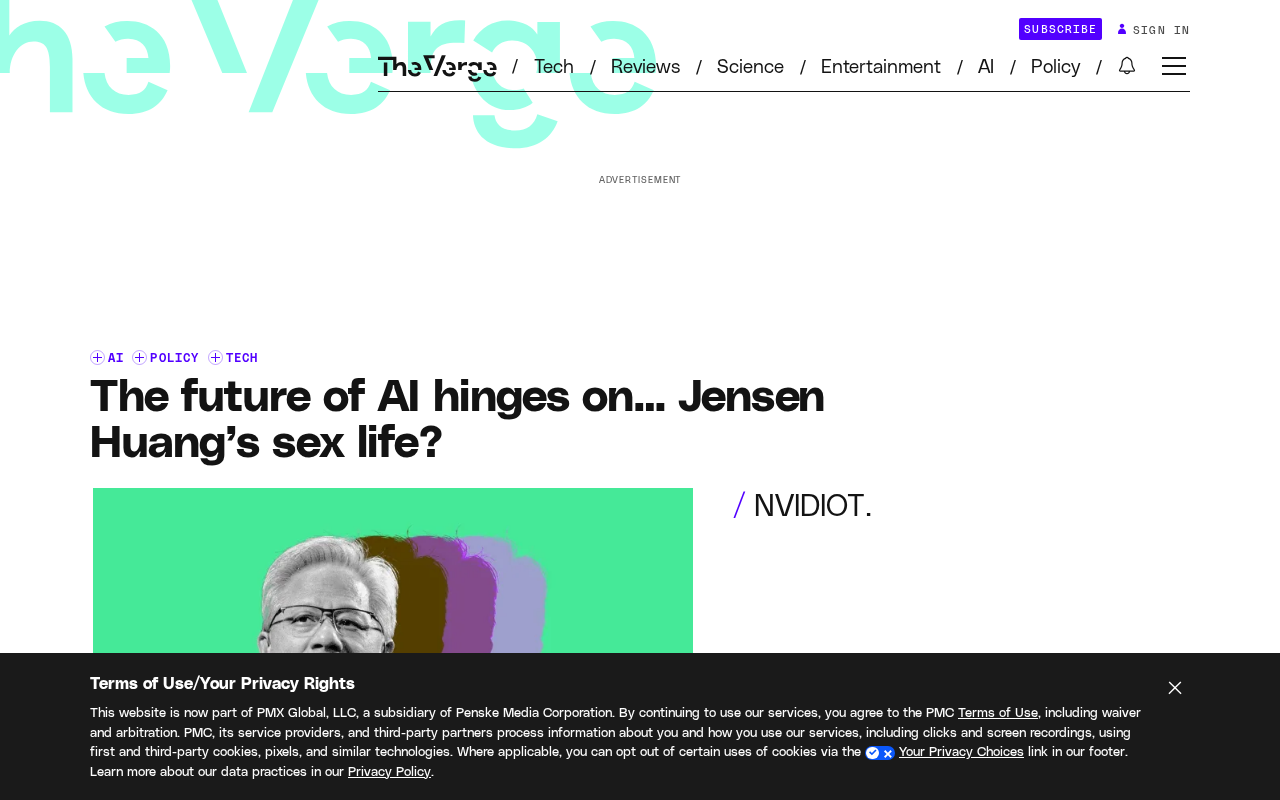
Recently, an article titled "The future of AI hinges on… Jensen Huang's sex life?" sparked discussion in tech communities. The original piece is steeped in sarcasm, directly implying that NVIDIA CEO Jensen Huang's personal conduct could undermine public trust in his judgment. The author wrote: "I would prefer that these people's sex lives were none of my business but I guess we have to talk about Jensen Huang and the National Security Incident." This sentence alludes to an event referred to as the "National Security Incident," but the original article provides no specific details.
For the AI industry, this raises a broader question: where should the line be drawn between a tech leader's personal behavior and their professional decisions?
NVIDIA and AI Computing Infrastructure
NVIDIA is the world's leading designer of GPUs (graphics processing units). Its GPU products were initially used for graphics rendering, but their parallel computing capabilities later made them widely adopted for AI training and inference. In recent years, with the explosion of deep learning and large models, NVIDIA's GPUs (such as the A100 and H100 series) have become the de facto standard for AI compute, powering the majority of AI training tasks worldwide. According to industry estimates, NVIDIA holds over 80% of the AI accelerator market, and its CUDA software ecosystem further reinforces its moat. This technological monopoly means that CEO Jensen Huang's decisions not only affect the company's fate but also influence the pace and cost of AI research globally. Public attention to Huang's personal behavior therefore stems in part from legitimate concerns about his control over critical infrastructure.
Public Figures' Private Conduct and Professional Judgment
The original article makes a sharp observation: "Who could have guessed that the guy who was out here signing titties might not have great judgment about how to behave around women?" The phrase "signing titties" refers to an incident in which Huang signed an autograph on a fan's chest at a public event—an act that sparked controversy after spreading on social media.
Critics argue that such behavior reflects a disregard for gender boundaries, which in turn casts doubt on his judgment in corporate governance and industry decision-making. But to be clear, there is currently no evidence that Huang's private life directly affects NVIDIA's technology roadmap or product decisions. Directly linking personal behavior to professional competence involves a logical leap.
The Ambiguity of the "National Security Incident"
The "National Security Incident" mentioned in the original article lacks any specific description. Inferred from context, it may refer to some controversial event involving Huang, but the original does not elaborate. Without reliable sources, any speculation about this incident could be misleading.
When covering such topics, tech media should distinguish between "legitimate public concern" and "unverified rumors." As the leader of NVIDIA, a company that controls the critical lifeline of AI computing infrastructure, public scrutiny of Huang's conduct is reasonable—but scrutiny is not conviction.
Tech Leader Accountability and Public Oversight
Tech leader accountability mechanisms refer to institutional arrangements—through law, corporate governance, industry self-regulation, and public oversight—that ensure tech company leaders are held responsible for their decisions and actions. In the AI field, due to technical complexity and information asymmetry, public oversight often struggles to penetrate technical details and tends to shift toward leaders' personal behavior. However, effective accountability should focus on substantive issues such as decision-making transparency, conflict-of-interest management, data ethics, and monopolistic practices. Currently, the AI industry lacks a similar framework for public discussion, causing serious governance issues to often be trivialized. Establishing independent ethics committees, strengthening information disclosure, and encouraging participation from diverse stakeholders are viable paths toward fostering a culture of accountability in the industry.
What Kind of Leader Accountability Mechanism Does the AI Industry Need?
The real value of this discussion may not lie in Jensen Huang as an individual, but in the fact that it exposes the AI industry's lack of a public framework for discussing leader behavior. NVIDIA's GPUs power the majority of global AI training tasks, and its leader's decisions have far-reaching impact. When personal behavior sparks controversy, what the industry needs is a transparent accountability mechanism, not gossip-style spectating.
The sarcastic tone of the original article is itself worth reflecting on: using a private-life topic to discuss the future of AI precisely demonstrates that the public lacks effective channels for overseeing tech power. Trivializing serious technology governance issues does not help advance the industry.
Conclusion: Distinguishing Gossip from Governance
Should Jensen Huang's private life controversy be the focus of discussions about AI's future? The answer depends on how we view the public responsibilities of tech leaders. Personal behavior can serve as a reference for judging their judgment, but it should not replace substantive discussion of technology roadmaps, business ethics, and governance structures. For those concerned about AI development, the more worthwhile questions are: How does NVIDIA's monopoly affect the AI innovation ecosystem? Who oversees the fairness of compute allocation? These are the questions that truly determine the future of AI.
One-line Summary
Jensen Huang's private life controversy sparks debate, but AI's future depends more on compute monopolies and governance mechanisms.
Paragraph Summary
Starting from a sarcastic article suggesting that Jensen Huang's private life may affect his judgment, this piece explores the boundary between tech leaders' personal behavior and professional decisions. The original mentions a "National Security Incident" without details. The author argues that public attention to Huang's private conduct is reasonable, but directly linking personal behavior to professional competence involves a logical leap. The article points out that the real value of this discussion lies in exposing the AI industry's lack of a public framework for leader accountability—gossip-style discussion does not help technology governance. The conclusion emphasizes that the issues truly determining AI's future are NVIDIA's monopoly position, fairness in compute allocation, and the innovation ecosystem—not personal private life.
Related articles

English Version of 'Thank You for Your Love' Gains Traction on Bilibili: A Cross-Cultural Rendition of a Classic Love Song
The English version of 'Thank You for Your Love,' titled 'I'll give you all my love,' trends on Bilibili with rewritten lyrics about giving all your love. This article analyzes its emotional expression, cross-cultural adaptation strategy, and differences from the Chinese original.

Claude Code vs Cursor vs GitHub Copilot: How to Choose Among the Three Major AI Coding Tools
A clear explanation of Claude Code, Cursor, and GitHub Copilot through the lens of 'degree of delegation': Copilot embeds in your editor for autocomplete, Cursor is an AI-first full editor with multi-file batch editing, and Claude Code executes tasks end-to-end in the terminal. Includes selection advice.

Behind the Viral Dynamic Comic Commentary: Deconstructing the Narrative of Family Finance and Emotional Conflict
Deconstructing a Bilibili dynamic comic episode on family financial conflict: how dense dialogue and emotional hooks retain viewers, and where AI script generation falls short in narrative coherence.