Jensen Huang's Return to Nvidia: A Deep Dive into a National Security Controversy

Foreign Policy uses strong language to place Jensen Huang and Nvidia at the center of a national security controversy, but a single source warrants cautious interpretation.
This article examines a Foreign Policy piece titled "Jensen Huang's Return Is the Biggest National Security Scandal in U.S. History," which sparked heated debate on Hacker News. Since the original material only provides the title and link, the article first defines "return" as possibly referring to Huang's renewed activity in tech export or supply chain decisions, not rejoining the company. It then analyzes why Nvidia's AI chip dominance links it to national security, including export controls and supply chain games. The 210 comments on Hacker News show a fractured community. The author stresses that the title's rhetoric may exaggerate under a single source, distills long-term trends like securitization of AI chip decisions and CEO-company branding, and advises readers to consult the original and verify from multiple sources.
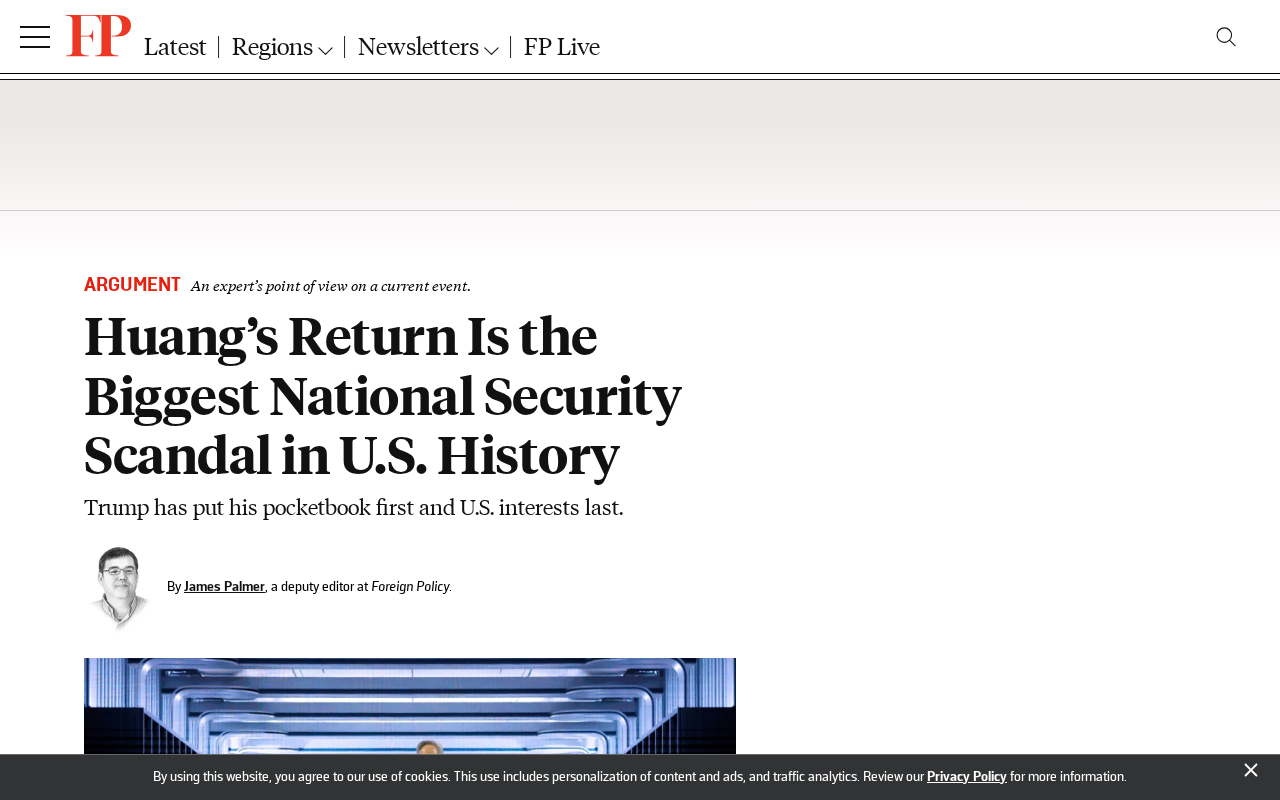
Recently, an article published in Foreign Policy titled "Jensen Huang's Return Is the Biggest National Security Scandal in U.S. History" thrust Nvidia CEO Jensen Huang's return into the spotlight. The piece quickly gained traction on Hacker News, garnering 274 points and 210 comments, sparking heated discussion in tech and policy circles. Based on this single source, this article outlines the contours of the controversy and attempts to offer an independent perspective.
The Starting Point of the Controversy: Jensen Huang and Nvidia's "Return"
According to the Foreign Policy article, Jensen Huang's return is characterized as a major event involving national security. The "return" here does not mean Huang rejoining Nvidia—he never left—but rather his renewed activity in specific policy or business decisions, potentially involving technology exports to China, supply chain arrangements, or dealings with the U.S. government. The article's title uses the strong phrasing "biggest national security scandal in history," suggesting the severity far exceeds ordinary business matters.
It must be noted that the original material only provided the article link and title without elaborating on specifics. Therefore, this analysis is based on the core signal conveyed by the title: some policy observers view one of Huang's actions as a major challenge to U.S. national security interests.
Why Is Nvidia's CEO Linked to "National Security"?
Nvidia's dominance in AI chips means any strategic adjustment reverberates through geopolitics. As the company's soul, Huang's public statements and business decisions are often scrutinized through a national security lens.
The Sensitive Zone of Technology Exports
High-performance GPUs are core hardware for AI training, and the U.S. government imposes strict controls on advanced chip exports. Nvidia's balancing act between compliance and maintaining market share has long been a point of contention. If Huang shows flexibility in export strategy, it is easily interpreted as "circumventing controls" or "compromising to commercial interests."
U.S. export controls on advanced chips are mainly based on the Export Administration Regulations (EAR) and specific rules targeting China, such as the semiconductor export restrictions updated in October 2022 and October 2023. These rules set red lines based on metrics like computing power (TOPS) and interconnect bandwidth, prompting Nvidia to launch "downgraded" chips compliant with regulations (such as A800/H800, later adjusted as rules tightened). Allegations of "circumventing controls" typically refer to companies adjusting chip specifications, using overseas subsidiaries, or third-party channels to maintain sales to China. This background helps explain why any tweak to Huang's export strategy is scrutinized through a national security lens.
The Global Game of Supply Chains
Nvidia's supply chain spans Asian manufacturers like TSMC and Samsung, and any capacity shift or deepened cooperation could touch policymakers' nerves. If Huang's return involves supply chain restructuring, it naturally takes on national security implications.
Nvidia is a classic fabless semiconductor company, with its GPUs primarily manufactured by TSMC, and advanced packaging (such as CoWoS) capacity also highly concentrated at TSMC. This geographic concentration makes its supply chain inherently geopolitically sensitive. In recent years, the U.S. has promoted the reshoring of advanced manufacturing through the CHIPS and Science Act while restricting companies like TSMC from exporting advanced processes to China. Therefore, if Nvidia adjusts order allocation, adds overseas capacity, or deepens cooperation with suppliers in specific regions, policy observers will interpret it as either responding to or deviating from national security arrangements.
The Fractured Reaction of the Hacker News Community
The article received 210 comments on Hacker News, indicating high interest from the tech community. Although specific comments cannot be quoted one by one, the topic's热度 suggests clear divisions: one side believes the title exaggerates and politicizes normal business behavior; the other worries about tech giants' unchecked influence on national security issues. This split itself reflects the lack of consensus at the intersection of tech and policy.
Hacker News (HN) is a tech community operated by Y Combinator, known for high signal-to-noise discussions. Its voting mechanism gives popular topics hundreds of points, while comments present diverse and even opposing views. On issues involving national security and tech giants, HN users often split into two camps: one favoring free markets and business rationality, the other emphasizing geopolitical risks and the need for regulation. This split is no accident; it reflects tech workers' complex attitude toward "securitization" narratives—both wary and resigned—worried that overregulation stifles innovation, yet concerned about corporate power lacking checks.
Cautious Interpretation Under a Single Source
The original material for this article is only the title and link of a Foreign Policy article, lacking body details and multi-source corroboration. Therefore, the following judgments should be labeled as inferences based on limited information:
- The title's rhetorical strategy: "Biggest national security scandal in history" is a strong assertion, possibly intended to spark discussion rather than state a conclusion.
- Huang's role positioning: The article targets the individual rather than the company, implying Huang's personal decisions or influence are seen as the key variable.
- Missing policy context: The material does not mention specific policy clauses, timelines, or events; readers need to consult the original for the full picture.
Implications for the Tech Industry
Regardless of the specific allegations, the discussion it sparked reveals several long-term trends: strategic decisions of AI chip companies are increasingly scrutinized through a security lens; CEO personal brands are deeply intertwined with company actions, making them symbols in policy games; the tech community remains wary of "national security" narratives, concerned about both overregulation and corporate power expansion.
For readers focused on AI governance, this controversy reminds us: amid rapid technological iteration, collisions between business logic and national security logic will become more frequent, and discussions lacking transparency can easily slide into emotional polarization.
Conclusion
The Foreign Policy article raises a complex issue with a highly impactful title. Without the full text and multi-source verification, this article can only present the framework of the controversy and its background logic. Readers are advised to read the original directly and form independent judgments by combining Nvidia's public statements and policy documents. The debate over the boundary between technology and security is far from settled.
One-line Summary
Foreign Policy uses strong language to place Jensen Huang and Nvidia at the center of a national security controversy, but a single source warrants cautious interpretation.
Related articles
MIT PhD Takes You from Scratch to Build DeepSeek: A 25-Hour Hardcore Course
MIT PhD Raj Dandekar launches a 25+ hour Bilibili course building DeepSeek from scratch—MoE, MLA, GRPO, hand-written code plus math derivations, aiming to reproduce mini R1.
DeepSeek Harness in Practice: From Installation to Plugin Ecosystem, Building a Fully Automated AI Workflow
Based on a hardcore Bilibili tutorial, this guide systematically covers DeepSeek Harness installation, three plugin installation methods, and real-world use cases to help developers quickly build customizable AI Agent workflows.
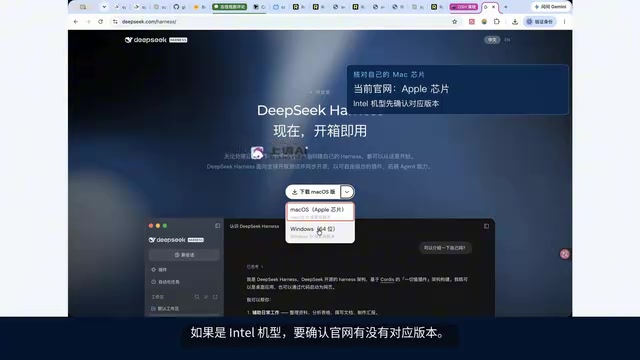
DeepSeek Harness in Practice: From Installation to Automated Workflows
Hands-on DeepSeek Harness tutorial covering Mac/Windows installation, login, workspace binding, model & permission setup, and minimal closed-loop verification for AI automation workflows.