Jensen Huang Says He Is Willing to Return as Nvidia CEO
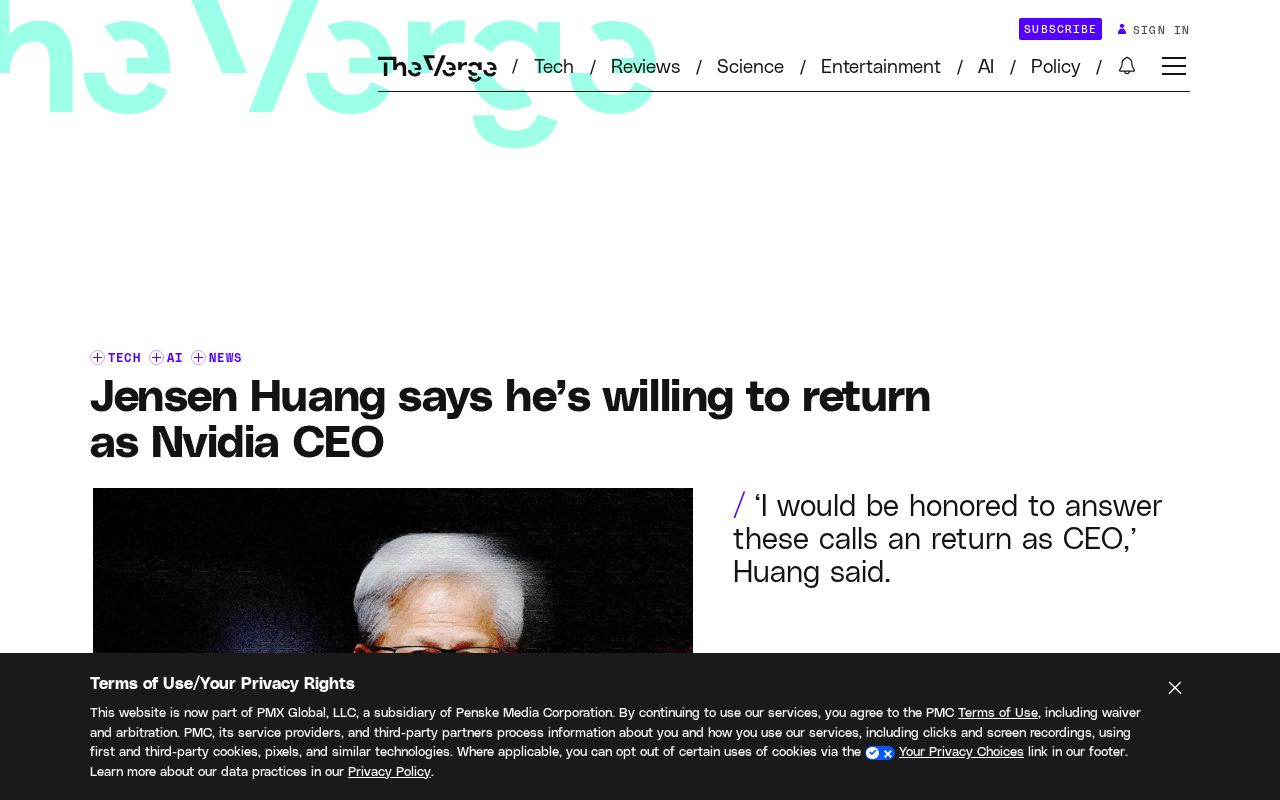
Jensen Huang says he would return as Nvidia CEO if the board invites him.
The article reports that Nvidia CEO Jensen Huang made his first public statement since resigning, saying he is willing to return as CEO if the board wants him back. The resignation background involves reports about three relationships, including with an individual accused of being a Chinese spy and a direct subordinate, elevating the matter from personal conduct to corporate governance and national security issues. The article analyzes that this statement leaves the decision to the board while potentially creating public opinion pressure; whether he returns depends on whether the board finds a suitable replacement, whether Huang still has support, and whether his personal influence is difficult to replace. The Nvidia board has not yet formally responded, and the matter is still at an early stage; follow-up attention should focus on the board's statement and management transition arrangements.
First Public Statement After Resignation
According to a statement reported by The Wall Street Journal, Jensen Huang, who resigned as Nvidia CEO last week, said he is willing to return as CEO if the company's board of directors wants him back. This is Huang's first public response regarding his personal plans since stepping down, leaving room for a possible future relationship with Nvidia.
Huang's resignation is no ordinary personnel change. Previous reports alleged that he was involved in three relationships, including dealings with an individual accused of being a Chinese spy and a relationship with a direct subordinate. These reports intertwined personal conduct with corporate governance and even national security issues, quickly pushing the matter beyond the scope of a routine executive departure.
Background: From Personal Rumors to Corporate Governance Issues
Jensen Huang is the iconic figure of Nvidia, and his personal image is closely tied to the company's brand. For this reason, once the resignation news broke, external attention quickly shifted from personal conduct to corporate governance: how the board would handle the crisis, whether management could transition smoothly, and whether investor confidence in Nvidia's stability would be affected.
It is worth noting that Huang did not directly address the reports in his statement, instead focusing on his attitude toward the company's future. This approach preserved his personal position while avoiding further escalation of sensitive details. From a PR perspective, it was a relatively restrained statement.
CEO Resignation and the Board's Legal Role
In the governance structure of U.S. public companies, the CEO is appointed and removed by the board of directors, which bears fiduciary responsibility for overseeing executive conduct and preventing conflicts of interest. When a CEO resigns amid controversy, the board typically needs to assess the impact on the company's reputation, compliance risk, and operational continuity, and decide whether to initiate a formal succession process. A CEO's voluntary resignation does not automatically terminate their legal relationship with the company; whether they return depends on whether the board issues a new appointment resolution. Therefore, Huang's statement that he is "willing to return" legally constitutes only an expression of intent, and its actual effect depends on the board's independent judgment and formal procedures.
Conflicts of Interest and Corporate Governance
A conflict of interest refers to a situation in which personal relationships or private interests may compromise the impartiality of one's professional decisions. Intimate relationships with direct subordinates are explicitly restricted in the codes of conduct of most U.S. companies because they may involve power imbalances, fairness in promotion, and team management issues. If sensitive dealings with external parties are involved, security reviews and disclosure obligations may also be triggered. Once such issues become public, boards often need to rely on outside legal counsel or an independent committee to conduct an investigation in order to address investor and regulatory concerns. This is also the key reason the matter escalated from a personal level to a governance level.
What "Willing to Return" Means
Huang's statement contains two layers of information. First, he has not completely severed ties with Nvidia, and the precondition for his return is that the board actively extends an invitation, meaning the initiative lies with the board. Second, the statement itself may exert some public opinion pressure on the board—if the board believes Huang's return serves the company's interests, the public statement has already paved the way for it.
From the conventional logic of corporate governance, it is unusual for a CEO to say shortly after resigning amid controversy that he is willing to return. This typically suggests several possibilities: the company has not yet found a suitable replacement; Huang still has the support of the board or major shareholders; or the company believes his personal influence is critical to the business and difficult to replace easily.
It should be emphasized that the above judgments are inferences based on public information, and the Nvidia board has not yet made a formal response on the matter. Whether Huang can return, and under what conditions, remains highly uncertain.
Potential Impact on Nvidia
Nvidia sits at the core of the AI chip supply chain, and management stability carries signaling significance for customers, suppliers, and investors. As the company's long-standing external representative, Huang's fate concerns not only internal management but also outside judgments about the continuity of Nvidia's strategy.
If the board ultimately invites Huang to return, it will need to clearly explain the governance arrangements to the outside world, especially how it will address the conflict-of-interest issues raised in previous reports. If the board chooses not to invite him back, it will need to clarify the new management structure as soon as possible to stabilize market expectations. Whichever path is taken, transparent and timely communication is key.
The matter is still at an early stage, and Huang's statement is only a personal expression; an actual personnel decision remains some distance away. For readers following Nvidia, the focus should now be on the board's formal statement and management transition arrangements.
Nvidia in the AI Chip Supply Chain
Nvidia occupies a core position in the AI chip supply chain. Its GPU products are the mainstream computing foundation for training and running large models, and data centers, cloud service providers, and AI startups all rely heavily on its hardware and software ecosystem (such as CUDA). This industry position means the company's strategic continuity not only affects its own performance but also transmits to downstream customers' procurement plans and upstream suppliers' capacity arrangements. Management changes do not necessarily alter the technology roadmap, but outsiders typically view executive turnover as a signal of strategic stability, which in turn affects partners' decision-making pace and capital market valuation expectations.
One-line Summary
In his first statement since resigning, Jensen Huang said he is willing to return as Nvidia CEO if invited by the board.
Paragraph Summary
The article reports that Nvidia CEO Jensen Huang made his first public statement since resigning, saying he is willing to return as CEO if the board wants him back. The resignation background involves reports about three relationships, including dealings with an individual accused of being a Chinese spy and a direct subordinate, elevating the matter from personal conduct to corporate governance and national security issues. The article analyzes that this statement leaves the decision to the board while potentially creating public opinion pressure; whether he returns depends on whether the board finds a suitable replacement, whether Huang still has support, and whether his personal influence is difficult to replace. The Nvidia board has not yet formally responded, and the matter is still at an early stage; follow-up attention should focus on the board's statement and management transition arrangements.
Related articles

FBI and USDA Hit by Cyberattacks: Critical Infrastructure Security Alarms Sound Again
FBI and USDA reportedly hit by cyberattacks; the FBI was breached for the second time in recent months, this time targeting the National Crime Information Center (NCIC). This article analyzes the incident details, NCIC's strategic value, and common security challenges facing government agencies.

How Do UK Grid Battery Storage Systems Make Money?
How UK grid battery storage makes money: stacking frequency response, capacity market, and wholesale arbitrage revenue, plus operational trade-offs and market risks.

Riemann Hypothesis Formally Verified in Lean? Joint Statement Sparks Heated Debate
The Lean community blog published a joint statement on formal verification of the Riemann Hypothesis, sparking heated discussion on Hacker News with 359 points and 263 comments. This article analyzes the background of Lean and mathlib formal verification, polarized community reactions, and why one should not conclude the Riemann Hypothesis has been proven before reading the original text.