Jensen Huang Steps Down as NVIDIA CEO? Colette Kress as Interim CEO Sparks Heated Discussion
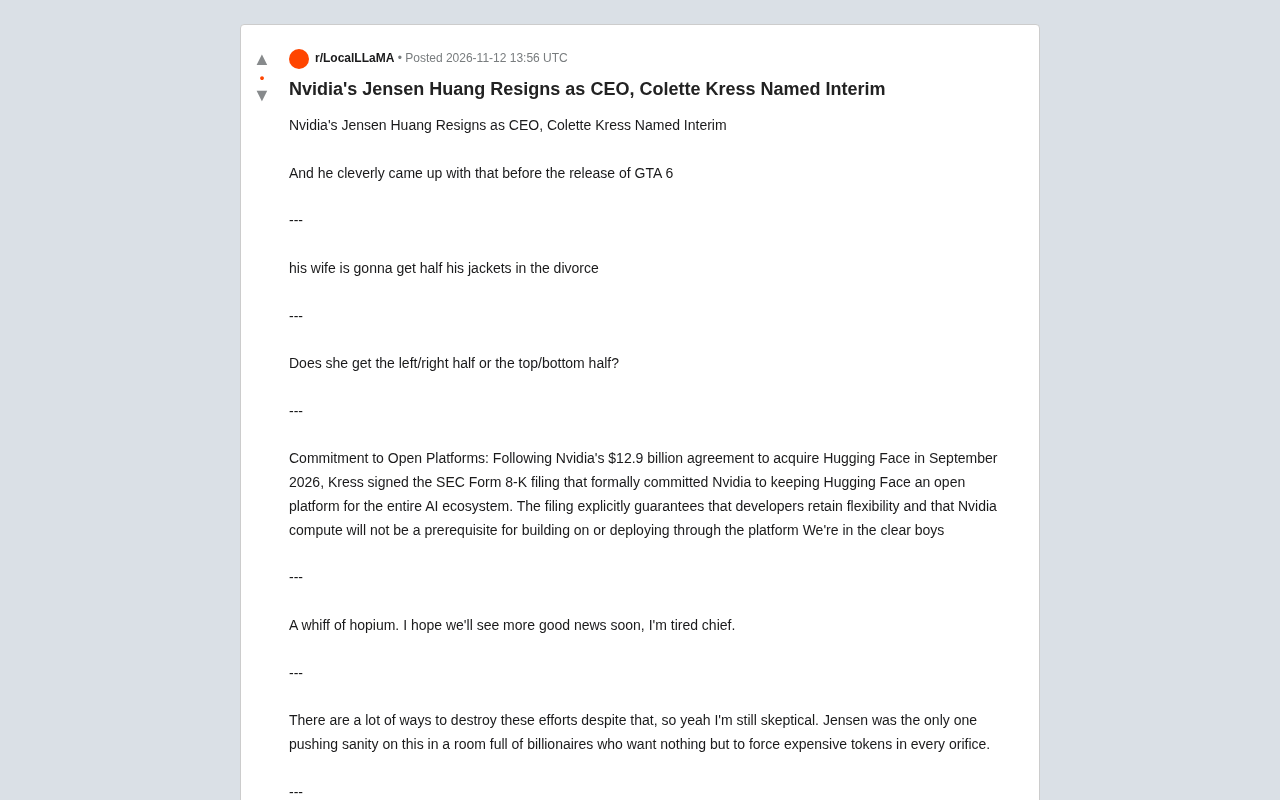
Reddit rumor says Jensen Huang stepped down as NVIDIA CEO, but lacks official corroboration; community discussion reflects AI hardware anxiety.
The article examines a Reddit post claiming NVIDIA CEO Jensen Huang has resigned, with CFO Colette Kress as interim CEO, but there is no official announcement, SEC filing, or mainstream media corroboration, and replies are mostly jokes. The only informative content is NVIDIA's $12.9B acquisition of Hugging Face and a claimed SEC Form 8-K commitment to keep the platform open and not force NVIDIA computing products, though this also appears only in community discussion. Community sentiment is divided: some hope management changes improve hardware supply and pricing, while others worry supply uncertainty will trigger panic hoarding. The article offers methods to verify such rumors and stresses that post-acquisition platform governance and hardware supply strategy are the real variables affecting developers.
A post from Reddit claims that NVIDIA CEO Jensen Huang has resigned from his position as CEO, with company CFO Colette Kress serving as interim CEO. The post has sparked extensive discussion in the community, but as of now, no mainstream tech media or official NVIDIA channels have confirmed this news. When facing such "explosive" rumors, it's necessary to first distinguish which parts are established facts and which are merely community speculation and jokes.
The Rumor Itself: Single Information Source, Lacking Official Corroboration
The original post title directly asserts that Jensen Huang has stepped down, yet the body text provides almost no verifiable details—no news links, no company announcements, no SEC filing numbers. The discussion in the replies quickly turned to jokes: some quipped that he "cleverly timed it before GTA 6's release," while others joked about dividing jackets in a divorce. These interactions suggest that, at least in the eyes of some participants, this post is more of a meme than serious financial news.
The most direct way to judge the authenticity of such news is to check NVIDIA's investor relations page and SEC 8-K filings. Executive changes are material events that must be disclosed—if they truly occurred, the company would issue a formal announcement within a very short time. Before seeing such filings, it is irresponsible to spread the post's title as fact.
SEC 8-K filing is a "current report" that U.S. public companies must submit to the U.S. Securities and Exchange Commission (SEC) under the Securities Exchange Act of 1934, used to disclose events that have a material impact on investors, such as executive changes, major mergers and acquisitions, and bankruptcy. Executive resignations or appointments typically need to be disclosed via 8-K within four business days after the event occurs. Once submitted, 8-K filings can be publicly searched in the SEC's EDGAR database, making them the most authoritative and direct primary source for verifying major corporate events. Therefore, if Jensen Huang truly resigned as CEO, NVIDIA would almost certainly file an 8-K within days, and claims spread solely through forum posts lack credibility when such a filing is absent.
Discussion Focus: Hugging Face Acquisition and Open Platform Commitment
The only content in the post with concrete informational value is about NVIDIA's $12.9 billion acquisition of Hugging Face. Replies claim that Colette Kress signed SEC Form 8-K, formally committing that NVIDIA will maintain Hugging Face as an open platform for the entire AI ecosystem, ensuring developers retain flexibility, and that NVIDIA's computing products will not become a prerequisite for building or deploying on the platform.
If this description is accurate, it points to a key issue: when a company known for hardware and the CUDA ecosystem acquires an open-source model community, developers' greatest concern is platform lock-in and the co-optation of the open ecosystem. The commitment in the 8-K—if it indeed exists—is precisely intended to alleviate such concerns. However, note that this claim also appears only in Reddit replies and lacks cross-verification from independent sources.
Why the Open Platform Commitment Deserves Attention
Hugging Face is home to a large number of open-source models and datasets, where developers build, fine-tune, and deploy models, having long formed cross-hardware, cross-framework working habits. Any transaction that could change this neutrality would touch a nerve across the entire open-source AI community. Even if the acquirer promises to maintain openness, the community will focus on how the commitment is implemented: whether the API remains neutral, whether model distribution is restricted to specific hardware, and whether commercial terms change. These are the details that determine the true value of the commitment.
Hugging Face is an AI community platform centered on hosting open-source models and datasets, offering open-source libraries such as Transformers and Datasets as well as a Model Hub, and is widely regarded as "the GitHub of AI." Developers can publish, download, fine-tune, and deploy models from various organizations on it, while the platform itself remains hardware- and framework-neutral. For this reason, any tech giant's acquisition of Hugging Face would raise concerns about platform neutrality: the acquirer might use API restrictions, distribution priorities, or commercial terms to tilt the ecosystem toward its own hardware or cloud services. The core of an open platform commitment is to ensure that model distribution and toolchains do not lose cross-hardware, cross-framework flexibility due to a change in ownership.
Vendor lock-in refers to the phenomenon where users find it difficult to migrate to other platforms at low cost because their data, toolchains, or workflows are deeply dependent on a particular vendor. In AI development, lock-in can manifest as: models that can only run on specific hardware, APIs compatible only with a certain cloud service, or fine-tuned outputs that cannot be exported to other frameworks. For developers relying on Hugging Face, if the platform gradually becomes deeply tied to NVIDIA's CUDA ecosystem after the acquisition, migration costs will rise significantly. Therefore, what the community cares about is not only whether the commitment exists, but whether it is enforceable—for example, whether a neutral model download interface is retained, whether hardware exclusivity clauses are prohibited in platform terms, and whether there is an independent oversight mechanism.
Community Sentiment: Expectation and Skepticism Coexist
One resonant comment in the replies said, "Jensen is the only billionaire in a room full of billionaires who just want to stuff expensive tokens into every crevice, and he's the only one still pushing for rationality." This expression reflects some developers' dissatisfaction with current AI hardware supply and pricing, and also explains why some would welcome a "CEO change" as good news.
Another comment directly called out, "Please trigger the bubble burst, I want to buy abandoned data center project hardware at bulk auction prices." Such voices treat the rumor as a signal of a market turn. But someone immediately countered: once uncertainty appears on the supply side, it could instead trigger panic hoarding and drive hardware prices higher. Still another comment argued that there is no real manufacturing problem at present—the shortage is artificially created by suppliers, and doubling production capacity is technically not impossible.
The value of these discussions lies not in judging whether the rumor is true or false, but in presenting the developer community's widespread anxiety about the AI hardware supply chain: high prices, tight supply, and deep dependence on a single vendor. Regardless of whether Jensen Huang steps down, these structural contradictions will not automatically disappear.
Panic buying in the context of the hardware supply chain refers to the phenomenon where buyers, fearing future supply disruptions or price increases, purchase large quantities in advance, which in turn further drives up prices and exacerbates shortages in the short term. The supply of AI accelerator cards (such as NVIDIA GPUs) is already constrained by advanced packaging (such as CoWoS) and HBM memory capacity, and any management change or acquisition rumor could be interpreted by the market as a signal of uncertainty in supply strategy. The community discussion's concern that "supply-side uncertainty may trigger hoarding" stems precisely from this: even if actual production capacity remains unchanged, changes in expectations are enough to disrupt the spot market and bulk procurement prices, thereby affecting hardware acquisition costs for developers and small and medium-sized enterprises.
How to Rationally View Such Executive Change Rumors
When facing news like "a tech giant's CEO resigns," you can quickly judge it through several steps: check the company's official newsroom and investor relations page; check 8-K filings on SEC EDGAR; see whether at least two independent financial media outlets have followed up with reports; and observe the immediate reaction of the company's stock price and options market. If any of these links is missing, you should remain skeptical.
Based on currently public information, this post is closer to a community rumor than confirmed news. As NVIDIA's CFO, Colette Kress is indeed one of the company's core executives, but the claim of "serving as interim CEO" requires official documentation to support it. For those following the AI industry, what is truly worth tracking is NVIDIA's platform governance actions after acquiring Hugging Face, and whether its hardware supply strategy is adjusted—these will actually affect developers' daily choices.
One-line Summary
Reddit rumor claims Jensen Huang has stepped down as NVIDIA CEO, but official corroboration is lacking; community discussion reflects AI hardware anxiety.
Paragraph Summary
The article centers on a Reddit post claiming that NVIDIA CEO Jensen Huang has resigned, with CFO Colette Kress serving as interim CEO, but the entire text lacks any official announcement, SEC filing, or mainstream media corroboration, and the replies are mostly jokes. The only informative content in the post is NVIDIA's $12.9 billion acquisition of Hugging Face, and the claimed commitment via SEC Form 8-K to keep the platform open and not force binding to NVIDIA computing products, but this claim also appears only in community discussion. The article notes that community sentiment is clearly divided: some developers hope management changes will bring improvements in hardware supply and pricing, while others worry that supply uncertainty will trigger panic hoarding. Finally, it provides methods for verifying such rumors and emphasizes that post-acquisition platform governance and hardware supply strategy are the substantive variables affecting developers.
Related articles
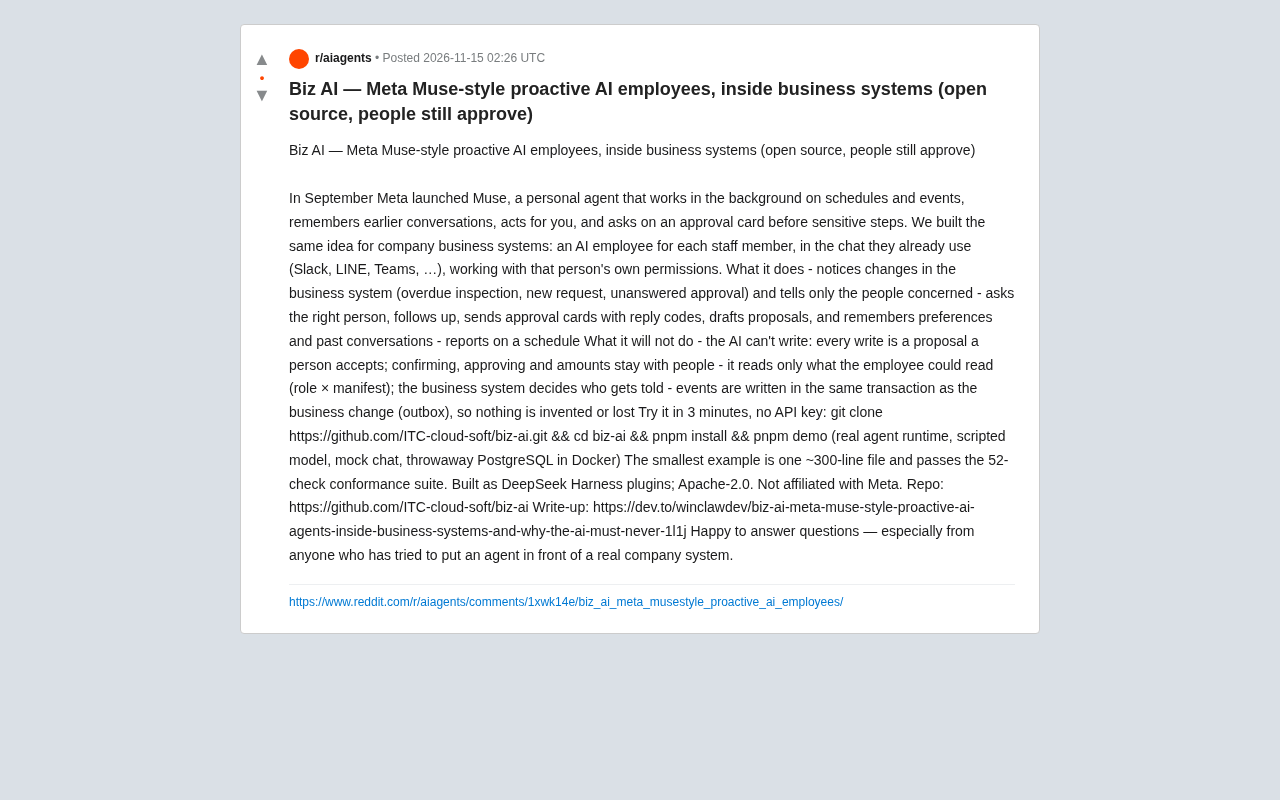
Biz AI: Proactive AI Employees for Enterprise Systems, With Write Access Still in Human Hands
Open-source Biz AI brings Meta Muse-style proactive AI employees to enterprise systems—AI reads and proposes only, all writes require human approval.

LinkedIn and Monster Remove Thousands of Fake Job Listings After Investigation, Highlighting AI's Anti-Fraud Challenges
After a CBC investigation, LinkedIn and Monster removed over 1,000 fake job listings. This article analyzes common motives behind fake jobs, platform review gaps, and AI's capabilities and limits in job fraud detection.
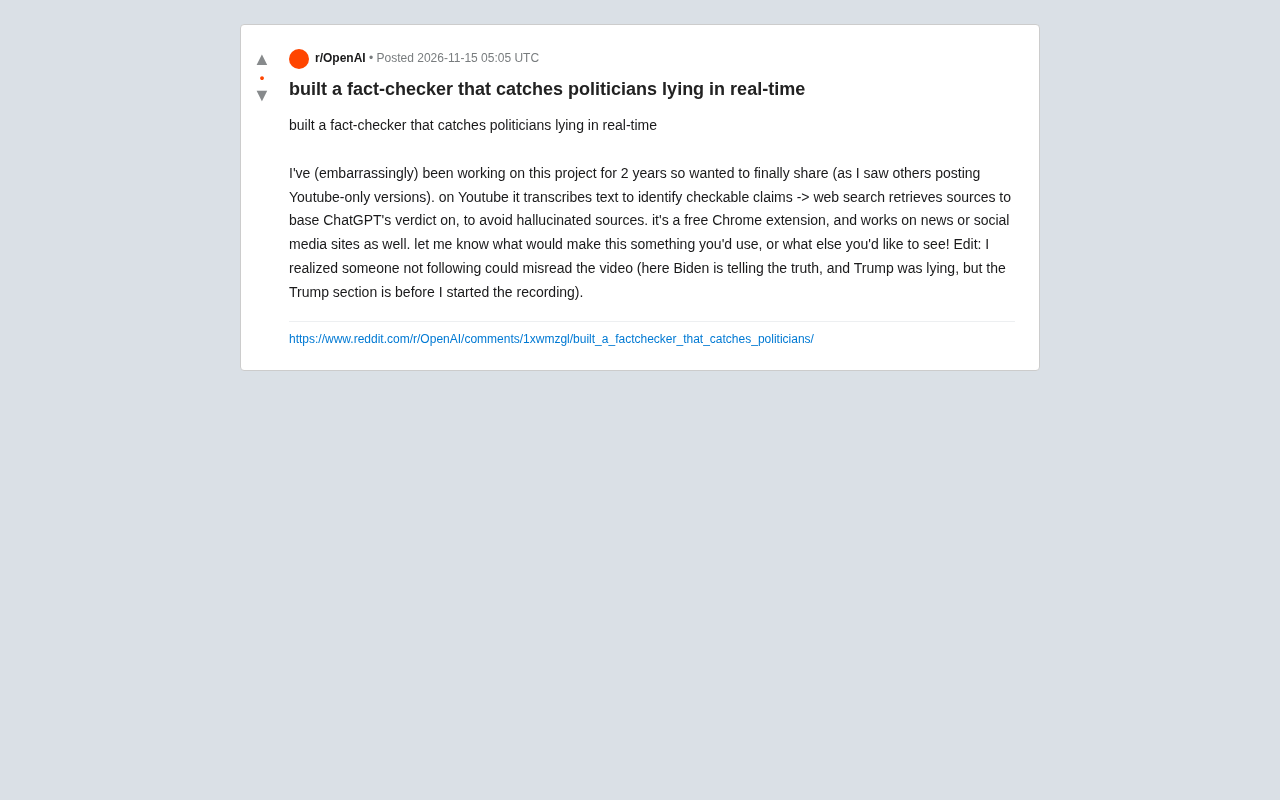
Two Years to Build a Real-Time Fact-Checking Tool That Uses AI to Catch Politicians' Lies
A developer spent two years building a real-time fact-checking Chrome extension that transcribes YouTube, news, and social media content, identifies verifiable claims, and uses web search to avoid ChatGPT hallucinations while judging politicians' statements in real time.