Two Years to Build a Real-Time Fact-Checking Tool That Uses AI to Catch Politicians' Lies
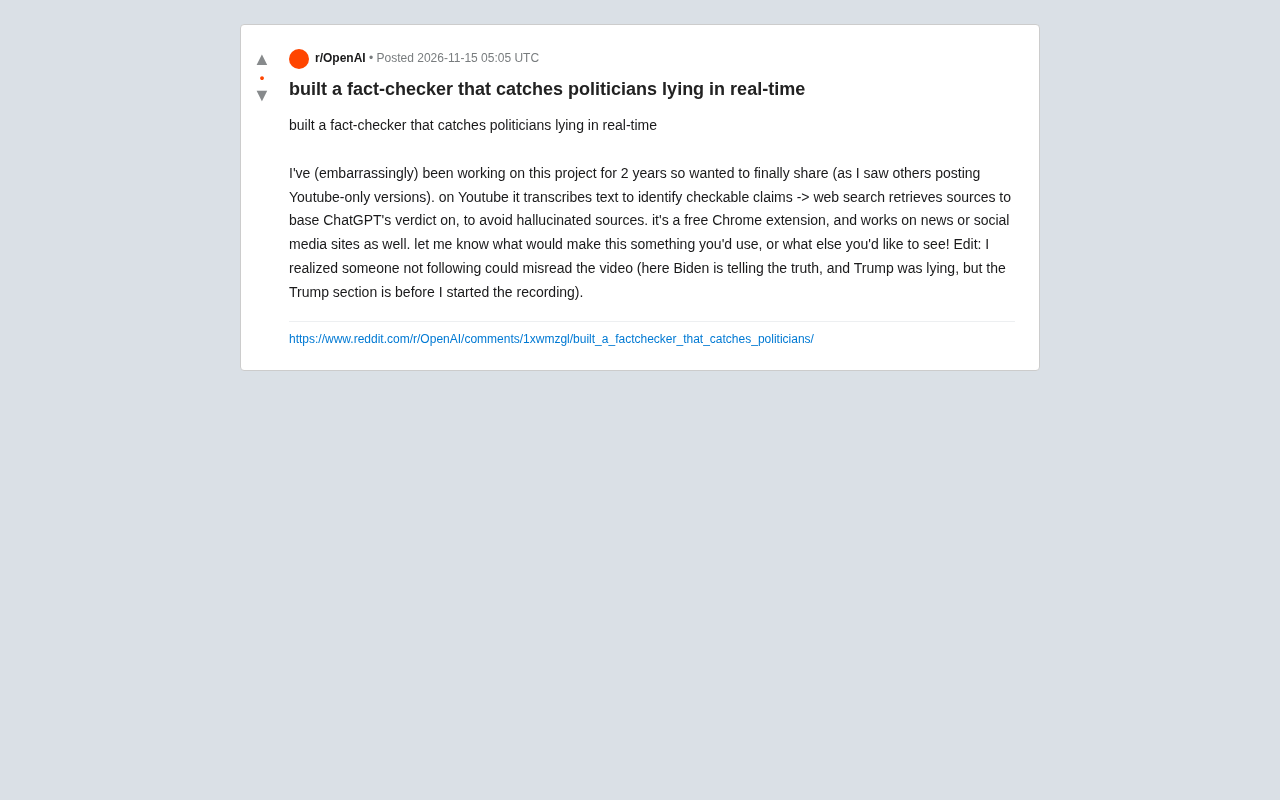
An indie developer spent two years building a Chrome extension that fact-checks politicians' statements in real time and avoids AI hallucination.
A developer shared a Chrome extension he spent two years building that can fact-check politicians' statements in real time. It transcribes audio from videos or web pages, identifies verifiable factual claims, then performs web searches to collect real sources, and finally has ChatGPT make judgments based on those sources—avoiding fabricated sources. The tool initially supported only YouTube and has now expanded to news websites and social media platforms. The developer emphasizes that avoiding hallucination is a core design goal and is actively seeking user feedback to improve functionality. The article also analyzes its technical workflow, key challenges, and evolution from side project to practical tool.
From Side Project to Practical Tool: One Indie Developer's Two-Year Journey
A developer shared on Reddit a project he spent two years building: a Chrome extension that can fact-check politicians' statements in real time. The tool originally ran on YouTube, transcribing speech from videos, identifying verifiable claims, then performing web searches to collect sources, and finally having ChatGPT make a judgment based on those sources—avoiding citations of fabricated sources. Now, it has expanded to news websites and social media platforms.
The developer admitted in the post that the project took considerable time, and mentioned that after seeing others release YouTube-only versions, he decided to share his own work. He also specifically clarified a demo clip that could cause misunderstanding: in the video, Biden was telling the truth while Trump was lying, but the Trump portion occurred before recording began.
How the Tool Works: Transcribe, Identify, Search, Judge
Transcription and Claim Identification
The tool first transcribes audio content into text, then identifies fact-based claims that can be checked. This step is crucial because not all statements need fact-checking—only sentences containing specific factual assertions are processed further.
Automatic Speech Recognition (ASR) is the technology that converts speech signals into text, with core challenges including handling accents, background noise, and variations in speaking speed. Modern ASR systems are typically based on end-to-end deep learning models (such as Transformer architectures) and can achieve near-real-time transcription. In fact-checking scenarios, low latency is critical because users expect immediate feedback while watching videos or browsing web pages. Common open-source options include OpenAI's Whisper model, which supports multiple languages and is highly robust but computationally expensive; streaming ASR models, on the other hand, reduce latency by incrementally processing audio chunks. Developers need to weigh these factors to ensure transcription accuracy and real-time performance.
Web Search and Source Collection
After identifying claims, the tool performs web searches to collect relevant sources. The developer emphasized that this step is intended to prevent ChatGPT from generating fake sources based on hallucinations. By retrieving web pages that actually exist, the tool can provide a reliable basis for subsequent judgments.
ChatGPT Judgment and Real-Time Feedback
Finally, ChatGPT makes a judgment on the claim based on the collected sources and presents it to the user in real time. The entire process is completed within the browser, so users can see fact-check results without leaving the current page.
Hallucination in large language models (LLMs) refers to the model generating plausible-sounding but factually incorrect or fabricated information, including inventing non-existent sources, citations, or data. In fact-checking applications, hallucination can severely damage the tool's credibility, because users rely on its judgments to verify the truth of political statements. To reduce hallucination, common strategies include Retrieval-Augmented Generation (RAG): first retrieving relevant documents from an external knowledge base, then providing the retrieval results as context to the model and requiring it to generate answers based on those sources. In addition, prompt engineering (such as explicitly instructing "judge only based on the provided sources") and output constraints (such as requiring citation of specific passages) can also reduce hallucination risk. However, these methods cannot completely eliminate hallucination, so tools typically need to design human review or confidence-indication mechanisms.
From YouTube to the Whole Web: Expanding Use Cases
Initially, this tool could only run on YouTube, but the developer later expanded it to news websites and social media platforms. This means users can also fact-check political statements mentioned in news articles or while browsing social media in real time. This expansion increases the tool's practicality, making it no longer limited to video scenarios.
The developer stated that this is a free Chrome extension and is seeking feedback: what features would make you willing to use it? What other improvements would you like to see?
Technical Challenges and Design Trade-offs
Although the developer did not elaborate on technical details, several key challenges can be inferred from the description. Real-time transcription requires low-latency speech recognition models; claim identification requires natural language processing techniques to distinguish facts from opinions; web search requires efficient retrieval and filtering of sources; and ChatGPT's judgment requires carefully designed prompts to ensure accuracy based on sources.
Avoiding hallucination is one of the core design goals. By constraining ChatGPT's output to retrieved sources, the tool attempts to reduce the risk of the model fabricating information. This approach is particularly important in fact-checking because incorrect information could damage the tool's credibility.
Retrieval-Augmented Generation (RAG) is a technical framework that combines information retrieval with text generation, aiming to improve the accuracy and timeliness of large language model responses. In RAG, the system first retrieves relevant document fragments from external knowledge sources (such as web indexes or databases) based on the user query, then inputs these fragments as additional context to the generative model so that it generates answers based on the retrieved content. For fact-checking tools, the key advantage of RAG is that the model no longer relies on internal parametric knowledge (which may be outdated or fabricated) but instead cites real sources retrieved in real time. Implementing RAG requires building an efficient retriever (such as dense retrieval based on vector similarity or sparse retrieval combined with keywords) and designing reasonable prompts to guide the model in using retrieval results correctly. Developers need to balance retrieval recall and precision, as well as the faithfulness and fluency of generated answers.
User Feedback and Future Directions
The developer is actively seeking user feedback to improve the tool. His questions include: what features would make you willing to use it? What other improvements would you like to see? This shows that he hopes to polish the tool into a truly practical product, not just a technical demo.
For potential users, this tool may help quickly obtain factual context while watching political debates or reading news. However, its real-time performance and accuracy still need to be tested in actual use. The developer's two-year investment demonstrates commitment to the project, and feedback from the open-source community and users will determine whether it can become a widely used tool.
Chrome extensions are browser plugins built on web technologies (HTML, CSS, JavaScript) that can modify or enhance browser functionality. Chrome extensions define permissions and injected scripts through a Manifest file and can access the current page's DOM, initiate network requests, communicate with background services, and more. In a fact-checking tool, the extension needs to capture audio from the page (such as YouTube videos) or text (such as news articles), send it to a backend for processing, and display fact-check results in real time. This involves challenges such as cross-origin requests, Content Security Policy (CSP), and user privacy. The developer chose the Chrome extension format because it lowers the barrier to use—no standalone app installation is required, and the service can be obtained directly in the browser. However, extension permission management also needs to be handled carefully to avoid excessive collection of user data and privacy concerns.
Conclusion
This fact-checking tool demonstrates how to use existing AI technologies (speech transcription, web search, large language models) to build a practical application. It avoids common hallucination traps and lowers the barrier to use through a Chrome extension. The developer's experience also reminds us that valuable tools often require long-term iteration and refinement. If you are interested in the truthfulness of political statements, you might try this extension and provide feedback.
Related articles

Skills as Programs: A New Paradigm for LLM Application Development
Skills are the programs of LLMs—this analogy reveals a new paradigm for LLM app development: skill modularization, message-board orchestration, experimentation, and community sharing.

AI in Four Years Will Be Unrecognizable: The Leap from GPT-3.5 to Superintelligence
Over four years AI went from GPT-3.5 toy to expert intern like Aster. Why verifiable domains are key, and how AI may surpass humans in chip design, trading, and materials.
How Will the RASA Act Throw the Open-Source LLM Ecosystem into Disarray?
The U.S. House passed the RASA remote access security bill restricting adversary nations' remote access to critical AI tech. Reddit fears it will fragment the open-source LLM ecosystem and raise compliance costs.