Jensen Huang to Testify Before Senate: First Public Hearing Since Returning as Nvidia CEO

After returning as Nvidia CEO, Jensen Huang will appear at a Senate public hearing and face bipartisan questioning over a personal controversy involving a suspected Chinese spy.
The article reports that Nvidia CEO Jensen Huang will appear at a U.S. Senate public hearing next week to face questioning over a personal controversy involving a suspected Chinese spy. The hearing was triggered by bipartisan calls, indicating the matter has crossed party lines and touches on national security issues. The report notes that the hearing is scheduled after his return as CEO, and that management stability combined with the personal controversy may create dual pressure on corporate governance and investor confidence. The article analyzes potential impacts on Nvidia and the AI industry, including concentrated regulatory attention, market sentiment volatility, and an industry demonstration effect, and notes that questioning may extend to core business issues such as export controls and supply chain security. The specific date of the hearing, the list of senators, and details of the matter have not yet been disclosed, and the direction of events remains to be observed.
Nvidia CEO Jensen Huang will appear before a U.S. Senate public hearing next week to face questioning over personal matters that have drawn outside attention. The arrangement comes after he returned to the company's CEO role, marking the congressional scrutiny surrounding his personal controversy entering a public phase.
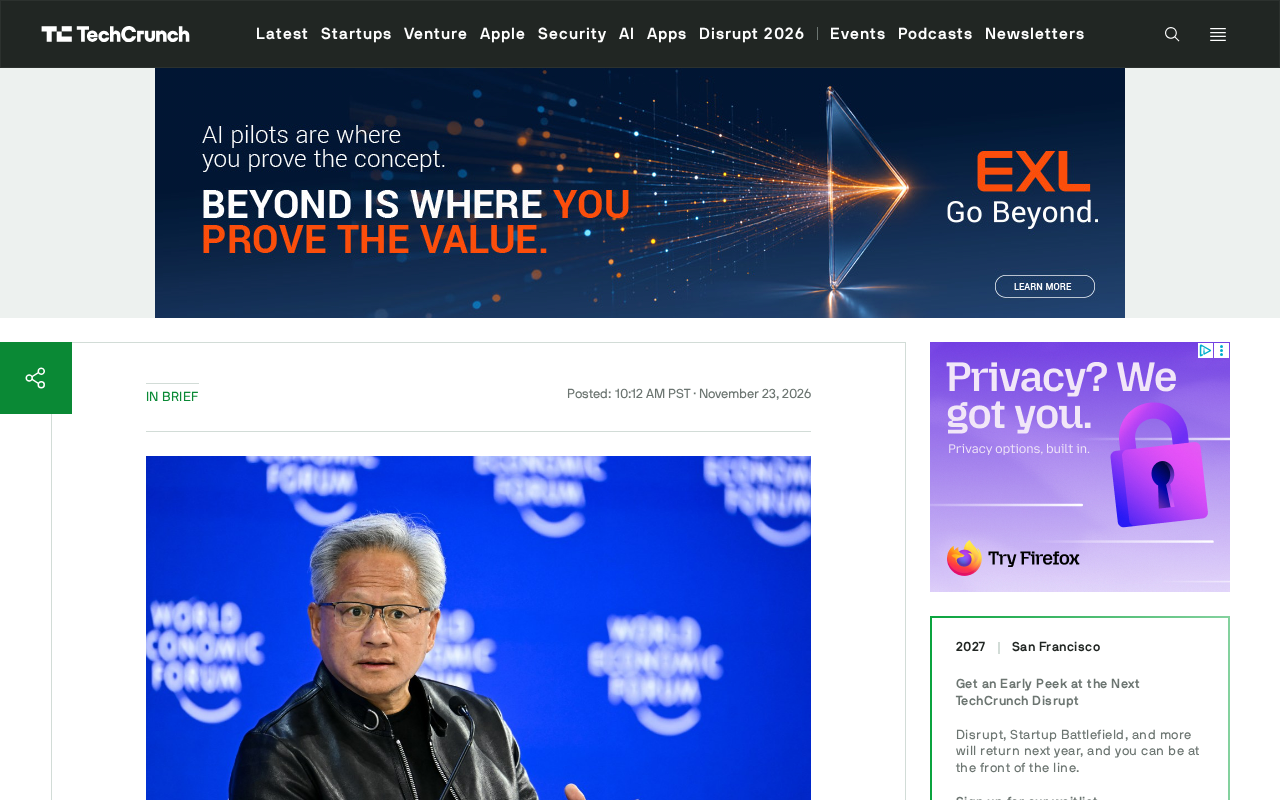
Background and Triggers for the Hearing
According to the original report, the direct trigger for the hearing is bipartisan calls for Huang to publicly testify about an "affair" involving a suspected Chinese spy. The report uses the phrase "bipartisan calls," indicating that the demand does not come from a single party but crosses party lines.
From a political-operations perspective, it is unusual for the two parties to form a joint front on oversight of tech executives. This suggests the sensitivity of the matter has moved beyond ordinary corporate governance and entered the framework of national security and foreign influence. The hearing is described as a "public hearing," meaning the testimony and questioning will be open to the public, with media and the public able to access information in real time.
Congressional public hearings are one of the main forms through which the U.S. Congress exercises its oversight authority, typically convened by the relevant committee (such as the Senate Banking Committee, Judiciary Committee, or Homeland Security Committee). Hearings fall into two categories—public and closed (executive session)—and the testimony record of a public hearing enters the congressional archive and is open to the media. Those asked to testify may be government officials, corporate executives, or independent experts, and their appearance can be voluntary or compelled by subpoena; the former tends to be more conciliatory, while the latter carries compulsory legal force. A hearing itself does not directly produce legal consequences, but it is often seen as a precursor to draft legislation, regulatory investigations, or political pressure. For corporate executives, a public hearing is both a risk and an opportunity: poor testimony can trigger stock price volatility and follow-up investigations, while a clear and forceful statement may defuse public pressure.
Timing of the CEO Return and Governance Implications
The report's headline explicitly states that the hearing is scheduled after Huang's "reinstatement as Nvidia CEO." This wording is noteworthy: Huang went through a period in which he was not CEO, then returned to the top management position.
A corporate executive facing congressional questioning soon after a change in status creates dual pressure. On one hand, the company needs to demonstrate at the governance level that management stability is unaffected by the personal controversy; on the other hand, the CEO's performance at a public hearing directly transmits to investor confidence and company reputation. As a core supplier in the AI chip sector, Nvidia's management developments have spillover effects across the entire AI supply chain.
Reinstatement as CEO is uncommon in Anglo-American corporate governance. It usually occurs when a founder briefly leaves management amid controversy and then retakes the helm, often involving board power struggles, investor pressure, or strategic adjustments. Unlike a conventional CEO succession, reinstatement means the company goes through two management transitions in a short period, which can easily signal governance instability to the outside world. From a regulatory perspective, the personal controversy of a reinstated CEO is more likely to be amplified—because he has regained top decision-making authority, Congress has reason to believe that personal risk and company risk are now highly intertwined. In addition, the U.S. Securities and Exchange Commission (SEC) has disclosure requirements for material personal matters involving executives of public companies; if information disclosed at the hearing involves previously undisclosed material facts, it could trigger disclosure compliance issues.
Potential Impact on Nvidia and the AI Industry
Nvidia occupies a key position in the AI computing market, and its product supply cadence, strategic decisions, and executive stability are all variables closely tracked by industry participants. The Senate hearing itself will not directly change the company's product roadmap, but it may have indirect effects at several levels:
Concentrated regulatory attention. Congressional hearings are often a precursor to subsequent legislation or regulatory action. Even if the hearing focuses on personal matters, lawmakers may extend their questioning to export controls, supply chain security, and other issues directly relevant to Nvidia's business.
Market sentiment volatility. The content of testimony at a public hearing is uncertain, and investors typically adjust expectations before and after the event. For a company with a massive market capitalization, management reputation risk is priced by the market.
Industry demonstration effect. If Congress treats this hearing as a precedent for scrutinizing the personal conduct of tech executives, executives at other AI and semiconductor companies may face similar oversight pressure.
Export controls and supply chain security are the background framework for understanding Nvidia's regulatory situation. Since 2022, the United States has imposed multiple rounds of export restrictions on advanced AI chips, prompting Nvidia to launch downgraded models for the Chinese market (such as the A800 and H800), but the relevant rules have continued to tighten. Both parties in Congress are highly aligned on technology restrictions against China, so a hearing involving China-related factors can easily extend from personal matters to the compliance of the company's China business. Supply chain security involves structural facts such as reliance on TSMC for chip manufacturing and the distribution of packaging and testing across Asia. If lawmakers touch on these issues during questioning, they are in effect using the window of a personal controversy to influence the overall regulatory framework for the AI chip industry. For the industry, this means that scrutiny of executives' personal conduct may become a new entry point for tech governance.
Information Still Unclear
Based on the available material, the report is limited in length, and several key details have not been disclosed: the specific date of the hearing (described only as "next week"), the list of senators who will question Huang, whether Huang is cooperating voluntarily or has been subpoenaed, and the specific nature of the "affair." The original report uses the phrase "suspected Chinese spy" but provides no further factual details.
The absence of this information means that current judgments about the direction of events can only remain at the framework level. The actual content of the hearing, Huang's stance in his testimony, and whether further investigations are triggered afterward all need to wait for events to unfold before they can be assessed.
What to Watch
For readers following the AI industry and tech governance, the core questions worth tracking at next week's hearing include: whether questioning goes beyond personal matters to touch on Nvidia's China business and export compliance; whether the questioning by senators from both parties shows a consistent stance; and how Huang handles the boundary between personal controversy and company interests in his testimony. The answers to these questions will determine whether the hearing remains an accountability exercise limited to the personal level or evolves into a substantive discussion of the regulatory framework for the AI chip industry.
One-line Summary
After returning as Nvidia CEO, Jensen Huang will appear at a Senate public hearing and face bipartisan questioning over a personal controversy involving a suspected Chinese spy.
Paragraph Summary
The article reports that Nvidia CEO Jensen Huang will appear at a U.S. Senate public hearing next week to face questioning over a personal controversy involving a suspected Chinese spy. The hearing was triggered by bipartisan calls, indicating the matter has crossed party lines and touches on national security issues. The report notes that the hearing is scheduled after his return as CEO, and that management stability combined with the personal controversy may create dual pressure on corporate governance and investor confidence. The article analyzes potential impacts on Nvidia and the AI industry, including concentrated regulatory attention, market sentiment volatility, and an industry demonstration effect, and notes that questioning may extend to core business issues such as export controls and supply chain security. The specific date of the hearing, the list of senators, and details of the matter have not yet been disclosed, and the direction of events remains to be observed.
Related articles

Inside the Optimization of Rust Compiler's New Trait Solver
An in-depth look at the optimization of the Rust compiler's next-generation trait solver, covering architecture evolution, community discussion, and impact on developers.

AI Role-Play in a Barbershop: How Veda Builds Immersion Through Dialogue
From a Bilibili Veda barbershop video, explore how AI role-play builds immersion through task dialogue, relationship maintenance, and improvisation.

Why Does Python Endure? A 20-Year Developer's Firsthand Account
A senior developer shares his journey from C, Java, and other languages to Python: convinced by its concise code in 2006, he asks himself every year whether to keep using Python, and the answer is always yes. Python's flexibility and versatility are the key to its enduring popularity.