Jev AI Decision Model: 7 Use Cases to Make Your Coding Agent Faster and Cheaper

Jev AI is a parallel decision model that acts as a cheap, fast auxiliary layer for coding agents like Claude Code.
Jev AI, developed by TypeSafe, is a decision model that selects from given options in parallel rather than generating text, making it extremely fast and cost-effective. The article covers connecting Jev via Vercel AI Gateway and details seven practical use cases for embedding it into coding agent workflows: context compaction, documentation rule validation, skill selection, file ranking, pre-filtering code reviews, browser navigation automation, and enforcing rules via hooks. The core idea is to offload "judgment" tasks — what to keep, which file is relevant, whether a change violates a rule — from expensive generative models to a specialized decision model, boosting efficiency without compromising main model quality. Jev is positioned as a complement to models like Claude, not a replacement.
What Is the Jev AI Decision Model
Unlike generative models such as Claude and GPT, Jev AI (developed by TypeSafe) doesn't write out answers token by token — it selects from a set of given options. That's why it's called a "decision model": instead of an open-ended prompt, you give it a list of candidates. This could be a yes/no question, choosing one option from several, or scoring something.
Every decision Jev returns comes with a confidence score — a number indicating how certain the model is about its choice. More importantly, speed is where it truly shines: while Claude and GPT generate one token at a time, Jev processes all options in parallel and returns results almost instantly. It's also cheaper — you only pay for what you send to it, and the decision it returns is free.
To be clear, Jev doesn't replace the main model inside Claude Code or Codex. It doesn't generate text, can't write code, and can't call tools — it functions purely as a "decision layer" embedded in those tools' workflows. According to hands-on testing from the AI Labs channel, the real value shows up precisely at the junctions where Jev connects to your everyday coding agent.
From an architectural perspective, the "discriminative decision" paradigm Jev represents differs fundamentally from generative large language models. Generative models like GPT and Claude rely on autoregressive mechanisms to output tokens sequentially, with computational cost scaling linearly with output length. Decision models, by contrast, have a fixed output space — a finite set of options — making them conceptually closer to traditional classifiers or rankers. This allows parallel scoring across all candidates rather than sequential decoding, dramatically reducing latency. The confidence score typically derives from the softmax probability distribution across options — when one option's probability far exceeds the others, confidence is high; when the distribution is roughly uniform, confidence is low, and the system can fall back to a more conservative strategy such as triggering a full review. This design makes decision models naturally suited as a "gating layer" in workflows, cheaply filtering out cases that don't require an expensive model's involvement.
How to Connect Jev: Configuring Keys via AI Gateway
TypeSafe's own platform has temporarily paused new user registration due to surging demand, but Jev is available through aggregator platforms like OpenRouter and Vercel AI Gateway. These platforms let you access models from many providers with a single key, and Jev is one of them.
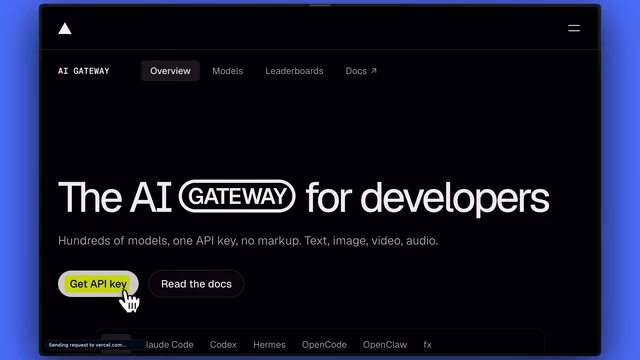
In practice: open your Vercel dashboard, navigate to the AI Gateway API Keys page, and create a key. Note that Vercel will only show the key once — copy it immediately. Then use the export command in your terminal to save it as an environment variable. This way, when you open Claude in the same terminal session, it can read the key and call Jev.
An AI Gateway is a middleware service that wraps multiple model provider APIs under a unified interface. Developers only need one platform key to call models from OpenAI, Anthropic, Mistral, and others through the same interface, without managing separate authentication logic for each. Vercel AI Gateway and OpenRouter are two of the more mainstream implementations. These gateways also typically provide usage analytics, cost monitoring, and request logging — useful for teams tracking actual model usage in multi-model architectures. For embedding Jev into a Claude Code workflow, the gateway's value lies in letting Claude communicate with Jev using the same environment variables and request format, even though they come from different providers. The export command writes the key into the current shell process's environment, meaning the key only persists for that terminal session — you'll need to set it again after closing the terminal. In production, you'd typically use a .env file or a secrets management service for persistent storage.
Use Cases 1–3: Compression, Documentation Validation, and Skill Selection
Replacing context compaction. When agents like Claude Code compress context, they typically send the entire conversation back to the model for summarization — a slow process. Jev can directly judge which parts of the conversation matter and distill what's truly important. A plugin called FastJev Compaction already implements this, though it originally only supported TypeSafe's own platform and requires Claude to make minor adjustments to work with the Vercel gateway. In testing, compression often completes in under a second. There's one constraint: Jev isn't activated when the session is below 25% capacity — it falls back to Claude's standard compaction — ensuring Jev is only invoked when it can make a meaningful difference.
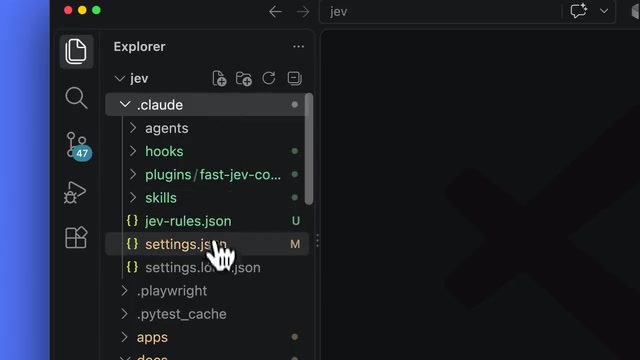
Documentation rule validation. Projects accumulate many documentation and rules files that agents struggle to track consistently. AI Labs created a hook that triggers whenever Claude edits files related to access permissions, prompting Jev to check whether every rule in the documentation has a corresponding test. This helps teams quickly identify rules that are listed but never tested.
Skill selector. When a project has a large number of skills, the main model has to weigh all of them within the context window before making a choice — slow and context-hungry. A skill selector hook lets Jev read each skill's name and description, then combined with a prompt, picks the best match (or none if none fits), and passes the selection directly to Claude — significantly speeding up the process.
Context compaction is one of the core engineering challenges facing long-session coding agents. Large models have hard context window limits (e.g., 200K tokens for the Claude 3 series), and when conversations approach the limit, the agent must compress history to free up space. The traditional approach sends the full history back to the model for "summarize and rewrite," consuming large amounts of tokens and introducing additional latency. The hook mechanism is an event-driven extension point provided by coding agent frameworks like Claude Code: developers can register scripts or functions that automatically trigger before or after specific operations (such as file edits, session compaction, or tool calls), injecting custom logic without modifying the main model's behavior. Jev is "mounted" into the workflow through this hook mechanism — it doesn't change Claude's decisions, but inserts a lightweight judgment step before or after Claude acts, serving as a pre-filter or post-validator.
Use Cases 4–5: File Finding and Code Review
Finding files faster. When Claude searches for files, it runs a separate Explorer agent. Previously, Explorer defaulted to the lightweight Haiku model; later it was changed to match the main model — so if you're using Opus, Explorer also runs on Opus, making every search slower and more expensive. With Jev, you can create a skill that works in two steps: first a keyword search to narrow down candidates, then Jev scores 20 files at a time, and Claude only opens the top-ranked ones. In testing, it ranked 35 files in just 1.6 seconds and placed the correct file at the top.
Accelerating code review. The agent building a feature shouldn't also review its own work, so another model typically does the review — but full reviews are slow. The approach here is to add Jev as a pre-check before review: it reads the changes and answers seven yes/no questions (e.g., does this change conform to the rules? Was this something that shouldn't have been changed at all?). If all answers are no, the reviewer does a quick pass; if any answer is yes or Jev is uncertain, a full review is triggered. High-risk changes still get thorough inspection, while small changes move through much faster.
Use Cases 6–7: Browser Testing and Rules Enforcement
Browser automation testing. Agents sometimes open a browser and click through buttons like a human would, verifying that built features work correctly. The "what to click next" decision can be delegated to Jev: the skill opens the app, lists all buttons and links on the page, Jev picks the option closest to the goal and clicks it, then generates a new list from the resulting page and repeats — until it determines the goal is complete or it's blocked. The final verdict of "is the app working" still comes from the main model, but navigation decisions made by Jev are significantly faster. AI Labs used this to log in as admin, manager, and employee roles respectively, checking whether each role could only access permitted pages, with Claude then comparing results against documented rules.
Enforcing rules. Rules in CLAUDE.md are just instructions — the model follows them most of the time, but not always. Since hooks run every time and can't be skipped by the model, the team created a hook that triggers whenever Claude attempts to edit a file: it sends the changes along with the relevant rules to Jev, which answers yes or no for each rule violation. If Jev is at least 80% confident a rule is being violated, the edit is blocked outright, and Claude is told which specific rule was violated so it can fix the issue. During testing, Claude attempted to create a file that read employee data directly from the browser — a violation of established rules — and Jev blocked the file before it was ever created.
The Value Proposition of Decision Models
These seven use cases point to a common insight: within a coding agent's workflow, a large number of steps are fundamentally about "making judgments" rather than "generating content" — what to keep during compression, which skill is the best match, which files are relevant, whether a change violates a rule. Stripping these judgments away from expensive, slow generative models and handing them to a purpose-built decision model saves both time and money.
Jev doesn't compete with Claude or GPT — it exists as an auxiliary layer alongside them. For developers who rely heavily on coding agents, this "decision and generation separated" architecture is worth paying attention to. All the skills and hook configurations discussed in this article come from AI Labs channel's hands-on work, shared here as a reference for building your own workflows.
Related articles

Chain of Thought Isn't Just for AI: How Humans Can Use CoT to Improve Thinking Quality
Chain of Thought isn't just a prompt trick for large models. Starting from a Hacker News discussion, this article analyzes why CoT works for human thinking too, breaks down actionable ways to transfer it, and highlights the key differences between human CoT and machine CoT.
Cloudflare Teams Up with OpenAI: Closi…
Cloudflare Teams Up with OpenAI: Closing the Loop from Vulnerability Discovery to Defense with AI
Cloudflare uses OpenAI Daybreak to investigate security vulnerabilities and generate reviewable remediation plans, while developers use Codex to boost coding efficiency and quality.

Orca Multi-Agent Orchestration in Practice: A Guide to Parallel Collaboration with Claude and Codex
Orca is Stable AI's free open-source agent workbench supporting 34 agents like Claude Code and Codex in parallel. Learn its Git worktree isolation, multi-model orchestration, and mobile management.