JEV as a Judge: A Low-Cost, High-Speed Semantic Verifier

JEV as a Judge is a cheap, fast semantic verifier designed for large-scale online LLM evaluation.
In LLM application evaluation, using powerful judge models (LLM-as-a-Judge) to score every output is expensive and hard to scale for high-volume online scenarios. "JEV as a Judge" refers to lightweight semantic verifiers that trade some judgment depth for significantly lower inference costs and faster speeds. Their sweet spot is online evaluation — scoring the large volumes of execution traces continuously generated in production environments. Rather than replacing heavyweight judge models, semantic verifiers complement them in a funnel-style tiered architecture: a cheap first tier handles the majority of clear-cut judgments, while a powerful second tier handles ambiguous or high-value cases, balancing cost control with judgment accuracy.
What Is JEV as a Judge
In the evaluation (evals) stage of large language model applications, quickly and cheaply determining whether model outputs meet expectations has long been a pain point in engineering practice. The traditional approach relies on powerful judge models (LLM-as-a-Judge), which deliver strong results but come with high costs and significant latency — making them difficult to scale in scenarios that require processing massive volumes of traces.
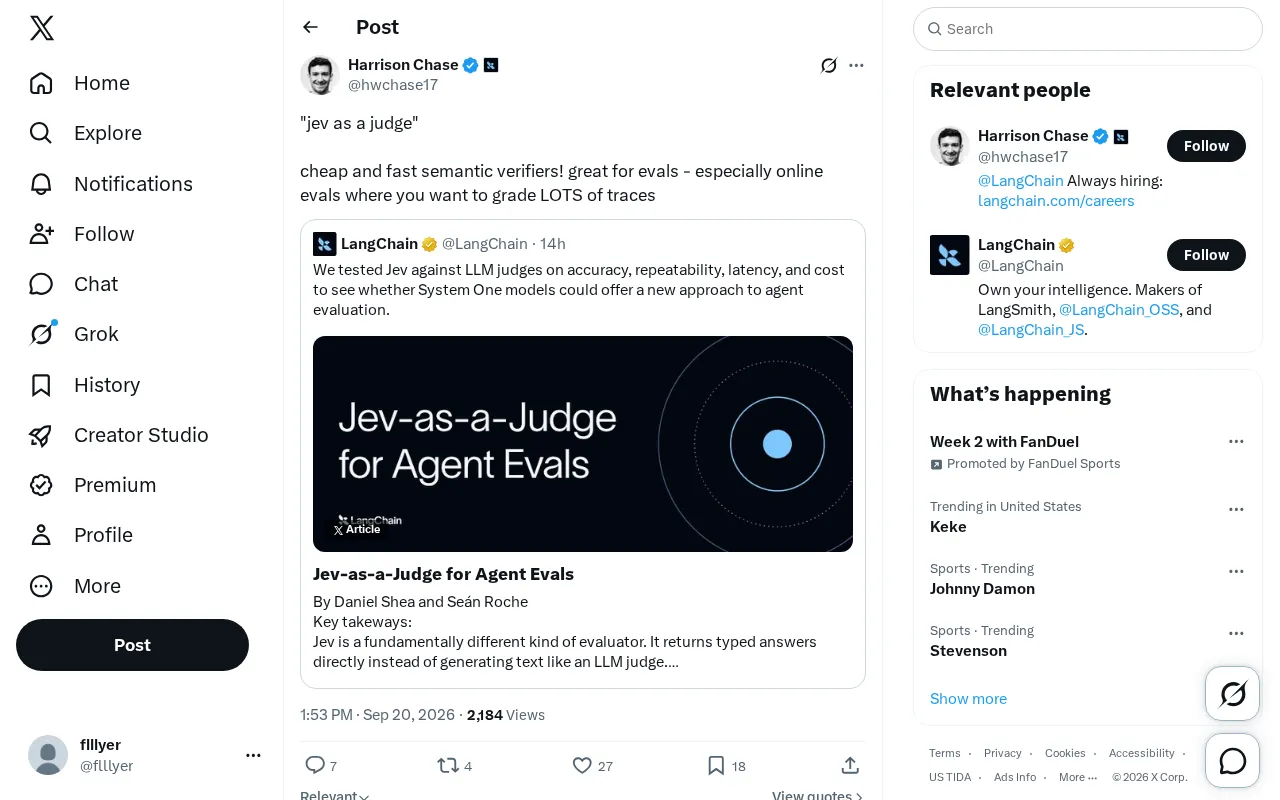
The concept of "JEV as a Judge," which has emerged in recent community discussions, refers to a class of low-cost, high-speed semantic verifiers. Its core value proposition is straightforward: cheap and fast — making it especially well-suited for evaluation tasks, particularly online evals where you need to grade large numbers of execution traces.
Why Semantic Verifiers Matter for Evaluation
Evaluation (evals) is a foundational component of building reliable AI systems. Developers need to continuously verify whether a model's behavior meets standards across real or simulated inputs. Two distinct scenarios typically arise:
Offline Evals vs. Online Evals
Offline evaluation is typically conducted during development, where data volumes are relatively manageable. Even using a heavier judge model to score each output individually keeps costs within an acceptable range.
Online evaluation (online evals), however, is a different story entirely. Once a system goes live, it continuously generates large volumes of execution traces. If you want to monitor and score the quality of these real-time outputs, the cost and latency of the evaluator itself become decisive factors. Using an expensive large model to score every single trace will quickly cause both your bill and your response times to spiral out of control.
A trace refers to the complete execution record of an AI system processing a single request — typically including the input, intermediate reasoning steps (such as Chain-of-Thought or an agent's tool-call sequence), and the final output. In complex agent systems, a single trace may contain dozens of LLM calls and tool interactions. When a production service handles tens of thousands to millions of requests per day, the total volume of traces becomes enormous — and that's the fundamental reason online evaluation faces such significant cost pressure.
The Role of Semantic Verifiers
Semantic verifiers focus on whether an output meets requirements at the semantic level, rather than relying on exact string matching. Compared to heavyweight judge models, these verifiers trade some depth and generalization in their judgments for significantly lower inference costs and faster response times. The "cheap and fast" emphasis in the original discussion captures the essence of this tradeoff.
LLM-as-a-Judge is the dominant paradigm for evaluating model outputs today — using a more capable LLM (such as GPT-4 or Claude) as a judge to score or make binary decisions on another model's outputs according to specified criteria. This approach is more efficient than human annotation and shows high agreement with human ratings on many tasks, but each judgment requires a full large-model inference call, making cost and latency impossible to ignore. Semantic verifiers typically use lighter-weight architectures — such as purpose-fine-tuned small models, embedding-based similarity calculations, or hybrid rule-and-model approaches — to perform judgments on specific evaluation dimensions at a fraction of the cost.
Use Cases and Practical Significance
The phrase "great for evals — especially online evals where you want to grade LOTS of traces" pinpoints the ideal deployment scenario: whenever you need to batch-score a large number of traces.
Typical applications include:
- Production quality monitoring: Continuously sampling or fully validating outputs from live services at the semantic level to catch regressions or quality degradation early.
- Large-scale A/B testing: Rapidly scoring thousands or tens of thousands of results when comparing different model versions or prompt variants.
- Data pipeline filtering: Using lightweight verifiers to filter out low-quality samples during synthetic data generation or training data construction.
In these scenarios, the per-evaluation cost is amplified thousands or even millions of times over — making "cheap and fast" a direct determinant of whether a solution is even feasible.
The Cost-Quality Tradeoff
It's worth being clear-eyed here: semantic verifiers are not meant to replace LLM-as-a-Judge — they complement it. The two can form a tiered evaluation strategy:
- Tier 1: Use cheap, fast semantic verifiers to pre-screen massive volumes of traces, covering the vast majority of clear pass/fail judgments.
- Tier 2: Route ambiguous, edge-case, or high-value samples to a more powerful judge model for fine-grained evaluation.
This "funnel-style" evaluation architecture keeps overall costs under control while preserving the necessary judgment accuracy — and it's becoming an increasingly common pattern in LLM engineering practice.
The concept of tiered evaluation has well-established precedent in software quality assurance, analogous to the test pyramid structure of "many fast unit tests + a few slow integration tests." Adapting this to LLM evaluation scenarios, the key engineering challenge lies in defining routing rules for "ambiguous samples" — i.e., determining which traces should be escalated to a stronger judge. Common strategies include: automatically escalating samples where the semantic verifier's confidence falls below a threshold, sending a random sample percentage to fine-grained evaluation, and mandating double verification for high-risk business logic. Designing these routing rules well is the central variable that determines where the overall cost-quality balance lands.
Summary
"JEV as a Judge" represents one direction in the evolution of evaluation tooling toward lighter-weight, more scalable solutions. As AI applications move into large-scale online deployment, cost-effectively maintaining quality control over massive volumes of outputs will become essential knowledge for every engineering team. Cheap, fast semantic verifiers are one practical tool for meeting that challenge.
Note: This article is based on a brief piece of community discussion material. Implementation details and performance data for specific tools await further public information to be filled in.
Related articles

Chain of Thought Isn't Just for AI: How Humans Can Use CoT to Improve Thinking Quality
Chain of Thought isn't just a prompt trick for large models. Starting from a Hacker News discussion, this article analyzes why CoT works for human thinking too, breaks down actionable ways to transfer it, and highlights the key differences between human CoT and machine CoT.
Cloudflare Teams Up with OpenAI: Closi…
Cloudflare Teams Up with OpenAI: Closing the Loop from Vulnerability Discovery to Defense with AI
Cloudflare uses OpenAI Daybreak to investigate security vulnerabilities and generate reviewable remediation plans, while developers use Codex to boost coding efficiency and quality.

Orca Multi-Agent Orchestration in Practice: A Guide to Parallel Collaboration with Claude and Codex
Orca is Stable AI's free open-source agent workbench supporting 34 agents like Claude Code and Codex in parallel. Learn its Git worktree isolation, multi-model orchestration, and mobile management.