Jev Sets AI Gateway's Fastest Adoption Record: Reached 13% of Teams on Day One

Jev hit 13% of AI Gateway teams on day one — 2x faster than GPT-5.6 and 6x faster than Fable 5.1.
Jev, launched by @typesafeai, set the fastest model adoption record on AI Gateway, reaching ~13% of team users on day one — 2x the GPT-5.6 family and 6x Fable 5.1. The article notes that because AI Gateway lets teams freely compare models, this level of first-day uptake carries real weight. However, the author cautions that day-one adoption reflects curiosity rather than retention, and vendor-reported figures warrant scrutiny over methodology and free-trial inflation. For developers, the takeaway is to treat this as a signal to watch, not a reason to switch — real selection should be driven by A/B testing on your own use cases.
Jev Breaks AI Gateway Adoption Speed Record
A tweet making the rounds in the industry reveals that an AI model called Jev has set the fastest adoption rate ever recorded on the AI Gateway platform. According to the publisher, Jev — launched by @typesafeai — reached approximately 13% of team users on its very first day, a figure that is 2x the GPT-5.6 family and 6x that of Fable 5.1.
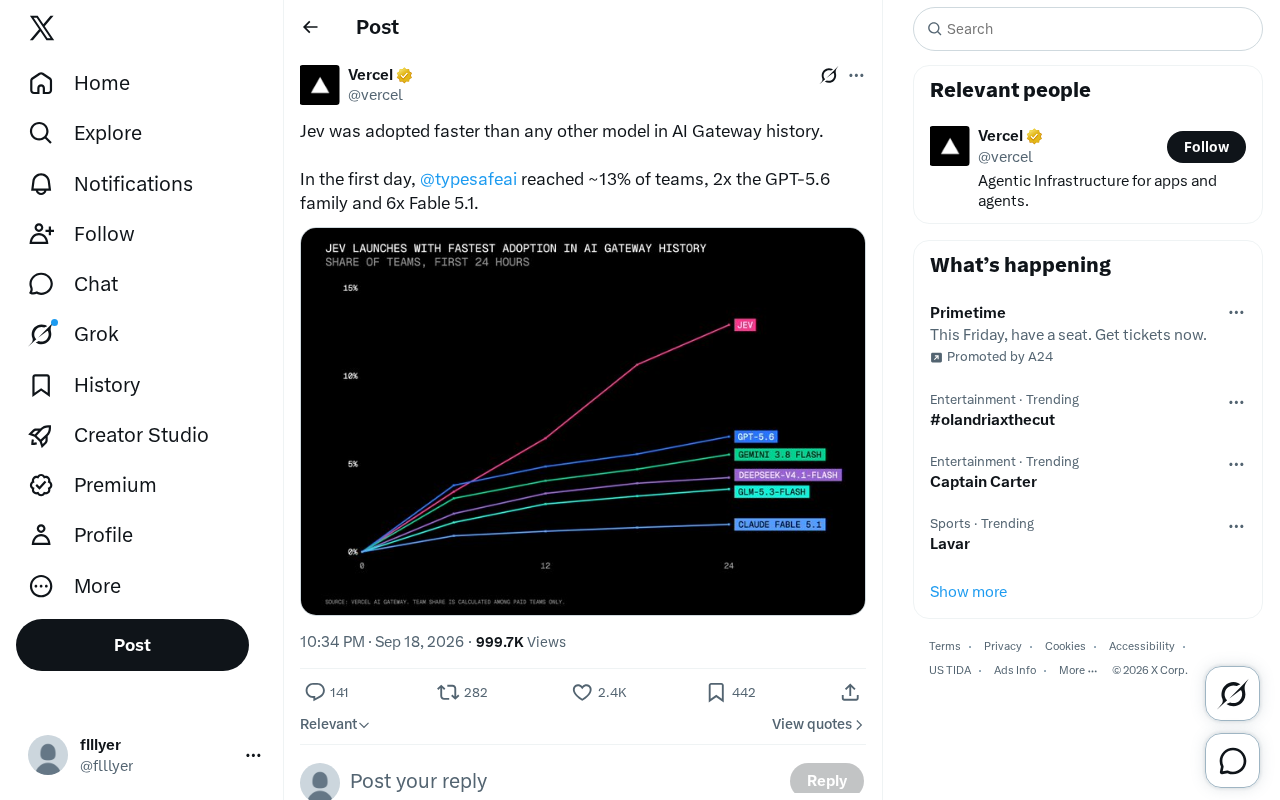
For any new model, the day-one adoption curve is often a critical early signal of market reception. In the fiercely competitive large model distribution ecosystem, AI Gateway serves as an aggregation layer where teams can freely switch between and compare different models. Being able to attract over 10% of teams to actively try a model on launch day suggests that Jev arrived with considerable buzz and practical appeal right out of the gate.
AI Gateway is a category of middleware or platform service that acts as a "model routing layer," allowing development teams to call large language models from multiple providers through a unified API — without needing to integrate each vendor's SDK and authentication system separately. Typical features include cost- or latency-based automatic routing, unified usage billing and audit logs, model fallback strategies, and rate limit management. Because users can compare multiple models side by side on the same platform, adoption data from AI Gateway is a more accurate reflection of real competitive dynamics than signup numbers on any single model's website — every team switch is an active, deliberate choice rather than passive default behavior.
What the Comparative Data Actually Means
The benchmarks cited in this announcement are particularly revealing. Placing Jev's adoption rate alongside the GPT-5.6 family and Fable 5.1 implies these three are in the same competitive tier, targeting similar developer and team audiences.
The 2x advantage over the GPT-5.6 family is especially noteworthy — the GPT series is generally the highest-recognition, most-defaulted-to model family on the market. A newcomer outpacing an established series on day one typically points to a few possibilities: a significant performance edge, more attractive pricing, or differentiated capabilities for specific use cases (such as code generation or type safety). The publisher's handle, @typesafeai, also hints that the model may have a particular focus on type safety or engineering reliability.
It's worth noting that day-one adoption is a snapshot metric — it measures willingness to try, not long-term retention. The true measure of a model's value is its sustained usage rate and team stickiness over weeks and months.
Type Safety, in an engineering context, refers to using static type systems or runtime validation to ensure that the data types of variables and function inputs/outputs are verified at compile time or call time, reducing runtime errors caused by type mismatches. Translated to the AI model domain, this means a model's outputs can more predictably conform to predefined structured formats (such as JSON Schema), reducing the risk of downstream code crashing due to parse failures. For engineering teams that need to pipe model outputs directly into business logic, structural stability of outputs is often just as important as raw performance — which is likely why the @typesafeai handle resonates with developers.
How to Interpret This Kind of Launch Data Rationally
Adoption data self-reported by vendors inherently carries a marketing dimension, and readers should approach it with appropriate skepticism. Key questions worth asking include: how is the 13% figure defined (active teams vs. all registered teams), whether the adoption numbers include a short-term spike from free trials, and whether AI Gateway itself gave the new model any default recommendations or traffic boosts.
That said, even with some discount applied, outpacing the GPT family by several times within the same platform is a market signal that cannot be dismissed. It reflects a defining characteristic of today's large model ecosystem: user loyalty is not entrenched, and development teams are willing to migrate quickly for better value or more scenario-specific capabilities.
For developers, this kind of news is better treated as a "watch list alert" than a "model selection conclusion." In a multi-model environment like AI Gateway, the most pragmatic approach remains running A/B tests against your own business use cases and letting real-task performance drive model selection — rather than chasing day-one launch hype.
Conclusion
Jev's record-breaking adoption on AI Gateway is yet another sign of how intensely competitive the large model space has become. While the raw information is limited, the trend it signals is clear: model iteration is accelerating, switching costs for users are falling, and vendors are placing ever-greater value on the propagation of early adoption data. Whether Jev can convert its day-one momentum into lasting market share remains to be seen — and will require much more data to verify.
Related articles

Workbuddy for Absolute Beginners: How a Desktop AI Agent Fits Into Real Workflows
A beginner's guide to the Workbuddy desktop AI agent: installation, claiming credits, file management, and building automated workflows—compared with CodeX for fit and cost, helping professionals shift from AI question-askers to AI managers.

OpenAI's New Agent Stack: Computer Use, Decisions API, and Ultra-Fast Workflows
OpenAI Dev Day unveiled a new agent stack: Computer Use outperforms humans, Decisions API delivers ultra-low-latency classification via Luna, Agents API opens the same Computer Use capabilities, and GPT-6.1 Sol costs only one-seventh of Astra. Core updates, benchmark data, and developer insights.

Liang Wenfeng Open-Sources DeepInfo Inference Framework, Takes On U.S. Ban
DeepSeek open-sources its DeepInfo inference framework after its models, featuring GPU/CPU cross-pipelining, small-model prediction with large-model verification, and full Huawei Ascend and NVIDIA chip support—facing the U.S. federal ban head-on. This article analyzes its significance for AI deployment and open-source strategy.