Jev State: Turning AI Conversations into Testable, Runnable Code

Jev State turns AI conversations into regression tests and exportable code, catching wrong branches before you ship.
Jev State is an open-source developer tool that makes conversational AI workflows explainable, testable, and exportable. It lets developers save successful AI conversations as regression test cases, automatically catching logic errors when prompts, models, or workflow logic change. Workflows can be exported as TypeScript code, workflow JSON, or integration skills for coding agents. The project uses a free open-source plus BYOK model, keeping data and API costs fully in the user's control.
When building conversational AI applications, developers often run into a frustrating problem: a conversation flow works perfectly in demos, but takes a wrong turn in front of real users after launch. Why does it go wrong? How do you catch these errors before shipping? The open-source tool Jev State aims to answer that question — by converting AI conversations directly into test cases and runnable code.
What Is Jev State
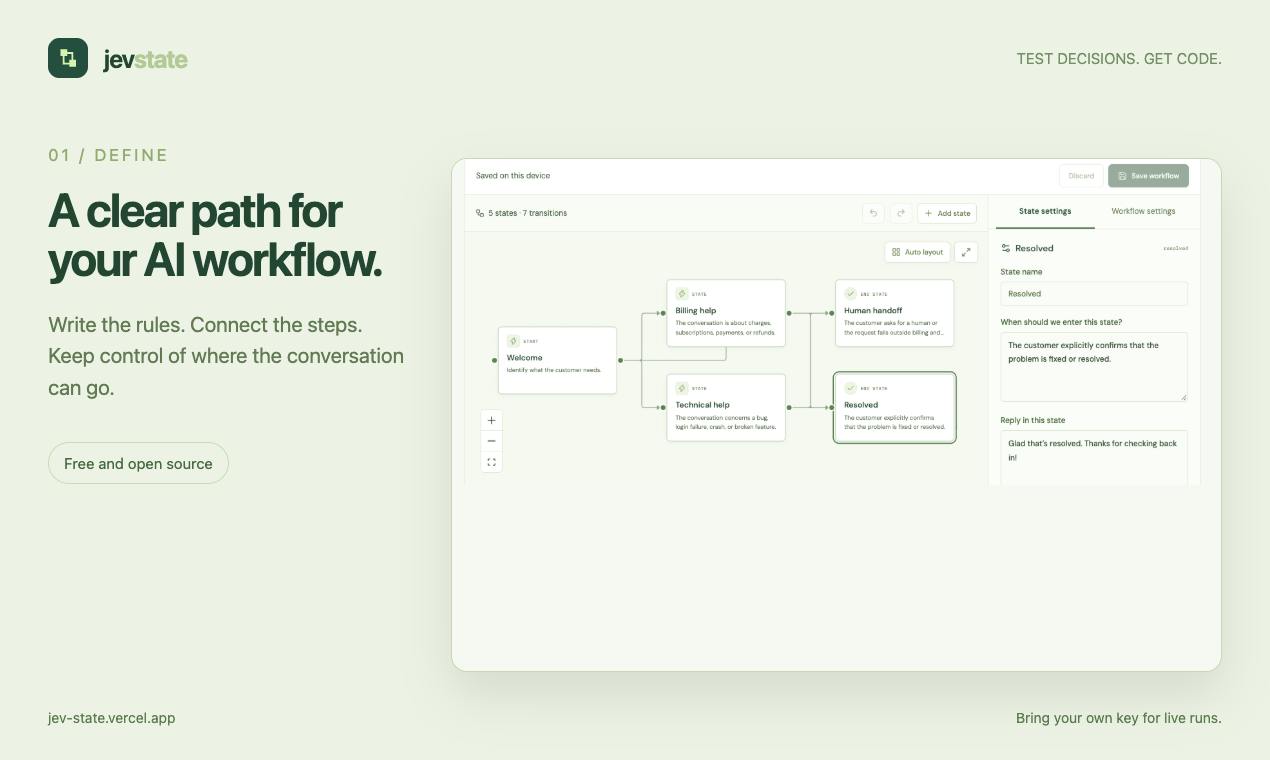
Jev State is an open-source tool built for developers, designed for building and testing conversational workflows. Its core philosophy can be summed up in one sentence: manage AI conversations as regressable assets.
Traditionally, interactions with large language models are one-off and hard to reproduce. You debug prompts in a chat box, hardcode the result that works, and move on — but the next model update or a slight variation in input can break the entire flow. Jev State's approach is to make every conversation traceable and re-runnable as a test.
According to its Product Hunt page, the tool currently ranks 11th with 81 upvotes. It was developed by Priyankar Kumar and is categorized under open source, developer tools, and artificial intelligence.
Core Features: Explainable, Testable, Exportable
See Why Each Step Happened
The first capability Jev State emphasizes is explainability — "See why each step happened." When debugging a conversation flow, you can see exactly why each step was triggered. This is especially critical for diagnosing unexpected branches and logic jumps. The unpredictability of conversational AI is precisely what makes many teams hesitant to deploy it in production, and transparent execution paths go a long way toward reducing that uncertainty.
Save Conversations as Tests
The second highlight is the ability to save conversations directly as test cases. This means a successful interaction can be preserved as part of a regression test suite. When you tweak prompts, swap models, or adjust workflows, these tests help you "catch wrong turns before you ship," keeping bugs out of production.
This "conversation as test" design essentially brings the proven software engineering practice of test-driven development (TDD) into LLM application development, filling a gap in quality assurance for conversational AI.
In traditional software engineering, TDD works by writing test cases that define expected behavior first, then writing the implementation that makes those tests pass. The challenge with LLM applications is that model outputs are non-deterministic — the same input can produce very different outputs depending on temperature settings or model versions, making conventional assertion-based testing difficult to apply directly. Two main approaches have emerged in the industry: soft assertions based on semantic similarity (checking whether output is "close enough" to the expected result), and using another LLM as an evaluator to score outputs. Jev State's approach is closer to the former — by preserving successful conversation paths as regression baselines, it records acceptable execution trajectories and verifies that new outputs still follow the same path after workflow changes.
Export Runnable Code and Integration Skills
Jev State supports exporting workflows in multiple formats: runnable TypeScript code, workflow JSON, and integration skills prepared for coding agents. This makes it more than just a debugging sandbox — it's a productivity tool that can plug directly into your development pipeline.
For developers already using AI coding assistants, the "integration skill" export is particularly valuable — it means conversation logic you've validated in Jev State can be directly understood and reused by a coding agent.
The concept of "integration skills" originates from the AI coding assistant ecosystem. It refers to structured, semantically described functional units that can be directly invoked or understood by coding agents (such as GitHub Copilot, Cursor, etc.). Unlike ordinary code snippets, integration skills typically include semantic descriptions of inputs and outputs, invocation constraints, and usage examples, enabling agents to correctly select and combine these capabilities in automated programming tasks. Jev State's support for exporting validated conversation logic in this format means workflows proven in the sandbox can serve as "trusted building blocks" that AI assistants can reuse directly, reducing the overhead of manually re-describing intent in the main codebase.
Open Source and the "Bring Your Own Key" Model
Jev State is free and open source, while requiring users to "Bring Your Own Key" (BYOK) for live execution. This model is becoming increasingly common in AI tooling: the tool itself is free, but the cost of calling the underlying model is borne by the user.
This design has several advantages. For developers, data and API calls stay entirely in their own hands, avoiding dependence on third-party hosted services and aligning better with enterprise data privacy requirements. For the project itself, the open-source plus BYOK combination reduces operating costs and enables long-term, sustainable maintenance.
BYOK (Bring Your Own Key) has become one of the mainstream licensing models for AI developer tools. The underlying logic is: the tool provider is only responsible for the software logic, while users apply for API keys directly from model providers like OpenAI or Anthropic and pay for actual token consumption themselves. This model is especially attractive to enterprise users — all API requests originate from the user's own account, conversation data never passes through the tool provider's servers, and in GDPR or industry compliance scenarios, it can significantly simplify data processing agreements. For individual developers, it means paying only for actual usage, avoiding fixed subscription fees for hosted services.
What Real Pain Points Does It Solve
Building conversational AI applications is difficult largely because testing is hard. Traditional unit tests target deterministic inputs and outputs, but LLM outputs are stochastic and context-dependent, making them difficult to cover with conventional methods.
Jev State's value lies in providing a systematic quality assurance approach for these applications: explore and validate through conversation first, then lock in successful paths as tests, and finally export them as maintainable code. This pipeline connects exploratory conversational debugging with rigorous software engineering.
For teams building AI agents, chatbots, or multi-step conversation flows, tools like this can significantly reduce the rework cost of discovering wrong branches only after going live.
Summary
Jev State represents a direction worth watching in the evolution of AI toolchains: as more and more products place large language models at the center of core business processes, ensuring the reliability of those processes is becoming a genuine necessity. With open source, exportability, and testability as its selling points, it addresses real pain points in conversational AI development.
It's worth noting that current public information is primarily based on its Product Hunt launch page. Real-world usability, test coverage capabilities, and ecosystem maturity still need to be validated in actual projects. For developers who are interested, the open-source and BYOK nature of the tool keeps the barrier to trying it out quite low.
Related articles

Felix Rieseberg Personal Homepage
Felix Rieseberg's personal homepage sparks attention on Hacker News. This article covers the Slack engineer's technical background, the rise and fall of nativefier, and the value of a developer homepage as a tech calling card.

@ai-sdk/vue 3.0.306 Patch Release Syncs with [email protected] Update
@ai-sdk/vue 3.0.306 released, synced with [email protected]. A routine patch release for the Vercel AI SDK ecosystem with no public API changes; the Vue adapter layer stays version-aligned with the core package.

Gemini 4 Argon API Launches: The Era of Million-Token Output Begins
Google launches Gemini 4 Argon with sparse MoE architecture, up to 1M output tokens, and a 68.90% Vals Index score, available across API, AI Studio, and the Gemini app.