JEV Tested: The Job Search AI That Analyzes 400 Companies for Fit in 12 Seconds

JEV analyzes 400 companies for candidate fit in 12 seconds at a cost of just $0.0005 per run.
JEV is an AI-powered job search tool that batch-evaluates candidate-to-company fit at scale. A Reddit user's real-world test showed it processing 400 companies in 12 seconds — outputting offer probability predictions, confidence scores, and mismatch detection for just $0.0005 total. The performance reflects falling LLM inference costs and mature use of batch processing and structured output techniques. Beyond matching, JEV offers company scoring, experience analysis, and opportunity identification. However, the article cautions that prediction accuracy is unverified, output quality depends on input data, and human factors like interview performance remain hard to quantify — making AI matching a useful prioritization aid rather than a replacement for human judgment.
Redefining Job Search Matching with AI
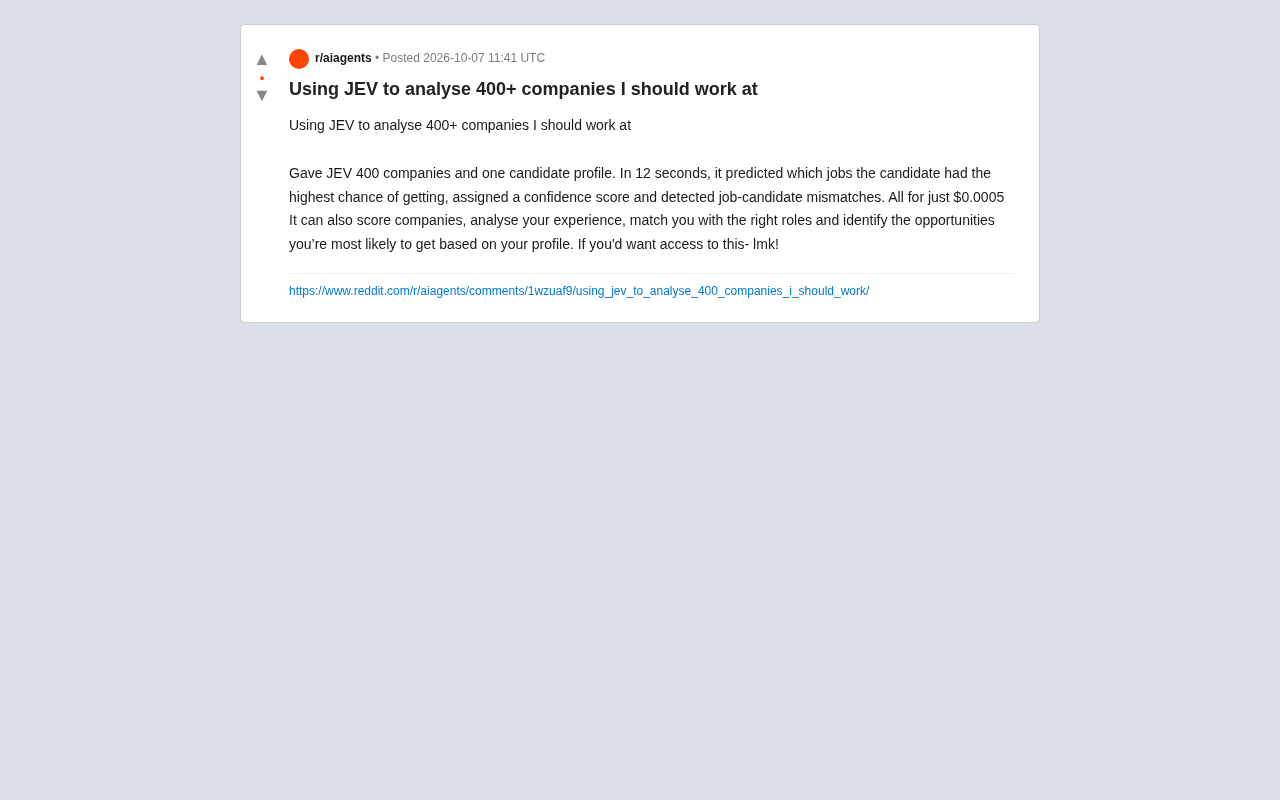
Traditional job hunting typically involves researching target companies one by one, repeatedly tweaking your resume, and manually evaluating role fit — a time-consuming process riddled with subjective judgment. A tool called JEV aims to solve this pain point through automation. According to a real-world test shared by a Reddit user, it can batch-analyze hundreds of companies in a matter of seconds and predict how well a candidate matches each opportunity.
The core value of tools like this lies in transforming job search decisions — which traditionally rely on experience and gut instinct — into quantifiable, comparable data outputs. For job seekers in the middle of a mass application campaign, that means being able to focus energy on opportunities with the highest realistic chance of success.
A Real Test: 400 Companies, Results in 12 Seconds
According to the original post, the user fed JEV information on 400 companies along with a candidate profile, and the system completed the following in just 12 seconds:
- Predicted the candidate's probability of receiving an offer at each position
- Assigned a confidence score to each match result
- Detected mismatches between the candidate and specific roles
Even more striking was the cost — the entire analysis run came to just $0.0005 (a fraction of a cent). That near-zero per-run cost means large-scale batch analysis is economically trivial. Users can iterate freely, adjust their profile, and re-run evaluations without worrying about costs adding up.
The Technical Logic Behind the Speed and Cost
Processing 400 companies in 12 seconds at under one-thousandth of a dollar reflects the rapid decline in LLM inference costs in recent years. Through batch processing and structured output, these applications can deliver analysis that would take a human several hours — at a marginal cost that's essentially negligible.
That said, it's worth noting that the original post did not disclose the specific model used, data sources, or any method for validating prediction accuracy. The so-called "offer probabilities" are fundamentally inferences based on publicly available information, and their real-world reliability remains to be verified through independent testing.
LLM inference costs have fallen exponentially in recent years. For OpenAI's GPT series alone, the cost per million tokens dropped by over 90% between 2023 and 2025, with competition from Anthropic, Google, and others continuing to drive prices down. Structured Output — which requires the model to return results according to a predefined JSON Schema rather than free-form text — is a key technical choice for batch analysis tools like this. It reduces unnecessary token generation and eliminates the complexity of post-processing. Batch APIs allow hundreds of requests to be packaged and processed asynchronously, typically at 50%+ savings over real-time calls. The $0.0005 per-run cost suggests JEV likely uses a lightweight model (such as GPT-4o-mini or a similarly positioned small-parameter model), which performs comparably to flagship models on structured tasks at a fraction of the cost.
What JEV Can Do
Beyond the core batch matching feature, the poster outlined several additional capabilities:
- Company scoring: Quantitative ratings for target employers
- Experience analysis: Parsing and evaluating a candidate's background
- Role matching: Connecting candidates with the most relevant positions
- Opportunity identification: Surfacing the roles most likely to yield an offer based on the candidate's profile
Together, these features sketch the outline of a "job search decision assistant" — one that goes beyond simple keyword filtering and attempts to build a holistic evaluation framework across candidate skills, role requirements, and hiring probability.
What This Means for Job Seekers
For candidates overwhelmed by the sheer volume of job listings, the greatest value of tools like this is prioritization. Rather than blindly applying to hundreds of companies, you can use data to surface the top 20% of high-fit opportunities first, then concentrate your preparation there. This "analyze first, act second" approach could meaningfully improve the conversion rate of your applications.
A Grounded Take on Job Search AI
Impressive demo numbers aside, there are a few things worth keeping in mind before using this as a basis for job search decisions:
Prediction accuracy is unknown. Probability scores and confidence ratings look professional, but without backtesting against real hiring outcomes, these numbers may reflect the algorithm's self-assurance more than actual odds.
Data quality determines output quality. The completeness of the candidate profile and company information directly affects match quality. The vaguer the inputs, the less reliable the conclusions.
Human factors are hard to quantify. Interview performance, cultural fit, team chemistry — these critical variables are difficult to predict from resume data alone. AI matching is better suited as an initial screening reference than a final answer.
The post appears to be in an early promotion phase, with the author inviting interested users to reach out for access — suggesting the product may not yet be publicly available at scale. For readers following AI application development, JEV represents a direction worth watching in the job search space: using low-cost LLM inference to reconstruct information-intensive personal decision-making processes.
"Confidence Score" is a common output format in machine learning systems, expressing how certain a model is about a given prediction — typically as a value between 0 and 1. In LLM-based applications, however, these scores carry a fundamental limitation: LLMs do not produce calibrated probability estimates. In other words, a model outputting "85% offer probability" does not mean that candidates in similar situations actually receive offers 85% of the time. This is fundamentally different from weather forecasting or financial risk models, which are calibrated against large volumes of historical data. Without backtesting against real offer/reject outcomes, the probability figures produced by job search AI are better understood as ranking signals — useful for distinguishing high-fit from low-fit opportunities, but not as predictions of absolute success rates.
Takeaway
The JEV demo illustrates a classic pattern of AI applied to a vertical use case — compressing labor-intensive human analysis into a seconds-long, low-cost automated process. The numbers (400 companies in 12 seconds, $0.0005 per run) genuinely reflect meaningful advances in technical efficiency. But as a job seeker, the more pragmatic framing is to treat it as a decision-support tool that improves prioritization — not an oracle that replaces your own judgment. As independent testing and accuracy data emerge, the true value of tools like this will come into sharper focus.
Related articles

Workbuddy for Absolute Beginners: How a Desktop AI Agent Fits Into Real Workflows
A beginner's guide to the Workbuddy desktop AI agent: installation, claiming credits, file management, and building automated workflows—compared with CodeX for fit and cost, helping professionals shift from AI question-askers to AI managers.

OpenAI's New Agent Stack: Computer Use, Decisions API, and Ultra-Fast Workflows
OpenAI Dev Day unveiled a new agent stack: Computer Use outperforms humans, Decisions API delivers ultra-low-latency classification via Luna, Agents API opens the same Computer Use capabilities, and GPT-6.1 Sol costs only one-seventh of Astra. Core updates, benchmark data, and developer insights.

Liang Wenfeng Open-Sources DeepInfo Inference Framework, Takes On U.S. Ban
DeepSeek open-sources its DeepInfo inference framework after its models, featuring GPU/CPU cross-pipelining, small-model prediction with large-model verification, and full Huawei Ascend and NVIDIA chip support—facing the U.S. federal ban head-on. This article analyzes its significance for AI deployment and open-source strategy.