Jev: The AI Model That Makes Decisions, Not Text — Results in Under Half a Second

Jev is a decision-first AI model that outputs results in under half a second, not text.
TypeSafe's Jev is an AI model positioned to "make decisions rather than write text," claiming sub-half-second output to address the high latency and cost of agent apps that rely on text generation. Creator Jon Kraayenbrink launched the "Made with Jev" directory on Product Hunt, featuring real use cases — browser automation, game NPC logic, email triage, and viral tweet analysis — with transparent cost labeling. The project also includes a free AI slop detector and follows a community cold-start strategy. Technical details and third-party validation are still pending.
What Is Jev, Exactly?
While most people are still debating how to make large language models generate smoother text, TypeSafe has taken a different path with Jev. According to its official description, Jev is an AI model that "makes decisions rather than writes text," delivering results in under half a second.
This positioning cuts to the heart of a real pain point in AI application deployment: many agent products feel sluggish and expensive because they rely on large models to "think and generate a response," then parse out the intended action from that response. Jev aims to skip the verbose text generation step entirely and output decisions directly — gaining an edge in both latency and cost.
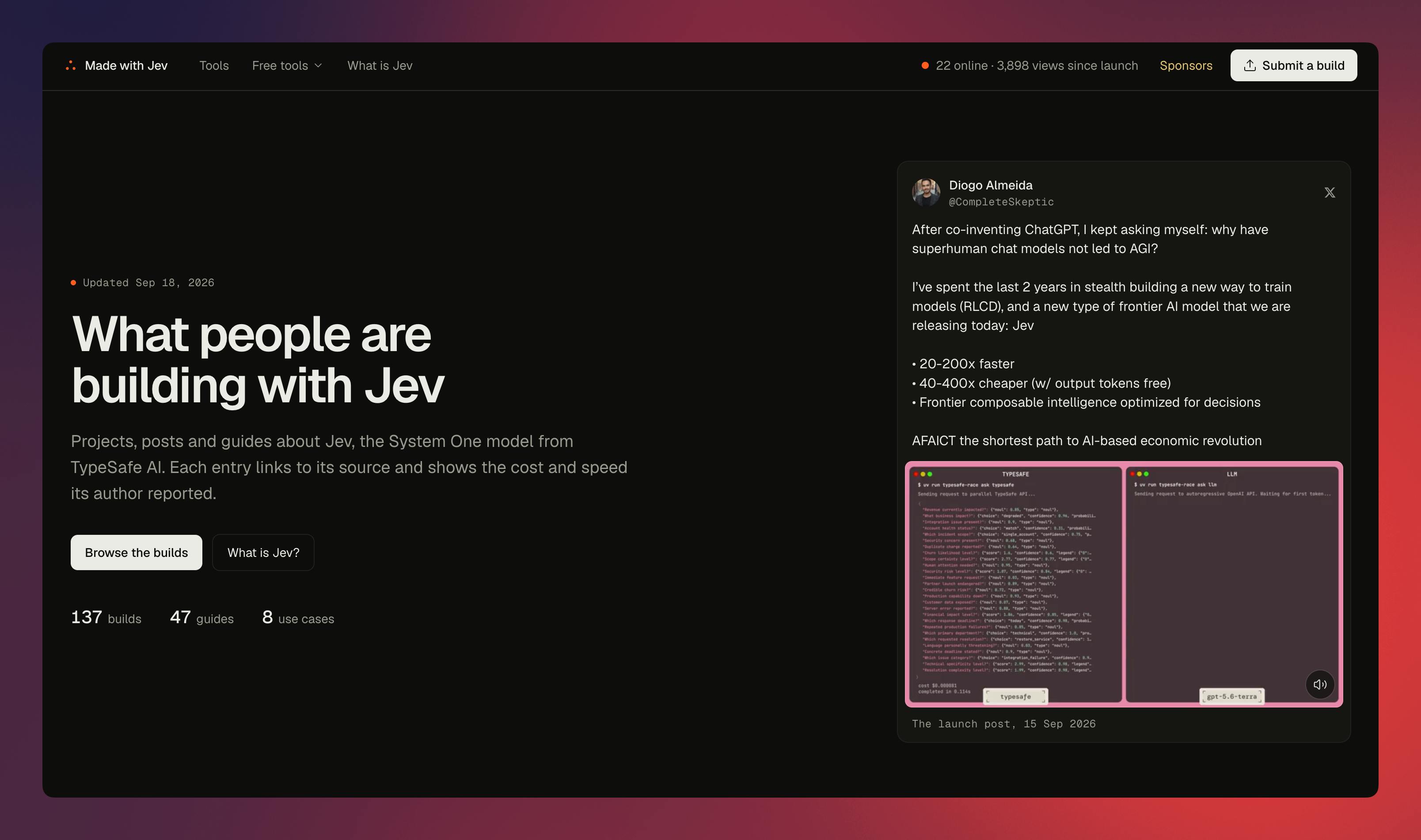
Built around Jev, creator Jon Kraayenbrink launched "Made with Jev" on Product Hunt — a directory site dedicated to collecting Jev-related resources and real-world use cases. Rather than being just another model launch, it positions itself as an aggregation platform showcasing "what people have actually built with Jev."
The Difference Between a "Decision Model" and a "Text Model"
Traditional large language models are fundamentally predicting the next token, producing natural language as output. To get them to execute tasks, developers typically need an extra layer: prompting the model to output JSON, use function calls, or wrapping decisions in text via prompt engineering before parsing.
Jev's "decision-first" approach theoretically eliminates these intermediate steps. Sub-second response times matter enormously in interactive scenarios — tasks like browser automation, real-time game logic, and email triage are extremely latency-sensitive, where even a few seconds of waiting is enough to ruin the experience.
It's worth noting that the official information available is still limited. "Making decisions rather than writing text" is largely a product positioning statement, and technical details such as underlying architecture, model scale, and accuracy rates have not been disclosed in available materials. For developers, a true value assessment will require more complete technical documentation and third-party benchmarks.
From an engineering perspective, getting large language models to "output decisions" isn't new — OpenAI's Function Calling, Anthropic's Tool Use, and Structured Output are all existing solutions. What these approaches share is a common cost: the model still completes a full forward pass, generates tokens, and then has external code parse the structure. Latency typically runs 1–5 seconds or more, and cost scales linearly with token count. If Jev's claimed "decision-first" approach can truly achieve sub-half-second responses, it likely means the model has trimmed generation depth, been purpose-distilled for classification/routing tasks, or uses an inference architecture fundamentally different from autoregressive Transformers. This technical direction aligns with the trend toward "small models with specialized capabilities" — similar to Google's Gemini Nano or Apple Intelligence's lightweight on-device judgment models, trading generality for extreme low-latency performance on specific tasks.
What People Have Already Built With It
The most interesting aspect of the "Made with Jev" directory is that it directly showcases real projects built by the community using Jev — with each project's actual cost labeled. This is extremely developer-friendly: cost transparency means you can immediately assess whether a given approach is worth replicating.
The directory lists a remarkably diverse range of application types:
- Browser agents: Enabling AI to autonomously operate web pages, completing tasks like clicking, form-filling, and scraping.
- Games: Embedding the decision model into game logic for NPC behavior or real-time judgment.
- Email triage: Automatically determining email priority and routing — a classic "decision" rather than "generation" use case.
- Viral tweet analyzers: Analyzing what kinds of content are more likely to spread.
What these cases share is that they all require "fast judgment" rather than "long-form output" — perfectly aligned with Jev's positioning. This also indirectly confirms the applicable boundaries of decision-type models: they excel at structured tasks like classification, routing, and judgment.
The Bundled Tools and Ecosystem Ambitions
Beyond the case directory, "Made with Jev" also offers a free AI slop detector for identifying low-quality, mass-generated AI content. In an era of rampant AI-generated content, this kind of detection tool has independent demand in its own right. The creator has also teased that more tools are in development.
From a product strategy perspective, what Jon Kraayenbrink is doing is essentially "building an ecosystem around the model": rather than simply selling the model, he's lowering the barrier to entry for developers through a directory, free tools, and cost-transparent case studies — while simultaneously building community momentum for Jev. This is a classic developer ecosystem cold-start playbook.
The project currently ranks #19 on Product Hunt with 6 upvotes and 2 comments — still firmly in early-stage territory. This indicates it hasn't yet reached scale, but it also means that for developers willing to explore early, now is the right window to experiment with this new type of model.
The developer cold-start strategy of "building an ecosystem around a model" has successful precedents in the AI tooling space. Hugging Face aggregated developers early on through model hosting and community directories; LangChain became the de facto standard for agent development through rich integrations and documentation. The core logic of this approach: when model differentiation is not yet obvious, be the first to establish a "discovery channel" and a "reference implementation library" — making it easier for developers to get their first working project running, and generating word-of-mouth from there. The decision to transparently label costs is particularly important — in the GPT-4 era, many teams didn't discover how far API bills exceeded expectations until they hit production. Cost predictability is itself a significant factor in developer tool selection.
Key Questions Worth Asking
For developers considering trying Jev, there are several key points worth clarifying first: What is the model's decision accuracy? What methods are supported for defining decision spaces? Does the sub-half-second latency hold up under production-level concurrency? And is the pricing model truly as transparent and controllable as the directory suggests?
The "decision-type AI" that Jev represents is a direction worth watching. While the industry broadly focuses on models that are bigger and better at writing, a small, specialized model focused on "making the right decision quickly" may be exactly what fills the efficiency gap in real-world agent deployments. Whether this niche can truly succeed still depends on future technical disclosures and validation across more real-world scenarios.
Related articles

Chain of Thought Isn't Just for AI: How Humans Can Use CoT to Improve Thinking Quality
Chain of Thought isn't just a prompt trick for large models. Starting from a Hacker News discussion, this article analyzes why CoT works for human thinking too, breaks down actionable ways to transfer it, and highlights the key differences between human CoT and machine CoT.
Cloudflare Teams Up with OpenAI: Closi…
Cloudflare Teams Up with OpenAI: Closing the Loop from Vulnerability Discovery to Defense with AI
Cloudflare uses OpenAI Daybreak to investigate security vulnerabilities and generate reviewable remediation plans, while developers use Codex to boost coding efficiency and quality.

Orca Multi-Agent Orchestration in Practice: A Guide to Parallel Collaboration with Claude and Codex
Orca is Stable AI's free open-source agent workbench supporting 34 agents like Claude Code and Codex in parallel. Learn its Git worktree isolation, multi-model orchestration, and mobile management.