Jevman: Watch AI Decision Models Play Pac-Man in Real Time
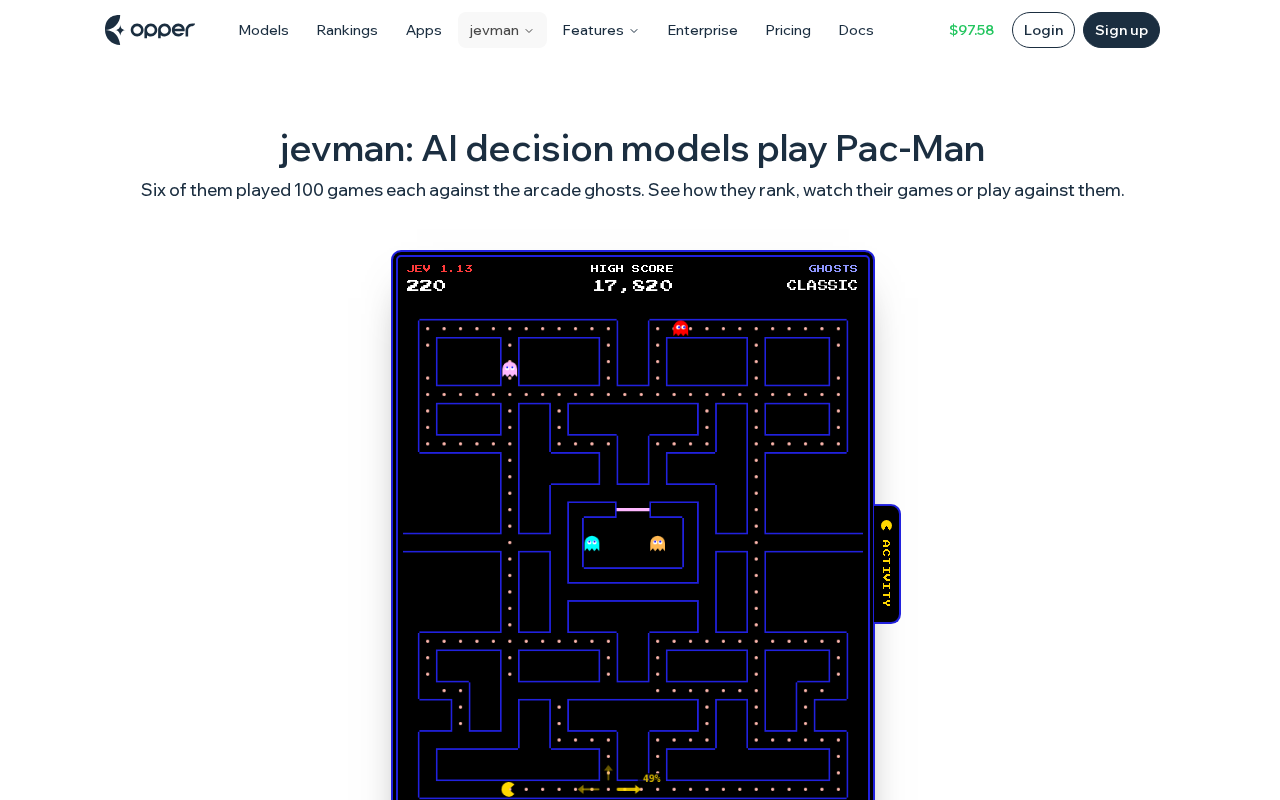
Jevman lets AI decision models play Pac-Man to visually compare real-time decision-making across models.
Jevman is a small open-source project on Hacker News that connects AI decision models to classic Pac-Man, offering an intuitive, side-by-side view of how different models make real-time decisions. Game environments have long served as AI benchmarks — from DeepMind's Atari experiments to AlphaGo — thanks to their closed, quantifiable, and multi-objective structure. Jevman's value lies in translating abstract AI decision logic into visible actions accessible to learners, researchers, and general audiences alike. Its limitations are equally clear: Pac-Man is relatively simple, and single-game performance cannot represent a model's general decision-making ability. With broader model support and richer decision analytics, it could carve out a meaningful niche as an AI education and research tool.
When AI Decision Models Meet a Classic Arcade Game
A project called Jevman has been catching attention in the developer community on Hacker News' Show HN section. The core idea is simple and compelling: let AI decision models play the classic arcade game Pac-Man, providing an intuitive way to visualize and compare how different models perform in real-time decision-making scenarios.
Pac-Man makes for an excellent test environment. It has clear objectives (eat all the pellets), dynamic threats (moving ghosts), and spatial constraints within a fixed maze. This clean, rule-based structure creates an ideal sandbox for evaluating AI capabilities in path planning, risk avoidance, and instant decision-making.
Why Use Games to Test AI?
Using games to evaluate AI is nothing new. From DeepMind's early breakthroughs on Atari games to AlphaGo conquering Go, game environments have long served as a key benchmark for AI decision-making. Games offer closed, repeatable, and quantifiable testing conditions that allow researchers to clearly observe how models behave when faced with sequential decisions.
What makes Pac-Man particularly valuable is that it requires AI to simultaneously juggle multiple conflicting objectives: efficiently collecting rewards (pellets), avoiding randomly moving hazards (ghosts), and performing real-time path planning through a maze-like map. This kind of multi-objective trade-off is far closer to the complex decisions AI faces in the real world than a straightforward optimization problem.
Jevman makes this testing process visual, allowing observers to directly watch different decision models make different choices in the same scenario — offering an intuitive, educational window into the "thinking" logic of each model.
DeepMind's 2013 DQN (Deep Q-Network) paper was a landmark in this field. The system achieved or surpassed human-level performance on 49 Atari games using only raw pixel input. Its core method combined deep neural networks with Q-Learning from reinforcement learning: the model learned through trial and error which actions maximize long-term cumulative reward in different game states. Pac-Man was among those 49 games, though DQN performed relatively poorly on it — Pac-Man demands longer-horizon strategic planning and coordinated evasion of multiple moving ghosts, which poses a tougher challenge for reinforcement learning models that rely on immediate feedback signals. The "AI decision models" used in Jevman take a different approach from DQN — they more likely call a large language model (LLM) API, describing the game state in text or structured data and receiving decision instructions in return. This represents an emerging experimental direction: replacing task-specific trained models with general-purpose reasoning models.
The Value of Visualizing Decision-Making
Jevman's significance goes beyond entertainment — it offers a transparent window into the AI decision-making process. When we talk about AI models, their internal decision logic is often an opaque black box. But through a game that everyone is familiar with, model behavior is translated into concrete, visible actions: move left, move right, risk cutting through a ghost's path or not.
This kind of visualization is valuable for several audiences: for learners, it concretely illustrates the differences between algorithmic strategies; for researchers, it provides a quick platform to compare model performance; and for general audiences, it makes abstract AI decision-making tangible and engaging.
Based on early feedback on Hacker News (9 upvotes, 1 comment), this is still a niche project in its early stages with limited community discussion. But its angle — combining AI decision-making with a classic game — reflects the creative spirit that has always characterized the developer community.
The "black box" problem in AI decision-making corresponds to a dedicated academic research area: Explainable AI (XAI). Modern deep learning models consist of hundreds of millions to hundreds of billions of parameters, making their internal reasoning difficult to trace directly — a problem that creates trust and regulatory challenges in high-stakes domains like healthcare, finance, and law. Game-based visualization is an intuitive form of "external explainability" in XAI: rather than attempting to explain internal weight calculations, it observes a model's behavioral patterns in a structured environment to infer its decision preferences and strategic characteristics. This aligns with a "behaviorist" evaluation paradigm — we can't see inside the black box, but we can map a model's capability boundaries through a sufficiently diverse set of stimulus-response pairs. Pac-Man's maze structure naturally provides observable behavior across multiple dimensions — path selection, risk tolerance, goal prioritization — making it a relatively rich vehicle for behavioral analysis.
Limitations and Potential
To be objective: while Pac-Man is a classic test environment, it is relatively simple and cannot fully reflect an AI model's real capabilities on complex tasks. Performance on a single game does not equate to overall decision-making ability.
That said, lightweight demo projects like this have their own unique value. They lower the barrier to understanding AI decision-making and provide a broad audience with an accessible, intuitive entry point into AI behavior. If Jevman could support integration and comparison of more models, along with more detailed analysis of decision data, it has the potential to become a genuinely useful educational and research tool.
For developers focused on evaluating AI decision-making capabilities, projects like this also offer an interesting approach: using familiar game scenarios as a "litmus test" for model capabilities — keeping experimental costs low while improving the interpretability of results.
Summary
Jevman represents a category of exploratory projects that gamify and visualize AI capabilities. While project details are currently limited and community interest modest, the idea of using Pac-Man as a vehicle to illustrate AI decision-making is worth recognizing. As demand for AI model evaluation grows, intuitive and comparable demonstration tools like this may find increasing application in education and research.
Related articles

Felix Rieseberg Personal Homepage
Felix Rieseberg's personal homepage sparks attention on Hacker News. This article covers the Slack engineer's technical background, the rise and fall of nativefier, and the value of a developer homepage as a tech calling card.

@ai-sdk/vue 3.0.306 Patch Release Syncs with [email protected] Update
@ai-sdk/vue 3.0.306 released, synced with [email protected]. A routine patch release for the Vercel AI SDK ecosystem with no public API changes; the Vue adapter layer stays version-aligned with the core package.

Gemini 4 Argon API Launches: The Era of Million-Token Output Begins
Google launches Gemini 4 Argon with sparse MoE architecture, up to 1M output tokens, and a 68.90% Vals Index score, available across API, AI Studio, and the Gemini app.